
📊 Full opportunity report: Forezai · Polybot: When the AI Disagrees With the Odds on ThorstenMeyerAI.com — validation score, market gap, and execution plan.
TL;DR
Polybot is an open-source AI trading bot that compares its own probability estimates to market prices on prediction markets. It aims to determine when AI can reliably identify mispricings, highlighting the challenges and risks of automated market disagreement.
Polybot, an open-source AI trading bot designed for Polymarket, is testing whether an AI can form probability estimates that disagree with market prices and act on those disagreements. This experiment aims to explore the potential and limitations of AI in prediction markets, emphasizing that it is not a financial advice tool but a research project.
Polybot compares its own probability estimates—derived from public information—to the market’s implied probabilities. When the gap exceeds a predefined threshold, the bot considers trading, but it primarily trades rarely and only on strong disagreements, following a risk-averse discipline that emphasizes small positions and infrequent trades.
The system records its reasoning for each estimate, allowing post-trade analysis of why the AI believed a mispricing existed. This transparency aims to improve calibration over time, rather than focusing solely on individual wins or losses. The project underscores that market prices are already dense with information, making beating them difficult and risky.
Polybot is explicitly labeled as an experiment, acknowledging that its edge is a hypothesis, not a guaranteed advantage. It emphasizes that markets are adversarial and that costs such as fees and slippage can easily erode any theoretical gains, especially in thin markets.
Polybot — when the AI disagrees with the odds
A prediction market puts a price on the future. Polybot asks: can an AI’s own estimate diverge from that price for real — and should it ever act on the gap?
Not financial, investment, legal or tax advice; not a recommendation or solicitation to trade, invest or use any software. Forezai · Polybot is experimental open-source software (MIT), provided “as is” without warranty of accuracy or profitability. Trading and automated trading carry a substantial risk of loss including total loss of capital; past or backtested performance does not indicate future results. Prediction-market participation is restricted or prohibited in some jurisdictions (including for US persons) — you are solely responsible for compliance with applicable law. Consult a licensed professional before any financial decision. Produced with AI assistance under human editorial oversight; independent commentary, the author’s own views. Product and company names are trademarks of their respective owners; mention does not imply endorsement.
Implications of AI Market Disagreement Testing
This project demonstrates the potential for AI systems to challenge market consensus, but also highlights the risks involved. The outcomes could inform future developments in AI-driven trading strategies or serve as a basis for further research. It also emphasizes the importance of cautious evaluation when deploying AI in financial contexts, especially in prediction markets where prices aggregate diverse opinions.

Use Claude to Build an AI Trading Bot: 90 Days with Stocks and Prediction Markets (AI Trading Bot Series Book 1)
As an affiliate, we earn on qualifying purchases.
As an affiliate, we earn on qualifying purchases.
Background on Prediction Markets and AI Testing
Prediction markets like Polymarket assign prices to future events, reflecting collective probabilities based on aggregated public information. These markets are considered efficient, making it difficult for any system to consistently beat them. Polybot builds on this premise by testing whether an AI, using public data, can form independent probability estimates that diverge meaningfully from market prices. The concept taps into broader debates about AI’s capacity to find edges in complex, information-dense environments.
Previous attempts at beating prediction markets have largely failed or been short-lived due to costs, market adversarial behavior, and the difficulty of calibration. Polybot’s approach emphasizes transparency, risk management, and rigorous evaluation over time, aligning with best practices in quantitative research.
“Polybot is a research artifact, not a money-making tool. Its goal is to understand when and if AI can reliably identify mispricings in prediction markets.”
— Thorsten Meyer, project creator
Use Claude to Build an AI Trading Bot: 90 Days with Stocks and Prediction Markets (AI Trading Bot Series Book 1)
As an affiliate, we earn on qualifying purchases.
As an affiliate, we earn on qualifying purchases.
Uncertainties About Polybot’s Real-World Effectiveness
It remains uncertain whether Polybot’s estimates will consistently outperform market prices over the long term. The project is still in early testing phases, and real-world factors like slippage, liquidity constraints, and adversarial responses could limit its effectiveness. The outcomes are still being observed, and no definitive conclusion has been reached regarding AI’s ability to reliably disagree with market odds.
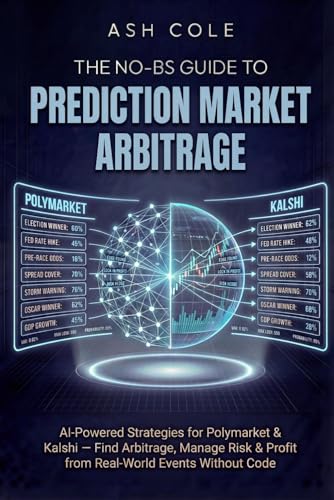
The No-BS Guide to Prediction Market Arbitrage: AI-Powered Strategies for Polymarket & Kalshi — Find Arbitrage, Manage Risk & Profit from Real-World Events Without Code (The No-BS AI Playbooks)
As an affiliate, we earn on qualifying purchases.
As an affiliate, we earn on qualifying purchases.
Next Steps in Polybot’s Testing and Evaluation
Polybot’s developers plan to continue testing its calibration over extended periods, refining thresholds for trading, and analyzing post-trade reasoning. They intend to publish ongoing results to assess whether the AI’s disagreements can be systematically profitable or remain primarily illustrative. The project may also explore broader applications beyond prediction markets, depending on findings.

Algorithmic Trading for Beginners 2026: Build Automated Trading Bots, Backtest AI Strategies, Manage Risk, and Trade Stocks, Forex, Crypto, and Options Without Guesswork (AI Creator Income)
As an affiliate, we earn on qualifying purchases.
As an affiliate, we earn on qualifying purchases.
Key Questions
Can Polybot be used for actual trading?
Polybot is an open-source research tool designed for experimentation and learning, not for real trading. It emphasizes risk management and transparency over profitability.
How does Polybot determine when to trade?
It compares its own probability estimates to market prices and only trades when the gap exceeds a predefined threshold, accounting for costs and uncertainties.
Is this approach guaranteed to beat markets?
No. The project explicitly states that market prices are dense with information, and beating them consistently is extremely challenging. Polybot’s purpose is to test the conditions under which disagreement might be meaningful.
What are the risks involved in using AI for prediction markets?
Risks include costs from fees and slippage, adversarial market responses, and the possibility that AI estimates are overconfident or wrong, leading to losses.
Source: ThorstenMeyerAI.com