
This checklist is for developers and QA teams who need to test network behavior across devices, links, and lab setups. It brings together a few hardware picks and practical guidance for categories without a named product. Start with your test scenarios so each item supports work you actually do.

Get business pricing on monitors, keyboards and dev gear
- Business-only prices and quantity discounts
- Tax-exempt purchasing
- Multiple users, one account, clear invoices
The sections follow the hardware categories in the brief: adapters, managed switches, access points, network taps, testers, and Raspberry Pi boards. Some picks may not match the category label exactly, so check the product’s stated function before treating it as a substitute for specialized testing gear.
Use the look-for lists to compare specifications against your ports, network standards, and deployment needs. Confirm compatibility with your existing equipment, and plan how you will capture or reproduce test conditions. Verify fit before buying, especially for connectors, power, and management features.
USB Ethernet Adapters
A USB Ethernet adapter can connect a computer to a wired network when its built-in ports do not meet the needs of a test setup. The listed pick is a USB-C and USB-A Data Blocker Adapters, 3-Pack. Its name identifies data blocker adapters; it does not establish that these provide Ethernet connectivity. Check the product details carefully before selecting it for a wired network connection.
A common buying mistake is to assume that a product belongs in this category because it is listed here. Confirm whether the adapter supports Ethernet, which USB connector each unit uses, and whether its interface matches the computer or host you plan to use. Also verify the supported network speed and operating-system compatibility from the manufacturer. Match the connector and function to your exact test device, and check whether any required driver or configuration is documented.
What to look for:
- Confirm the product actually provides USB-to-Ethernet connectivity.
- Match USB-C or USB-A connectors to the host device.
- Check supported Ethernet speeds and operating-system compatibility.
- Verify whether drivers or setup steps are required.
USB-C and USB-A Data Blocker Adapters, 3-Pack
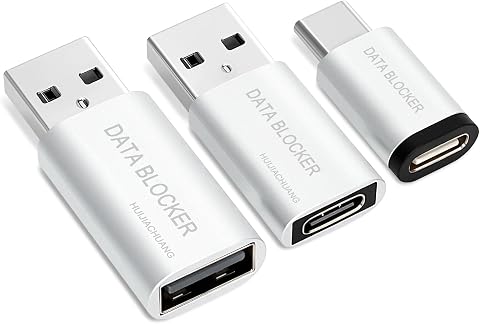
This set includes three USB-C and USB-A adapters designed to block data transfer while charging, helping protect devices from unauthorized access at public charging ports. The USB-C to USB-C adapter supports up to 100W (20V/5A), while the USB-A adapters support charging up to 2.4A.
Pros:
- Blocks data transfer during charging
- Supports up to 100W charging over USB-C
- Compact and portable
- Includes both USB-C and USB-A adapters
Cons:
- USB-A adapters are limited to 2.4A charging
- Does not support data transfer
Best for: Teams that need USB-C or USB-A data blocker adapters
Not ideal for: Anyone seeking a confirmed USB Ethernet interface
Bottom line: Confirm the product’s function and compatibility before relying on it for Ethernet testing.
Managed Network Switches
A managed switch can be useful in a development lab when tests call for configurable network connections. The listed pick is the Ubiquiti UniFi Switch Enterprise 8-Port Gigabit and 2.5G PoE+ Managed. Its name calls out eight ports, Gigabit and 2.5G, PoE+, and managed operation. Check the full product specifications to establish which capabilities apply to each port and whether they suit your intended test topology.
Do not choose a switch based on its headline features alone. Confirm that port count, link speeds, PoE support, management method, and power requirements align with the devices you intend to connect. Consider physical placement and cable reach as well. If your tests require a particular management feature or traffic behavior, verify that feature in the product documentation rather than assuming it is included. Map the ports first so the switch can support the planned devices and test cases.
What to look for:
- Confirm which ports support Gigabit and 2.5G links.
- Check the number of ports needed for the test topology.
- Verify PoE+ support and relevant power requirements.
- Review management features against required test workflows.
- Measure available space and cable reach for placement.
Ubiquiti UniFi Switch Enterprise 8-Port Gigabit and 2.5G PoE+ Managed Switch

The Ubiquiti UniFi Switch Enterprise 8-PoE is a managed network switch featuring eight ports with support for both Gigabit and 2.5G speeds. It provides PoE+ power delivery and SFP+ uplinks, housed in a durable metal case suitable for enterprise networking environments.
Pros:
- Supports high-speed 2.5G and Gigabit connections
- Includes PoE+ for powering devices over Ethernet
- Durable metal construction suitable for enterprise use
- Managed switch capabilities for advanced network control
Cons:
- Limited to 8 ports, which may not suit larger networks
- Requires specific UniFi software ecosystem for full management
Best for: Teams needing an eight-port managed switch with Gigabit and 2.5G identified in its name
Not ideal for: Setups that require unverified port or management capabilities
Bottom line: Compare the port-level specifications and management features with your planned topology.
Wi-Fi 6 Access Points
No product is named for this category, so choose an access point based on the wireless behaviors your tests need to exercise. Start by checking that the device supports Wi-Fi 6 and that its configuration options match your test plan. A test lab may need to reproduce different client conditions, but the required features depend on the scenarios you intend to run. Define the test conditions before comparing devices.
A common mistake is to focus on the Wi-Fi generation while overlooking compatibility and setup. Verify support for the client devices, management approach, power method, and mounting or placement constraints that apply to your environment. Check documentation for the specific wireless settings you need, and confirm whether your existing network equipment can support the access point. Validate the whole setup, including client and network compatibility, before settling on a model.
What to look for:
- Confirm Wi-Fi 6 support in the product specifications.
- Check compatibility with the client devices under test.
- Verify available wireless settings against the planned scenarios.
- Review management, power, and mounting requirements.
- Confirm compatibility with existing network equipment.
Hardware Network Tap
A hardware network tap is a specialized category, but the listed pick is an Ethernet Crimping Tool Kit 10-in-1 Pass Through RJ45/RJ11 Network Tool. Its name describes a crimping tool kit for RJ45/RJ11 connectors, not a network tap. Treat it as a possible cabling tool only after checking the full listing; do not assume it can provide traffic monitoring or capture.
The key buying mistake here is category confusion. If you need a tap, verify that a candidate device explicitly supports the traffic access and link configuration required by your monitoring setup. If you need a crimping kit, confirm the connector types and cable compatibility for your work, and check what tools are included. Separate capture from cabling requirements before making a selection, since the product name alone does not establish tap functionality.
What to look for:
- Confirm whether the item is a network tap or a crimping tool kit.
- For a tap, verify documented traffic access and link compatibility.
- For a crimping kit, check RJ45/RJ11 connector compatibility.
- Review the included tools and supported cable types.
- Match the item to the actual monitoring or cabling task.
Ethernet Crimping Tool Kit 10-in-1 Pass Through RJ45/RJ11 Network Tool Kit with

The AMPCOM 10‑in‑1 Ethernet crimping kit provides all essential tools for RJ45 and RJ11 termination, testing, and maintenance. It includes a high‑carbon steel crimper, network cable tester, punch‑down tool, wire strippers, extra blades, and a waterproof carrying bag for on‑site work.
Pros:
- Comprehensive 10‑piece set covers crimping, testing, stripping, and punch‑down tasks.
- Durable high‑carbon steel tools with gold‑plated connectors ensure reliable performance.
- Portable waterproof bag makes it easy to transport and use on site.
- Includes extra blades for long‑term use.
Cons:
- May be bulkier than single‑purpose tools, making storage less convenient.
Best for: Cabling work involving compatible RJ45 or RJ11 connectors
Not ideal for: Traffic capture or monitoring that requires a network tap
Bottom line: The named product describes a crimping kit, so verify its function before using it for tap work.
Portable Network Tester
No specific product is listed for portable network testing. Choose a tester by starting with the checks you need to perform in the field or lab. These may involve cable or link checks, but the right capabilities depend on your workflow. Write down required checks before comparing products so the chosen tester addresses the task rather than simply sounding comprehensive.
Check supported cable and connector types, the interfaces or link speeds relevant to your network, and how results are displayed or stored if your process requires records. Consider whether the tester must work with your existing equipment and whether its size and power approach suit your intended locations. Avoid assuming that a basic cable checker can perform broader network diagnostics. Match the tool to the test and verify each required function in the manufacturer’s documentation.
What to look for:
- List the specific checks the tester must perform.
- Confirm supported cable and connector types.
- Verify relevant link interfaces and speeds.
- Check result display or recording features if needed.
- Consider portability, power, and equipment compatibility.
Raspberry Pi Boards
A small board computer can be useful as a platform for development and network experiments when its configuration fits the task. The named pick is the CanaKit Raspberry Pi 4 4GB Starter PRO Kit. Its name identifies a Raspberry Pi 4 and 4GB, but the complete kit contents and compatibility details should be confirmed from its listing. Decide which software, peripherals, and network connections your project requires.
A common mistake is to assume a starter kit includes every accessory or feature needed for a particular test. Check the included components, power and storage requirements, operating-system support, and the network interfaces relevant to your setup. Confirm that the board can run the tools and workloads you intend to use, and account for any additional peripherals. Check the kit contents against your build plan before purchase.
What to look for:
- Confirm the kit contents and included accessories.
- Verify power and storage requirements for the planned setup.
- Check operating-system and software compatibility.
- Confirm the network interfaces required by your project.
- Match the board’s capabilities to the intended workload.
CanaKit Raspberry Pi 4 4GB Starter PRO Kit

A comprehensive starter kit for Raspberry Pi 4 Model B with 4GB RAM, featuring a pre-loaded 32GB microSD card, high-gloss case with integrated fan mount, low-noise cooling system, 3.5A USB-C power supply, heat sinks, and a 6-foot display cable supporting up to 4K60p. Includes the CanaKit USB-C PiSwitch for power control.
Pros:
- Includes all essential components for Raspberry Pi setup
- High-quality cooling system with low-noise fan
- Supports 4K60p display output
Cons:
- No smart home compatibility
- Does not include a monitor or keyboard
Best for: Developers seeking a Raspberry Pi 4 starter kit for a compatible project
Not ideal for: Workloads that need capabilities not confirmed in the product details
Bottom line: Verify the included components and project requirements before choosing the kit.
Prioritize purchases by the test cases you need to run and the gaps in your current setup. First confirm that each named product performs the function its category requires; then check interface, compatibility, and setup details. Buy for a defined need so each addition supports a real workflow.
Use the advice-only categories to build clear requirements before selecting a model, and check manufacturer documentation for features that matter to your environment. With a little planning, you can assemble a checklist that fits your devices, network, and testing goals. Start with one test scenario and expand your kit as your needs become clearer.