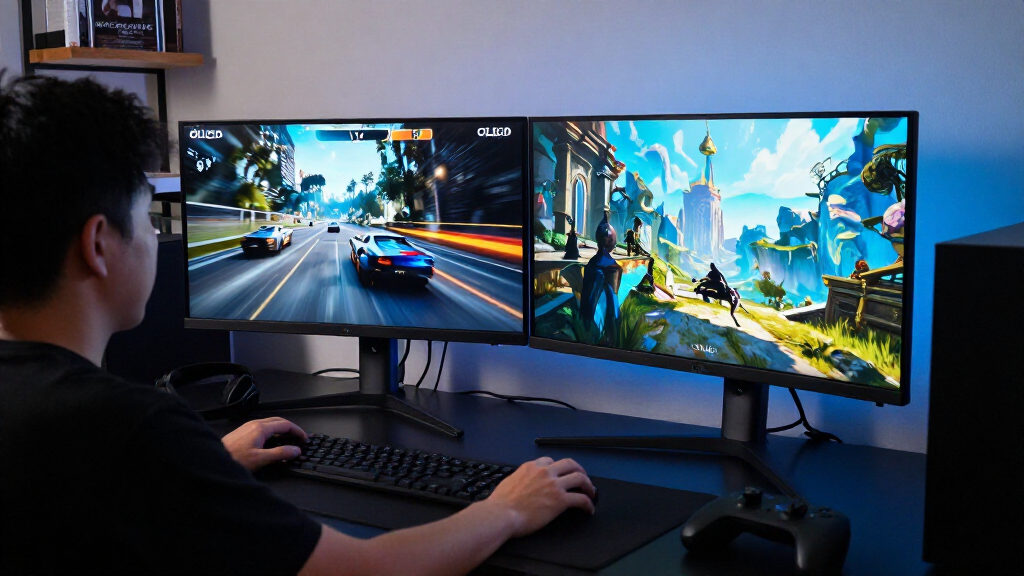

🔍 Read the full analysis: Compare 8 OLED Gaming Monitors For Speed, Detail, And Immersion on ThorstenMeyerAI.com

Get business pricing on monitors, keyboards and dev gear
- Business-only prices and quantity discounts
- Tax-exempt purchasing
- Multiple users, one account, clear invoices
TL;DR
A comparison published by ThorstenMeyerAI.com ranks eight OLED gaming monitors by stated specifications and intended use, with the ASUS ROG Strix XG27ACDNG at the top for its 360Hz QHD QD-OLED panel. The list also includes a 34.2-inch Alienware ultrawide and several 240Hz QHD choices; the source does not provide independent test results or prices.
ThorstenMeyerAI.com has compared eight OLED gaming monitors, ranking the ASUS ROG Strix XG27ACDNG first for its stated 27-inch QHD QD-OLED panel and 360Hz refresh rate. The lineup spans fast conventional QHD screens, a curved ultrawide Alienware model and a less feature-focused Samsung option, giving buyers different tradeoffs rather than one clear fit for every setup.
The comparison’s top pick is the ASUS ROG Strix XG27ACDNG, whose listed 360Hz refresh rate is the highest among the eight models in the source. For another look at the lineup, see this comparison of OLED gaming monitors. The ranking says that combination may suit competitive gaming, provided a player’s computer can produce enough frames to make use of the display’s refresh ceiling. A monitor’s stated maximum does not mean every game will run at that rate.
For a wider presentation, the report singles out the Alienware AW3425DW, a 34.2-inch curved ultrawide. It offers a different screen shape from the conventional QHD choices, but takes more desk space and depends on games supporting ultrawide formats. The comparison also names the LG 27GX704A-B for its 240Hz panel and broad adaptive-sync support, and notes HDMI 2.1 and DisplayPort among its listed connections.
Other listed options include 240Hz QHD models from Acer, AOC, ASUS, LG and Samsung, along with the Samsung G5 as the simpler choice in the lineup. Buyers comparing refresh rates can also consult this guide to high-refresh gaming monitors. The supplied material does not give prices, full model specifications for every product, or laboratory measurements. Its ordering is presented as a buyer-oriented ranking based on stated features and intended use, not as the result of published side-by-side testing.
The 8 picks
- 1
 Alienware AW3425DW 34.2-inch Curved QD-OLED Gaming MonitorView on Amazon →
- 2
 ASUS ROG Strix XG27ACDNG 26.5-Inch QHD QD-OLED Gaming Monitor, 360HzView on Amazon →
- 3
 ASUS ROG Strix XG27AQDMGR 27-Inch QHD 240Hz OLED Gaming MonitorView on Amazon →
- 4
 Samsung 27-inch Odyssey OLED G6 QD-OLED QHD Gaming Monitor (G61SH)View on Amazon →
- 5
 AOC Q27GAZDV 27-Inch QHD 240Hz QD-OLED Gaming MonitorView on Amazon →
- 6
 LG 27GX704A-B 27-inch Ultragear QHD (2650×1440) OLED Gaming Monitor 240Hz, 0….View on Amazon →
- 7
 Samsung 27-Inch Odyssey OLED G5 QHD Gaming Monitor (G50SF)View on Amazon →
- 8
 Acer Predator 26.5-inch QHD 2560×1440 QD-OLED Gaming Monitor X27U W1View on Amazon →
How Refresh Rate Shapes the Choice
The comparison matters because the OLED label alone does not describe how these monitors differ. A buyer deciding between 360Hz and 240Hz should weigh whether their games and PC can use the added refresh headroom. For players focused on cinematic titles, a larger or wider screen may matter more than the highest number on the spec sheet.
The format choice also affects practical use. A standard QHD 16:9 display is likely to fit more desks and game setups, while an ultrawide can offer a broader view when a title supports it. Buyers need to balance that potential immersion against desk space, graphics-card demands and possible compatibility issues.
OLED ownership adds another consideration beyond speed and shape. The source advises managing long periods of static desktop content and using available panel-care features. It does not supply product-specific endurance testing, so readers should check each model’s care options and warranty terms before treating the category’s general guidance as a guarantee about a particular screen.
Popular right now
Vitamix 5200 Blender with 64 oz Container, Black

Ninja Foodi 10-Qt DualZone XL Air Fryer, 6-in-1, Gray (DZ401)

Hisense 75-Inch U7 Mini-LED ULED 4K UHD Smart Google TV (75U7SG)
As an affiliate, we earn on qualifying purchases.
Eight Models, Several Gaming Priorities
The ranking says it weighs refresh rate, resolution, size and shape, adaptive-sync support, connections and how clearly a model serves a distinct use. It places the ASUS XG27ACDNG first for its 360Hz specification in a familiar 27-inch QHD format, while the Alienware earns a niche position for ultrawide immersion rather than broad appeal. The source says similar 240Hz models are separated by their listed features and intended buyers.
That approach is useful as a shortlist, but the supplied comparison does not establish measured differences in response time, brightness, reflections, color accuracy or durability. It also cautions that OLED and QD-OLED are not interchangeable descriptions of every display characteristic: panel construction and screen finish can affect use, particularly in bright rooms. Independent measurements may be needed for buyers who prioritize those qualities.
For connectivity, the source recommends checking the exact port capabilities and the resolution and refresh rate supported through the connection a buyer plans to use. Console owners should verify their console’s supported output modes rather than assuming that a high PC refresh-rate specification applies to their setup.
Specs Do Not Settle Every Comparison
Prices and availability are not included in the supplied material, and the publication date is not stated. The source also does not provide complete specifications for every monitor, independent performance testing, or a detailed explanation of how each ranking position was scored. It is therefore not possible from this material alone to compare value or verify image-quality and durability differences.
Some practical fit questions depend on individual setups: whether a PC can reach high frame rates at QHD, whether a game supports ultrawide ratios, and whether a particular port delivers the expected mode. The source recommends checking game and device compatibility, but it does not list results for specific titles, consoles or graphics cards.
Check Your Setup Before Buying
The next step for buyers is to compare each monitor’s current manufacturer specifications, price, warranty and OLED care features. Match the display’s resolution and refresh rate to the games and hardware in use, confirm required ports, and check whether an ultrawide format is supported by the titles played most often. The source does not announce a follow-up test or future update, so any new pricing or availability information remains to be checked separately.
Key Questions
Which monitor does the comparison rank first?
It ranks the ASUS ROG Strix XG27ACDNG first, citing its stated QHD QD-OLED panel and 360Hz refresh rate. That ranking reflects the comparison’s stated criteria, not independent test results provided in the source.
Which pick is aimed at ultrawide gaming?
The Alienware AW3425DW is the 34.2-inch curved ultrawide option. Check desk space, graphics-card capacity and support for ultrawide ratios in the games you play.
Does a 360Hz specification guarantee 360 frames per second?
No. The monitor’s refresh rate is a stated maximum, not a guarantee that a PC or game will produce that many frames. Actual performance depends on the computer and the game.
What should buyers check for OLED care?
The comparison advises managing long sessions with static desktop elements and using panel-care features where available. Check the exact model’s care options and warranty rather than assuming identical protections across the lineup.
Source: ThorstenMeyerAI.com