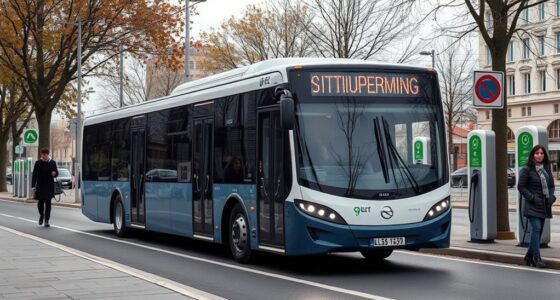
To guarantee your airport shuttle operates smoothly 24/7, you need to evaluate your daily energy needs, battery capacity, and charging strategies. Properly sizing batteries involves calculating total energy consumption and incorporating fast chargers for quick top-ups throughout the day. You must plan infrastructure upgrades and consider battery health to maximize lifespan and reliability. Focusing on these factors now helps you create a sustainable, efficient system—continue exploring to learn how to optimize your entire electrification plan.
Key Takeaways
- Calculate daily energy consumption to determine necessary battery capacity for uninterrupted 24-hour shuttle operation.
- Incorporate fast charging options to enable quick top-ups during the day, reducing downtime.
- Select batteries with longer lifespans and optimal performance to minimize replacement costs and ensure reliability.
- Design an integrated charging infrastructure with proper station placement for seamless, continuous shuttle service.
- Monitor battery health regularly and adopt proper charging practices to extend battery life and maintain operational efficiency.

Have you ever wondered how airports are reducing their carbon footprint? One significant step is electrifying shuttle services that transport passengers between terminals, parking lots, and rental car centers. Transitioning to electric shuttles requires careful planning, especially around the charging infrastructure needed to keep them operational around the clock. You’ll need a robust charging network that minimizes downtime, ensuring shuttles are always ready for their next trip. Fast chargers can replenish batteries quickly, reducing wait times, but they also demand significant power and infrastructure upgrades. Proper placement of charging stations is essential to maximize efficiency and keep the operation seamless. As you implement these systems, keep in mind that charging infrastructure isn’t just about the hardware; it’s about creating an integrated system that supports continuous operation without disruptions. Additionally, understanding the importance of high refresh rates in related technologies can help optimize the overall efficiency of charging and vehicle operation systems. An essential factor in this shift is understanding the battery lifecycle of your electric shuttles. Batteries don’t last forever—they degrade over time, and their capacity diminishes after numerous charge and discharge cycles. You need to plan for regular battery management, which includes monitoring state of health and performance to determine the best time for replacement. Extending battery lifespan can be achieved through proper charging practices, such as avoiding full discharges and overcharging, which can accelerate degradation. By maintaining the batteries well, you not only improve the reliability of your shuttle fleet but also reduce long-term costs associated with frequent replacements. Additionally, investing in batteries with longer lifespans or higher durability can be a cost-effective strategy over time, allowing your airport to operate sustainably and efficiently. When considering battery requirements for 24-hour operation, it’s essential to assess the daily energy demands of your fleet. This involves calculating the total energy consumption per shift and ensuring your charging infrastructure can meet these needs without causing delays. You might opt for a combination of overnight charging and quick top-ups throughout the day to keep shuttles ready. This approach reduces the need for excessive battery capacity on each vehicle, which can be costly and heavy, impacting vehicle performance. The balance between battery size, charging time, and operational schedule is key to creating an effective electrification plan that supports continuous, reliable shuttle service.

SEFEPODER 12V 20Ah Lithium LiFePO4 Deep Cycle Battery 2 Pack with 40A BMS
- High Energy Density: Made of high-quality cells for long life
- Lightweight Design: Only 1/3 the weight of lead-acid batteries
- Safe and Environmentally Friendly: No memory effect, safer than lead-acid batteries
As an affiliate, we earn on qualifying purchases.
As an affiliate, we earn on qualifying purchases.
Frequently Asked Questions
How Do Battery Costs Compare to Traditional Fuel Expenses?
You’ll find that battery costs are higher upfront compared to traditional fuel expenses, but over time, savings come from lower maintenance and fuel costs. Battery longevity and the need for robust charging infrastructure influence these expenses, as longer-lasting batteries reduce replacement frequency. While initial investments are significant, the ongoing savings from reduced fuel consumption and maintenance make electric options more cost-effective in the long run.
What Are the Safety Considerations for Large Shuttle Batteries?
You need to prioritize safety considerations for large shuttle batteries by focusing on battery thermal management to prevent overheating and thermal runaway. Guarantee the batteries meet safety certification standards, which verify their resilience against hazards like fires or leaks. Regular monitoring and proper design reduce risks, and adherence to industry safety standards helps protect passengers and staff, making your shuttle operations safer and more reliable.
How Is Battery Recycling Managed After End-Of-Life?
Did you know that over 50% of lithium-ion batteries are recycled globally? When your shuttle batteries reach end-of-life, recycling programs take charge to manage battery disposal responsibly. They extract valuable materials like lithium and cobalt, reducing environmental impact and conserving resources. By participating in these programs, you help prevent hazardous waste and support a sustainable future. Proper recycling guarantees batteries don’t end up in landfills, protecting both the environment and public health.
What Infrastructure Is Needed for 24-Hour Electric Shuttle Operation?
You need robust charging infrastructure and seamless power grid integration for 24-hour electric shuttle operation. Install fast chargers at key points for quick top-ups, and verify your grid can handle high energy demands without disruptions. Incorporating smart grid technology allows real-time energy management, reducing costs and optimizing load balancing. This setup guarantees continuous shuttle service, minimizes downtime, and supports sustainable, efficient airport transportation around the clock.
How Do Weather Conditions Affect Battery Performance?
Weather can be a thief in the night, quietly draining your shuttle’s energy. Temperature fluctuations cause batteries to work harder, reducing their efficiency and lifespan. Precipitation impacts charging and safety, making icy or wet conditions treacherous for reliable operation. To keep your shuttle fleet running smoothly, you must consider weather’s silent influence and implement strategies like thermal management and weatherproofing. Stay vigilant, and your batteries will stand strong against nature’s unpredictable moods.

Dzytnsy 200W Car Fast Charging Station,6 Ports, Compatible with MacBook pro/Air/M5 M4 M3 M2 M1/Dell/Lenovo/HP,for iPhone 17/16/15 Series,Samsung Galaxy S26/S25 Ultra/S24 Series and More
- High Power 6-Port Charging: Supports 200W for 6 devices simultaneously
- USB-C Laptop Compatibility: Compatible with MacBook, Dell, Lenovo, HP
- Fast Charging Ports: Includes 3 USB-C and 3 USB-A ports
As an affiliate, we earn on qualifying purchases.
As an affiliate, we earn on qualifying purchases.
Conclusion
As you consider electrifying airport shuttles, it’s clear that battery requirements aren’t just about technology—they mirror broader shifts toward sustainability and resilience. Coincidentally, just as airports adapt to modern demands, so must your approach to energy storage evolve. Embracing these changes isn’t only about efficiency; it’s about aligning with a future where every charged battery symbolizes a step toward a cleaner, more connected world. Sometimes, the smallest shift can lead to the most significant transformation.

Electric Vehicle Technology and Repair: Complete Guide to EV Diagnostics, Battery Management Systems, Charging Systems, Electric Motors, Inverters, … Analysis (Vehicle System Engineering Series)
As an affiliate, we earn on qualifying purchases.
As an affiliate, we earn on qualifying purchases.
airport shuttle charging infrastructure
As an affiliate, we earn on qualifying purchases.
As an affiliate, we earn on qualifying purchases.