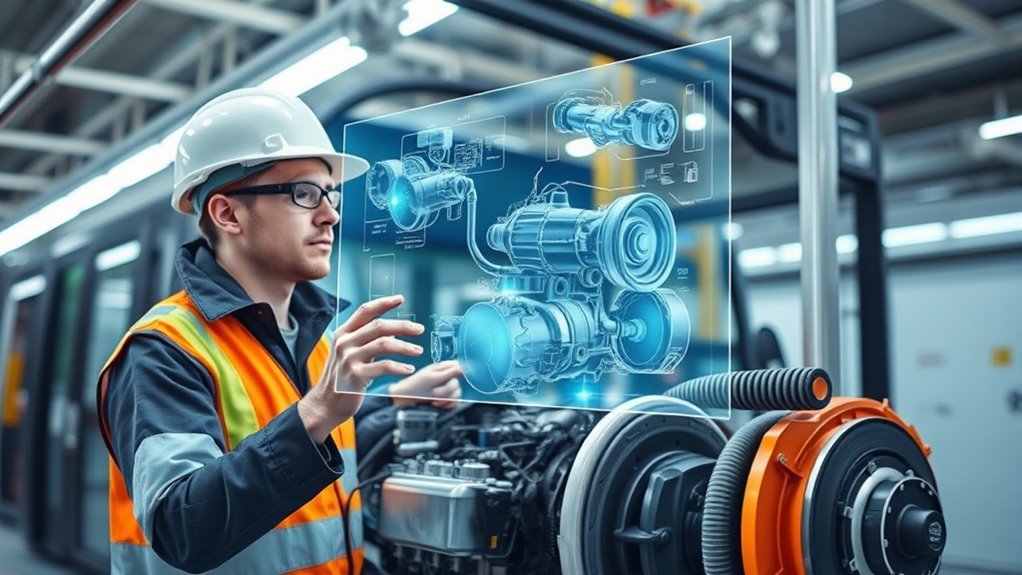

Augmented reality (AR) enhances bus maintenance and training by providing you with real-time visual guidance directly in your field of view. It offers overlays of schematics, fault pinpointing, and step-by-step instructions, making repairs faster and more accurate. AR also enables remote support from experts, reducing downtime and errors. With AR, you can improve your skills, work more safely, and boost overall efficiency—if you continue exploring, you’ll discover how this technology transforms maintenance practices even further.

Get business pricing on monitors, keyboards and dev gear
- Business-only prices and quantity discounts
- Tax-exempt purchasing
- Multiple users, one account, clear invoices
Key Takeaways
- AR hardware provides real-time, hands-free access to maintenance instructions and diagnostic data, improving repair speed and accuracy.
- Visual overlays and 3D models help technicians understand complex components and procedures easily.
- Remote expert collaboration via AR streaming reduces downtime and enhances repair quality.
- AR integration streamlines workflows, lowers operational costs, and minimizes errors during bus maintenance.
- Training with AR enhances technician skills, safety, and confidence through interactive, guided learning experiences.
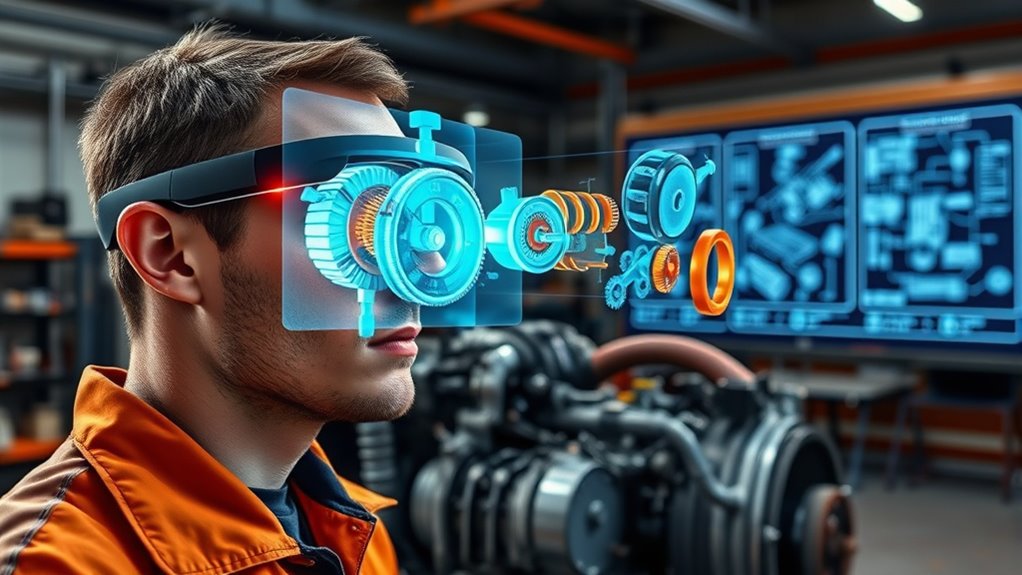
With augmented reality (AR) transforming various industries, bus maintenance is no exception. You’re now able to leverage AR hardware to streamline your repair and inspection processes, making maintenance more efficient and less time-consuming. AR hardware, including smart glasses and headsets, puts critical information directly into your field of view, reducing the need to constantly look away at manuals or screens. This hands-free approach allows you to access real-time data, step-by-step repair instructions, and diagnostic tools seamlessly, all while working on the bus. As a result, your maintenance efficiency skyrockets because you spend less time flipping through paper manuals or searching for parts, and more time fixing issues accurately and quickly.
AR hardware streamlines bus maintenance by providing real-time data and step-by-step guidance hands-free.
When you wear AR hardware, you gain immediate access to a digital overlay that highlights components, pinpoints faults, and guides you through complex procedures. Imagine walking up to a bus with an AR-enabled device, and instantly seeing the engine’s schematic projected onto the actual engine parts. This instant visualization reduces errors and ensures you follow proper procedures every time. Additionally, AR can incorporate animated 3D models to demonstrate intricate repairs, making it easier for you to understand and execute complex tasks. The clarity provided by AR minimizes guesswork, improves your confidence, and ultimately boosts maintenance efficiency across your team.
Furthermore, AR’s real-time data sharing capabilities mean you can collaborate remotely with specialists or supervisors without leaving the bus. If you encounter a tricky issue, you can stream what you see to a remote expert, who can then guide you through the repair process with precise instructions. This immediate access to expert knowledge shortens downtime and minimizes the need for specialized staff to be physically present at each bus location. Plus, AR systems can log all maintenance activities automatically, creating an accurate record for future reference and compliance. Incorporating specialized hardware ensures compatibility with existing tools and enhances overall performance.
The integration of AR hardware into your routine maintenance tasks transforms traditional workflows into smarter, faster operations. It helps you identify issues more swiftly, perform repairs with greater accuracy, and reduce operational costs. Over time, as you become more familiar with AR tools, your ability to diagnose problems improves because of the detailed, real-time insights provided. This technological leap doesn’t replace your skills; it enhances them, making every maintenance task more precise and efficient. Ultimately, embracing AR in bus maintenance means you’ll keep buses on the road longer, with fewer disruptions, while optimizing your team’s productivity and safety.
AR smart glasses for maintenance
As an affiliate, we earn on qualifying purchases.
As an affiliate, we earn on qualifying purchases.
Frequently Asked Questions
How Cost-Effective Is AR Implementation for Bus Maintenance?
Implementing AR for bus maintenance can be quite cost-effective, especially when you focus on cost reduction and ROI analysis. You save money by reducing downtime, minimizing errors, and decreasing training time. While initial investment may seem high, the long-term benefits and efficiencies gained often outweigh the costs. By carefully analyzing ROI, you guarantee that AR integration delivers substantial value, making it a smart financial choice for your maintenance operations.
What ARe the Main Technical Challenges in AR Deployment?
Imagine holding a tool that seamlessly guides your hand, yet hardware limitations often cause flickering screens or lag, disrupting your focus. You face challenges like hardware constraints that hinder smooth AR experiences and a user interface that isn’t intuitive, making complex maintenance feel overwhelming. These technical hurdles can slow down deployment, requiring continuous updates and testing to guarantee AR becomes a reliable, helpful assistant in your daily tasks.
How Does AR Impact Bus Maintenance Safety Protocols?
AR enhances bus maintenance safety protocols by ensuring you follow safety compliance more easily. It provides real-time visual guidance, helping you identify hazards and follow procedures accurately. During staff training, AR allows you to practice safety measures in a controlled environment, reducing risks. This technology keeps safety top of mind, improves adherence to protocols, and boosts confidence, making maintenance safer for everyone involved.
Can AR Be Integrated With Existing Maintenance Software?
Yes, you can integrate AR with existing maintenance software by ensuring software compatibility. Developers often design AR tools to connect seamlessly with current systems, making data sharing straightforward. Focus on user interface design to keep the AR experience intuitive for your team. With proper integration, AR enhances maintenance workflows, reduces errors, and improves efficiency without replacing your current software infrastructure.
What ARe Future Trends for AR in Bus Training Programs?
You’ll see future AR training programs become more immersive and engaging, boosting AR user engagement considerably. Advanced AR content customization will allow you to tailor training experiences to individual learning styles, making them more effective. As AR technology evolves, expect real-time feedback and adaptive scenarios that challenge and motivate you. This personalized approach will not only improve skills faster but also make training sessions more enjoyable and impactful, transforming how you learn on the job.
AR headsets for industrial repair
As an affiliate, we earn on qualifying purchases.
As an affiliate, we earn on qualifying purchases.
Conclusion
By embracing augmented reality for bus maintenance and training, you streamline processes and reduce errors. AR transforms complex tasks into manageable steps, saving time and costs. Remember, a stitch in time saves nine—investing in AR now prevents bigger problems later. So, stay ahead in the game, leverage cutting-edge technology, and keep your fleet running smoothly. The future of maintenance is here; don’t get left behind—adopt AR and reap the benefits today.
augmented reality training tools
As an affiliate, we earn on qualifying purchases.
As an affiliate, we earn on qualifying purchases.
As an affiliate, we earn on qualifying purchases.
Fall Picks
fall essentials
As an affiliate, we earn on qualifying purchases.