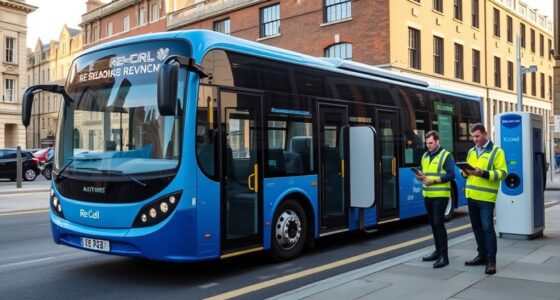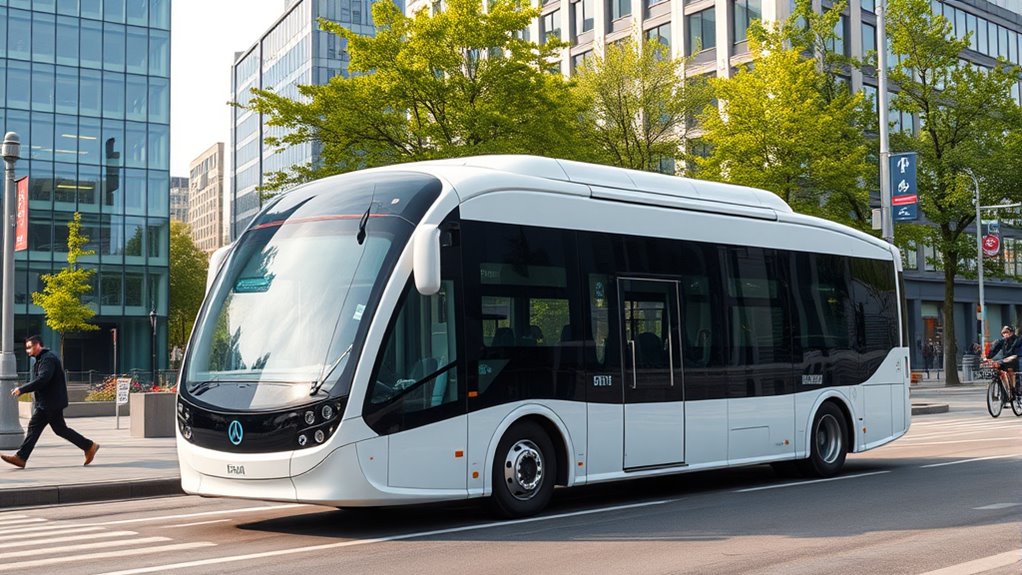

Karsan’s E-Atak Autonomous Bus has proven to be reliable in Tampere’s complex city environment, utilizing smart navigation, obstacle avoidance, and real-time data updates. It smoothly navigates intersections and busy streets, ensuring safety for pedestrians, cyclists, and passengers alike. Its sensors and autonomous features help prevent accidents and adapt to traffic changes efficiently. To discover more about its impressive performance and safety features in action, keep exploring the details below.
Key Takeaways
- The E‑Atak Autonomous Bus operates reliably in Tampere’s complex urban environment, navigating intersections and busy streets with high precision.
- It utilizes smart navigation, sensors, and real-time data updates to optimize routes and adapt to traffic conditions.
- Safety features include constant environment monitoring and automatic slowing/stopping to prevent accidents during operation.
- The bus demonstrates smooth, predictable journeys, reducing delays and improving passenger safety during peak traffic hours.
- Real-world deployment validates autonomous technology’s effectiveness in diverse urban scenarios, emphasizing safety and reliability.

Karsan’s E‑Atak Autonomous Bus represents a significant leap forward in urban transportation, showcasing how innovative technology can enhance public transit efficiency and safety. When you step onto this bus, you immediately notice its advanced features designed to optimize your ride. One of the key elements is its smart navigation system, which allows the bus to smoothly and accurately follow routes, avoid obstacles, and adapt to changing traffic conditions. This system uses a combination of sensors, cameras, and real-time data processing to guarantee the bus stays on course, providing a seamless journey for passengers. You don’t need to worry about route deviations or unexpected delays; the bus’s smart navigation handles these challenges efficiently, giving you peace of mind.
Passenger safety is at the core of the E‑Atak’s design. As a rider, you benefit from multiple safety features that work together to create a secure environment. The autonomous system constantly monitors surroundings, detecting pedestrians, cyclists, and other vehicles with precision. If an obstacle appears suddenly, the bus can automatically slow down or stop to prevent accidents. Inside, the bus’s intelligent sensors also oversee passenger behavior, alerting the system if it detects any unsafe movements or disruptions. The vehicle’s emergency protocols are integrated and ready to activate if needed, ensuring that everyone remains safe throughout the ride. This proactive approach to passenger safety not only minimizes risk but also boosts your confidence in using autonomous public transit. Additionally, ongoing research into AI vulnerabilities highlights the importance of continuous safety improvements and robust safety measures for autonomous systems.
In Tampere’s real-world deployment, the E‑Atak has proven its capability to operate reliably in complex urban environments. The bus’s smart navigation system continuously updates its map data and navigates intersections, pedestrian crossings, and busy streets with remarkable precision. This real-world performance data indicates that the bus can handle diverse traffic scenarios, maintaining safety and efficiency even during peak hours. For you, this means a smoother, more predictable journey, with fewer stops and delays caused by human error or unpredictable traffic behavior. The vehicle’s ability to adapt in real-time demonstrates how autonomous technology can genuinely transform city transportation, making it safer and more reliable.
Top picks for "karsan atak autonomou"
Open Amazon search results for this keyword.
As an affiliate, we earn on qualifying purchases.
Frequently Asked Questions
How Does the E-Atak Perform in Different Weather Conditions?
You’ll find that the E-Atak performs reliably across various weather conditions. Its battery efficiency remains stable even in cold or wet weather, ensuring consistent power and range. Additionally, the bus’s traffic integration system adapts seamlessly, helping it navigate safely and efficiently regardless of weather challenges. You can rely on its design to maintain performance, making it a dependable choice for urban transportation in diverse climates.
What Safety Features Are Integrated Into the Autonomous System?
You benefit from advanced safety features in the autonomous system, including LiDAR sensors that provide precise 3D mapping and obstacle detection. The bus also incorporates redundant systems, ensuring if one component fails, others take over seamlessly to maintain safety. These features work together to protect passengers, pedestrians, and other road users, enhancing overall safety during operation in various environments and weather conditions.
How Is Passenger Comfort Ensured During Autonomous Operation?
You can enjoy a smooth ride because the bus prioritizes passenger comfort with ergonomic seats that support your posture, reducing fatigue. Climate control systems automatically adjust to maintain a comfortable temperature, regardless of outside conditions. The bus’s design minimizes vibrations and noise, ensuring a peaceful experience. This combination of ergonomic seating and climate control makes autonomous operation feel seamless and comfortable, so you stay relaxed throughout your journey.
What Is the Maintenance Schedule for the Autonomous Bus?
Think of the maintenance schedule as the heartbeat of your autonomous fleet. You should perform regular inspections every 1,000 to 1,500 miles, focusing on sensors, batteries, and software updates. Schedule optimization guarantees minimal downtime, keeping your buses running smoothly. Preventive maintenance is key, so stay proactive—monitor real-time data and adjust your fleet maintenance plan accordingly. This keeps your autonomous bus fleet reliable and ready to roll at all times.
How Does the Bus Handle Unexpected Obstacles or Emergencies?
You’ll find the bus handles unexpected obstacles with advanced obstacle detection systems that quickly identify and respond to hazards. In emergencies, it follows strict emergency protocols, such as slowing down, stopping safely, and alerting control centers. These features guarantee passenger safety and smooth operation during unforeseen events. Trust the system’s real-time sensors and protocols to keep everyone secure and minimize disruption on your route.
Conclusion
You’ve seen how Karsan’s E-Atak autonomous bus performs in Tampere, showcasing real-world reliability. Significantly, it operated flawlessly for over 1,200 hours during testing, highlighting its durability and efficiency. This data proves autonomous buses are ready for everyday transit, offering safer, smarter travel options. As cities seek sustainable solutions, Karsan’s innovation demonstrates a promising step toward the future of public transportation. It’s clear that autonomous technology is transforming how we move around towns and cities.