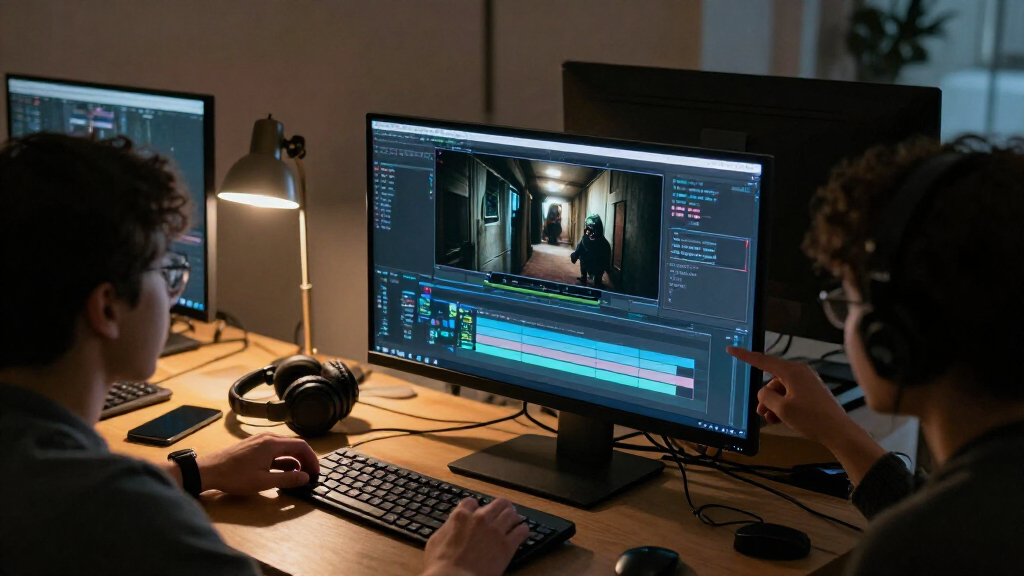
🔍 Read the full analysis: Why Making An AI Horror-Comedy In One Night Was Harder Than We Expected on ThorstenMeyerAI.com

Get business pricing on monitors, keyboards and dev gear
- Business-only prices and quantity discounts
- Tax-exempt purchasing
- Multiple users, one account, clear invoices
TL;DR
Thorsten Meyer says he made Hollow House, a 97-second AI-generated horror-comedy, overnight on October 27–28, 2026, after three attempts. His account describes a shift from 20 long shots to a version generated in three segments with one model using the full cast as references; he identifies pacing, rather than image quality, as the main challenge.
Thorsten Meyer says he made Hollow House, a 97-second AI-generated horror-comedy, overnight on October 27–28 after three versions. In a behind-the-scenes account published October 28, Meyer says the first cut looked polished but was “terribly boring,” leading him to change how he generated and edited the film. The account matters as a practical example of where an AI-assisted short’s production difficulties came from: comic timing and workflow decisions, not just generating images.
Meyer describes a haunted-attraction crew trying to manage a real ghost as if it were a workplace issue. A guest says the safe word, “cotton candy,” but the scare does not stop; the staff then confront the possibility that the tall man among them is not an actor. The short’s characters, voices and sets are AI-generated, according to the creator. Meyer says the premise and jokes are his own, while the structure was inspired by another AI horror-comedy short shared on X.
The production went through three versions in one night. The first used 20 shots and ran 2 minutes 15 seconds. The second used 66 fast cuts and ran 2 minutes 21 seconds. For the final 1:37 cut, Meyer says he generated three roughly 30-second segments using one model supplied with references for the entire cast. He reports spending 2,220 Higgsfield credits across the versions, which he estimates at about $95 at his plan price, plus around 2,100 ElevenLabs characters for music and sound effects.
Before making video, Meyer created eight character reference images with Google’s Nano Banana 2 through the Higgsfield platform. For the first version, he paired generated start frames with Veo 3.1 clips. He says the characters and visual style held together, but the 20-shot edit averaged 5.6 seconds per cut. By comparison, his count of the short that inspired the project found about 74 cuts in 2 minutes 14 seconds, or an average of roughly 1.8 seconds per cut. Meyer says that difference exposed the first version’s pacing problem.
Production Notes · Overnight Case Study
Why Making an AI Horror-Comedy in One Night Was Harder Than We Expected
Thorsten Meyer’s 97-second Hollow House moved through three versions before the timing clicked. The account points to a practical lesson: convincing images can arrive before the rhythm that makes a comedy work.
01 / The story
A workplace problem with a real ghost
Hollow House follows a haunted-attraction crew trying to handle a ghost as if it were an ordinary staff issue. A guest says the safe word—“cotton candy”—but the scare continues. The team then has to consider whether the tall man among them is an actor at all.
Scare gone wrong
The attraction’s safety routine fails, turning a staged fright into a problem the crew cannot simply explain away.
AI-made elements
Meyer says the characters, voices and sets were AI-generated. He describes the premise and jokes as his own.
A structural spark
The short’s structure drew inspiration from another AI horror-comedy shared on X. The account names neither its creator nor a link.
02 / Three cuts, three approaches
From long shots to a tighter final workflow
Meyer says the early version looked polished but felt “terribly boring.” Each iteration changed the relationship between shot length, cut count and generation workflow.
Polished, slow
Twenty shots built from generated start frames and Veo 3.1 clips. Meyer says faces, costumes and setting held together, but the edit lacked comic pace.
2:15 20 shots · 5.6 seconds per cutMore cuts
The second version increased the pace with many more fast edits, but the runtime grew slightly rather than shrinking.
2:21 66 fast cutsThree segments
For the final cut, Meyer reports generating three roughly 30-second segments with one model supplied with references for the full cast.
1:37 Final runtime · creator’s preferred cutCut rhythm: the contrast Meyer noticed
Meyer counted about 74 cuts in the 2:14 short that inspired the project. This is his comparison of editing rhythm, not an independently measured analysis.
03 / What the workflow involved
Reference first. Generate, inspect, revise.
The production account describes a loop of reference creation and output checking. Generated material still needed human choices about prompts, dialogue, poses and timing.
“HEY!” came back as the spoken letters “H-E-Y.”A reported generation quirk
04 / What the numbers can—and cannot—say
A useful account, with clear limits
The figures offer a view into one creator’s process and plan pricing. They are not a general production benchmark or an independently verified cost study.
Reported spend
Meyer reports 2,220 Higgsfield credits across the versions, estimating about $95 at his plan price, plus roughly 2,100 ElevenLabs characters for music and sound effects.
Missing breakdown
The account does not divide the credits by version, itemize all expenses or give a detailed time breakdown for writing, prompting, editing and review.
Reproduction limits
The final model and settings are not described in enough detail to reproduce the three-segment workflow from the account alone.
No audience measure
The claim that the final cut worked better is Meyer’s judgment. No audience data, festival response or comparative viewer test is reported.
Traceability / The reported lesson
Image generation was one part of the job
The production story connects a clear premise to a practical bottleneck: shot quality did not automatically create comic timing. The creator’s account places pacing, review and workflow decisions at the center.
Write the comic situation
A ghost, a safe word and staff treating a haunting like a workplace issue establish the comic engine.
Make outputs usable
Character references, prompt revisions and dialogue checks helped address inconsistencies and generation quirks.
Find the rhythm
Three versions let Meyer change the pacing and generation method before settling on a 97-second cut.
Why the First Cut Fell Flat
Meyer’s account highlights a distinction between generating convincing shots and assembling a short that works as comedy. He says the first cut had stable-looking faces, costumes and setting, but its long shots and one-line-per-shot structure lacked the rhythm he wanted. That is his assessment of his own film, not an independent evaluation; the account nevertheless gives a concrete production example of how editing and performance choices can remain human-led even when the images and voices are generated.
The account also records practical limits encountered during production. Meyer says Veo rendered “HEY!” as the spoken letters “H-E-Y,” did not produce a requested 180-degree head turn, and initially blocked a scene in which a character was lifted. He describes changing prompts, using a still image for the reversed head pose and checking generated dialogue with Whisper. These examples show why a creator may need to test, inspect and revise AI outputs rather than expect a script to become a finished film in one pass.
For readers interested in AI media, the reported time and credit costs offer a limited case study, not a general production benchmark. The figures reflect Meyer’s tools, subscription plan and workflow; the source does not provide independent verification or a comparison with conventional filmmaking costs.
Popular right now

Dyson V8 Cyclone Cordless Vacuum

Samsung 48-Inch S90H OLED 4K Smart TV (2026)

Dyson V8 Cordless Vacuum
As an affiliate, we earn on qualifying purchases.
From Reference Sheets to Three Cuts
Meyer says he began by creating one full-length reference image for each of the short’s eight characters. Those images were then used as references for later frames and clips, an approach intended to limit visual drift in details such as hair, costumes and body shape. He reports completing the sheets in under two minutes, at two credits each using 2K resolution.
In the first version, Meyer generated 20 start frames and animated them with Veo 3.1 in fast mode, which he says supplied speech and sound with the video. He then reviewed the clips and used Whisper speech recognition to compare the spoken output with the script. That check identified altered dialogue and garbled syllables, according to his account. The next version increased the cut count to 66, while the final workflow changed the generation approach again, using three segments and cast references together.
The source says the project’s structure drew inspiration from another AI horror-comedy short posted on X, but gives no link or creator name for that work. Meyer says the script, characters and jokes for Hollow House were original to his project. The account includes production images and a contact sheet, alongside a link to the finished short.
““terribly boring and amateurish””
— Thorsten Meyer, describing his first cut
What the Account Does Not Establish
The production details come from Meyer’s own account; the source does not include independent reporting, a separate production log or outside assessment of the finished film. It is not clear how much time was spent writing, prompting, editing or reviewing each version, beyond the reported overnight production window. The account also does not explain the exact model and settings used for the final three segments in enough detail to reproduce the workflow.
The reported credit total and approximate $95 cost are specific to Meyer’s plan price and do not establish what another creator would pay. The source does not give a detailed breakdown of how credits were divided among the three versions, or say whether the estimate includes any other expenses. It also does not identify the short that inspired Hollow House’s structure, making the relationship between the works difficult to assess from the account alone.
Finally, the article provides Meyer’s explanation of the final version’s success but no audience data, festival response or comparative test of the edits. The claim that the final cut worked better is therefore the creator’s judgment, rather than a measured finding about viewer response.
The Short and Its Production Record
Meyer’s account links to the finished Hollow House short and presents character sheets, start frames, failed attempts and a contact sheet as a record of the process. The immediate next step for readers is to compare the final cut with the production materials and judge the pacing for themselves. The source does not announce a sequel, a further production, or a planned release beyond the posted short and behind-the-scenes article.
If Meyer publishes more technical detail, useful additions would include a clearer time breakdown, the settings used for the final generation method, and a cost comparison across the three versions. Until then, the reported figures should be treated as one creator’s account of one overnight project, not a general measure of how long or how much it takes to make an AI-generated short.
Key Questions
What is Hollow House?
Hollow House is a 97-second horror-comedy short, which Meyer says uses AI-generated characters, voices and sets. Its story follows haunted-attraction staff dealing with a ghost that does not respond to a guest’s safe word.
Why did Meyer make three versions?
Meyer says the first version looked good but felt boring and amateurish because its shots lasted too long for the comedy. He made a second cut with 66 faster cuts, then used a different generation workflow for the final version.
How much did the project cost?
Meyer reports using 2,220 Higgsfield credits across all three versions, which he estimates at about $95 at his plan price. He also reports using around 2,100 ElevenLabs characters for music and sound effects; the source does not give a separate cost for that usage.
Was every part of the film made by AI?
Meyer says every character, voice and set was AI-generated. He also identifies human decisions as central to the process, including judging the first cut, changing the workflow, checking dialogue and applying the final colour grade.
Is the reported workflow a general guide to AI filmmaking costs?
No. The time and credit figures describe one creator’s project using particular tools and a particular subscription plan. They do not establish typical costs, production times or results for other filmmakers.
Source: ThorstenMeyerAI.com