
📊 Full opportunity report: Empowering Manufacturing Workforces With Next-Gen VR Training Solutions on IdeaNavigator AI — validation score, market gap, and execution plan.

Get business pricing on monitors, keyboards and dev gear
- Business-only prices and quantity discounts
- Tax-exempt purchasing
- Multiple users, one account, clear invoices
TL;DR
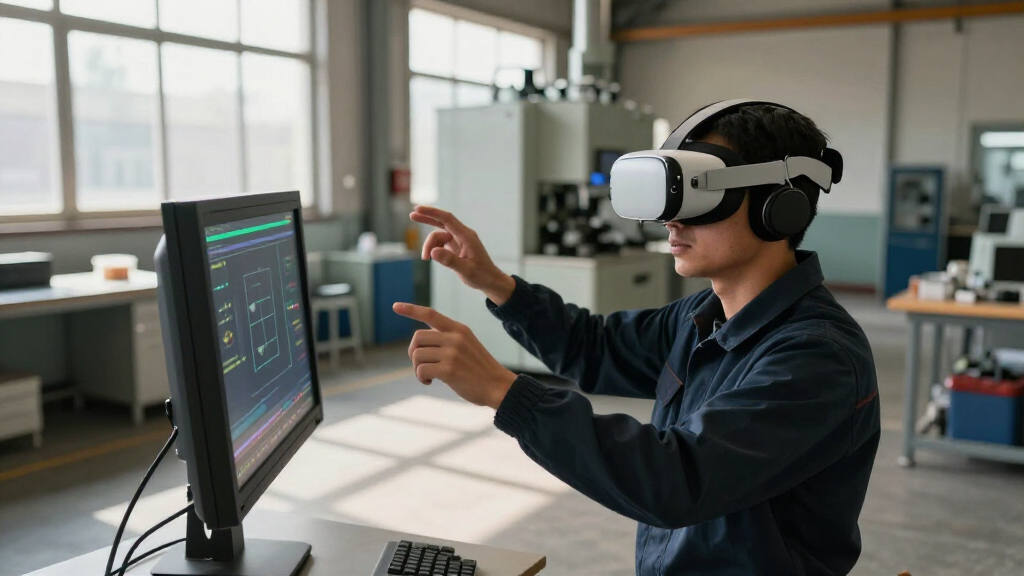
Manufacturing companies are piloting virtual reality training modules using standalone headsets to accelerate onboarding and enhance safety. This approach aims to address labor shortages and improve hazard recognition, with initial pilots showing promising results.
Manufacturing firms are beginning to deploy next-generation virtual reality (VR) training modules on standalone headsets as a targeted solution for onboarding and safety training. These pilots aim to address the industry’s ongoing labor shortages and skills gaps, with initial tests showing promising improvements in hazard recognition and training efficiency.
The initiative is focused on mid-to-large manufacturers responsible for onboarding new workers and reducing safety incidents. Traditional training methods, such as classroom instruction and on-the-floor demonstrations, are increasingly inadequate due to the rapid pace of workforce turnover and the risks associated with live machinery. The new VR modules are designed to simulate high-risk procedures, such as lockout/tagout and forklift safety, in a controlled, immersive environment.
According to sources, the pilot program involves deploying 5-10 standalone Meta Quest headsets to a single plant’s environmental health and safety (EHS) team. The VR modules are delivered via a cloud platform that tracks completion rates, hazard recognition scores, and overall competency. The goal is to measure whether VR training can shorten the time to competency and improve hazard detection compared to existing classroom-based methods.
Manufacturers see this as a way to standardize training across multiple plants, reduce training costs, and improve safety outcomes. The approach is supported by the decreasing cost of immersive hardware, with standalone headsets now available at price points that make large-scale deployment feasible without significant capital investment. The broader immersive enterprise training market is estimated to grow at around 20% CAGR, reflecting increasing industry interest.
Potential Impact on Safety and Workforce Readiness
This development could transform manufacturing workforce training by providing a scalable, standardized, and safer method to onboard workers rapidly. Improving hazard recognition and reducing the time needed to reach competency directly impacts safety outcomes, potentially lowering incident rates and associated costs. Additionally, addressing the skills gap with effective VR training may help mitigate the ongoing labor shortage, ensuring plants can operate efficiently and safely as demand grows.
As an affiliate, we earn on qualifying purchases.
Industry Challenges and Technological Advances Drive VR Adoption
Manufacturing faces a persistent labor shortage, with the U.S. sector alone reporting approximately 409,000 unfilled positions in August 2025, and projections indicating a need for 3.8 million new workers by 2033. Traditional training methods are often slow, inconsistent, and pose safety risks, especially when teaching high-risk procedures on live equipment.
In parallel, technological advances in immersive hardware—particularly the affordability and portability of standalone VR headsets like Meta Quest and Pico—have lowered barriers to deployment. Cloud-native streaming and software platforms enable scalable content management and tracking, making VR a practical tool for enterprise training. Industry analysts estimate the immersive enterprise training market at USD 14.55 billion in 2025, with manufacturing being a significant segment.
VR safety training modules for manufacturing
As an affiliate, we earn on qualifying purchases.
As an affiliate, we earn on qualifying purchases.
Uncertainties Surrounding Long-Term Effectiveness and Scalability
It is still unclear how well the initial pilot results will translate to larger-scale deployments across multiple plants. Questions remain about long-term retention of skills, cost-effectiveness at scale, and integration with existing training programs. Additionally, the impact on incident rates and overall safety metrics has yet to be conclusively demonstrated in extended studies.
As an affiliate, we earn on qualifying purchases.
Next Steps for Broader Adoption and Validation
Manufacturers plan to conduct 60-90 day pilot programs, measuring time-to-competency, hazard recognition accuracy, and supervisor assessments. Success in these pilots could lead to wider adoption, with plans to develop additional modules for other procedures and expand to multiple plants. Industry observers anticipate that if results are positive, VR training could become a standard component of manufacturing onboarding and safety programs within the next year.
standalone VR headsets for industrial training
As an affiliate, we earn on qualifying purchases.
As an affiliate, we earn on qualifying purchases.
Key Questions
How does VR training compare to traditional methods in manufacturing?
Initial pilots suggest VR training can reduce time-to-competency, improve hazard recognition, and provide a safer, more standardized learning environment compared to traditional classroom and on-the-floor training.
What types of procedures are being targeted with VR modules?
Early focus is on high-risk procedures such as lockout/tagout, forklift safety, and machine guarding, which benefit from immersive simulation to ensure understanding and compliance.
What hardware is used for these VR training modules?
Standalone headsets like Meta Quest are primarily used, enabling easy deployment without the need for extensive infrastructure or wired setups.
When will wider deployment of VR training be expected?
If pilot results are favorable, broader adoption could occur within the next 12 months, with additional modules and multiple plants adopting the technology.
Are there any limitations or challenges to this approach?
Uncertainties remain regarding long-term skill retention, cost at scale, and integration with existing training systems, which are being evaluated in ongoing pilots.
Source: IdeaNavigator AI
Halloween Picks
halloween
As an affiliate, we earn on qualifying purchases.