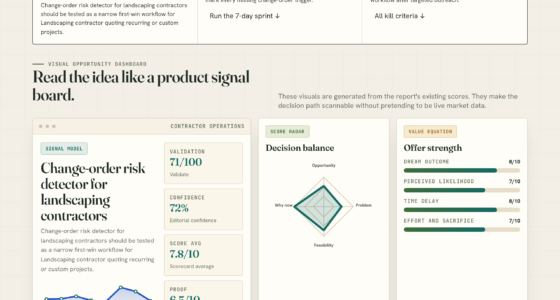

📊 Full opportunity report: The Balance Sheet Of Free Artificial Intelligence on ThorstenMeyerAI.com — validation score, market gap, and execution plan.

Get business pricing on monitors, keyboards and dev gear
- Business-only prices and quantity discounts
- Tax-exempt purchasing
- Multiple users, one account, clear invoices
TL;DR
As AI models become cheaper and more abundant, the core value shifts away from the models themselves. Physical infrastructure and human judgment remain scarce and valuable, shaping the future of AI economics.
Industry experts now agree that artificial intelligence is becoming a **commodity**, with models and algorithms rapidly approaching zero cost. However, the **core economic value** in AI is shifting toward **physical infrastructure** and **human judgment**, which remain scarce and strategic. This shift has profound implications for regions and companies aiming to maintain sovereignty and competitive advantage in the AI economy.
The dominant forecast in the AI industry predicts that intelligence will become abundant and nearly free, akin to electricity, seeping through the economy. Thorsten Meyer emphasizes that this abundance means the **value migrates away from the models themselves** toward the underlying **physical assets**—such as data centers, chips, and power supplies—that enable AI production. Building and maintaining this physical capacity requires significant time and investment, making it a **lasting moat**.
Furthermore, Meyer highlights that **human judgment and accountability** are immune to commoditization. Despite advances in AI, people still prefer **human oversight** because of the inherent need for **trust, responsibility, and accountability**. The **value of human judgment** is expected to grow as AI models become more widespread and cheaper, reinforcing the importance of **human-in-the-loop** decision-making processes.
The forecast is right: intelligence becomes a commodity, cheap and ambient like electricity. But “commodity” is a statement about where value leaves. The whole game is being early to where it goes instead.
▲ Opinion & analysis · not investment adviceWhen the crude is cheap, value moves to the refinery, the trusted name on the deal, and the buyer who can only drink so much. Same shape here.
When a capability becomes abundant and free, we stop exercising it. Some of that is fine. Some of it hollows us out.
knowing which wishes are worth making — and being a person who can still tell.
Implications of Scarcity in Physical Infrastructure and Human Judgment
This analysis reveals that **sovereignty and competitive advantage** in AI will increasingly depend on **physical assets** like data centers, chips, and power supplies, rather than on the models themselves. Countries and companies that **own and control** these assets will hold a strategic edge. Additionally, the enduring **value of human judgment and accountability** underscores the importance of human oversight, even as AI systems become more capable, shaping future **business models and regulatory approaches**.
As an affiliate, we earn on qualifying purchases.
Shift Toward Physical Assets and Human Oversight in AI Economics
The industry has long predicted that AI models would become cheaper and more accessible. Recent insights from Thorsten Meyer clarify that **the real economic moat** lies in **the physical infrastructure**—the **chips, data centers, and power supplies**—which are costly and time-consuming to build. This perspective contrasts with the common focus on model innovation, emphasizing that **physical production capacity** remains the most valuable and scarce resource. Meyer’s analysis builds on the broader industry trend of commoditization, highlighting that **the strategic game** is now about **control over physical assets** and **human oversight** rather than model complexity.
"The moat is the means of production, not the intelligence itself."
— Thorsten Meyer
As an affiliate, we earn on qualifying purchases.
Uncertainties About AI’s Future Economic Structure
While the analysis emphasizes the importance of physical infrastructure and human judgment, it remains unclear how rapidly regions or companies can develop or acquire these physical assets. The pace of infrastructure deployment, geopolitical factors, and regulatory changes could influence the actual distribution of value. Additionally, the long-term evolution of AI models and potential breakthroughs could alter the current understanding of scarcity and value.
As an affiliate, we earn on qualifying purchases.
Next Steps for Stakeholders in AI Infrastructure and Governance
Moving forward, companies and governments will likely focus on **building and securing physical AI infrastructure** and **fostering human oversight capabilities**. Investment in data centers, chips, and power supplies will be crucial, alongside policies that reinforce **human accountability** in AI deployment. Monitoring how these dynamics evolve will be essential for understanding future **competitive landscapes** and **regulatory frameworks**.
human oversight decision-making tools
As an affiliate, we earn on qualifying purchases.
As an affiliate, we earn on qualifying purchases.
Key Questions
Why is physical infrastructure more valuable than AI models?
Physical infrastructure, such as data centers and chips, takes significant time and investment to build and cannot be easily replicated, making it a durable source of competitive advantage. Models, on the other hand, are rapidly commoditized and can be replaced or improved quickly.
Does this mean AI models will no longer be important?
AI models will remain crucial for specific applications, but their economic value diminishes as they become commodities. The strategic advantage shifts toward controlling the physical assets that enable AI production.
What role does human judgment play in the future of AI?
Human judgment remains essential for accountability, trust, and decision-making. Even with advanced AI, people prefer oversight and responsibility, which sustains the value of human involvement.
How can regions or countries maintain sovereignty in AI?
By investing in and controlling physical infrastructure—such as data centers, chips, and energy supply chains—regions can retain strategic independence and avoid outsourcing the most valuable layer of AI economics.
What are the risks if physical infrastructure remains scarce?
If physical assets remain limited, it could lead to increased geopolitical tensions and economic disparities, as only a few can afford the infrastructure needed to produce and sustain AI capabilities at scale.
Source: ThorstenMeyerAI.com
Halloween Picks
halloween
As an affiliate, we earn on qualifying purchases.