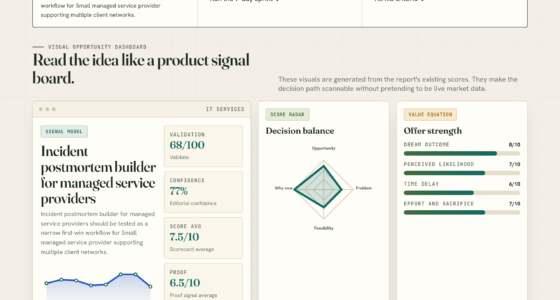

📊 Full opportunity report: Week Three — Foundation model vs Brownian motion. Kronos on five-minute BTC. on ThorstenMeyerAI.com — validation score, market gap, and execution plan.

Get business pricing on monitors, keyboards and dev gear
- Business-only prices and quantity discounts
- Tax-exempt purchasing
- Multiple users, one account, clear invoices
TL;DR
A recent study tested Kronos, a foundation model, against a Brownian motion baseline for five-minute BTC predictions. The results show Kronos does not outperform Brownian motion in out-of-sample tests, challenging assumptions about modern models’ predictive advantages.
Recent testing shows that Kronos, a state-of-the-art foundation model, does not outperform the traditional Brownian motion baseline in predicting five-minute Bitcoin price movements in out-of-sample data.
Over the past two weeks, a trading bot called Polybot, developed privately and not publicly available, which uses a geometric Brownian motion model to estimate Bitcoin’s short-term price movement, was tested against Kronos, a large foundation model trained on millions of candlesticks from global exchanges. The test involved analyzing 497 historical trades, reconstructing market contexts, and comparing the predictive accuracy of each model.
The results indicate that Kronos’s predictive metrics—measured via Brier score and log-loss—are statistically indistinguishable from those of the Brownian baseline. Specifically, on the out-of-sample data, Kronos’s Brier score was 0.189, while Brownian’s was slightly better at 0.188. The difference of 0.0011 was within the margin of statistical noise, meaning Kronos did not demonstrate a clear advantage in predicting whether Bitcoin would close above its open price in the five-minute window.
Consequently, the study concludes that, at least for the specific horizons and data used, a modern learned model like Kronos does not outperform the traditional Brownian motion approach in a measurable, out-of-sample context. As a result, integrating Kronos into the bot’s trading pipeline as a predictive strategy is not justified based on current evidence.
Implications for AI-Based Market Prediction
This finding challenges the assumption that more complex, learned models inherently provide better short-term market predictions than simple mathematical models like Brownian motion. For traders and researchers, it underscores the importance of rigorous out-of-sample testing before adopting advanced models in live trading systems. The result also highlights the persistent effectiveness of traditional statistical methods in certain high-frequency trading contexts, and suggests that the perceived edge of modern AI models may be limited or context-dependent.
As an affiliate, we earn on qualifying purchases.
Background on Model Testing in Crypto Markets
Over recent years, there has been increasing interest in applying machine learning to financial markets, especially in high-frequency and short-term trading. The foundational assumption is that learned models trained on large datasets can capture complex market signals beyond what traditional models like Brownian motion can. Previous experiments with simple models, such as geometric Brownian motion, have shown limited predictive power in real trading scenarios. Kronos, an open-source foundation model trained on millions of candlestick data, was developed to test whether such advanced models could outperform traditional methods in predicting short-term BTC movements. This latest testing builds on earlier efforts, including two weeks of paper trading, which indicated that most purported edges did not survive out-of-sample validation.
“Kronos, despite its scale and training data, does not outperform the Brownian baseline in out-of-sample predictions for five-minute Bitcoin moves.”
— Thorsten Meyer, researcher behind the test
high-frequency trading tools for crypto
As an affiliate, we earn on qualifying purchases.
As an affiliate, we earn on qualifying purchases.
Limitations and Unanswered Questions in Model Evaluation
While the current test indicates no outperformance by Kronos, it remains unclear whether different model configurations, training data, or market conditions could yield different results. Additionally, the study focused solely on five-minute BTC predictions; other horizons or assets might produce different outcomes. The potential for future model improvements or hybrid approaches also remains untested in this specific context.
cryptocurrency prediction software
As an affiliate, we earn on qualifying purchases.
As an affiliate, we earn on qualifying purchases.
Future Directions for Short-Term Market Prediction Research
Further research is needed to explore whether alternative training methods, larger models, or different market conditions could enable foundation models like Kronos to outperform traditional baselines. Additionally, testing across various short-term horizons and different assets will help clarify the scope of these models’ predictive capabilities. For now, traders and developers should approach claims of AI superiority in high-frequency trading with caution, emphasizing rigorous out-of-sample validation.
As an affiliate, we earn on qualifying purchases.
Key Questions
Does this mean foundation models are useless for crypto trading?
Not necessarily. The current evidence shows that, for five-minute BTC predictions, Kronos does not outperform a simple Brownian motion baseline. Future models or different configurations might yield better results, but rigorous testing is essential before deployment.
Can traditional models like Brownian motion still be effective?
Yes. The study confirms that Brownian motion remains a competitive baseline for short-term predictions in high-frequency crypto trading, especially when tested out-of-sample.
What does this mean for AI-based trading strategies?
It suggests caution. While AI models have potential, their advantages over traditional methods are not guaranteed and must be validated through careful, out-of-sample testing before being used in live trading.
Will future versions of Kronos or similar models perform better?
This remains an open question. Enhancements in training data, architecture, or hybrid approaches could improve predictive performance, but no guarantees exist without rigorous testing.
Source: ThorstenMeyerAI.com
Fall Picks
fall essentials
As an affiliate, we earn on qualifying purchases.