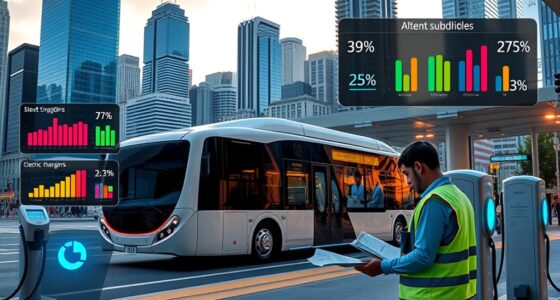
When exploring tenders for autonomous buses, you’ll find that safety and liability are key priorities. Tenders specify strict standards for vehicle performance, sensor reliability, cybersecurity, and emergency procedures, requiring safety certifications and demonstration data. They also establish clear liability frameworks to clarify responsibility in case of accidents, covering manufacturers, software providers, and operators. This careful approach helps build trust and ensures safe deployment. If you want to understand how these standards are implemented and enforced, there’s more to uncover.
Key Takeaways
- Tenders require detailed safety certifications and demonstration data to ensure autonomous buses meet technical and safety standards.
- Procurement processes incorporate cybersecurity measures and AI security technologies to protect autonomous systems from cyber threats.
- Safety and performance benchmarks are established through regulatory standards, guiding bidders to comply with national and international safety laws.
- Liability frameworks within tenders clarify responsibility among manufacturers, operators, and software providers in case of accidents or failures.
- Clear liability clauses promote transparency, accountability, and stakeholder confidence in the deployment of autonomous buses.

As cities around the world seek to modernize their public transportation systems, autonomous buses are emerging as a promising solution. These vehicles promise increased efficiency, reduced congestion, and enhanced accessibility. However, integrating autonomous buses into existing transit networks requires careful planning, particularly when it comes to safety and liability. When governments issue tenders for autonomous bus procurement, they often establish strict requirements related to regulatory standards and liability frameworks to guarantee these vehicles operate safely and responsibly.
Regulatory standards are vital in defining the technical and safety benchmarks that autonomous buses must meet before they hit the roads. As a purchaser, you need to confirm that the bidding process emphasizes compliance with national and international safety regulations. These standards cover everything from vehicle performance and sensor reliability to cybersecurity measures and emergency protocols. Bidders are typically required to submit detailed safety certifications and demonstration data, proving that their autonomous buses can handle various scenarios reliably. This not only helps prevent accidents but also builds public trust in the new technology. When tenders specify clear regulatory standards, they set a level playing field where only compliant, safety-focused solutions can compete, reducing the risk of deploying unsafe vehicles. Additionally, AI security technologies can play a vital role in safeguarding these autonomous systems against cyber threats, ensuring operational integrity and passenger safety.
Liability frameworks are equally important because they determine who bears responsibility when something goes wrong. In autonomous bus tenders, you should look for provisions that clearly assign liability in case of accidents or system failures. This often involves establishing whether the manufacturer, software provider, or operator is accountable, and under what conditions. Clearly defined liability frameworks help prevent legal ambiguities that could delay deployment or increase costs. They also guide bidders in designing safety protocols and insurance strategies, knowing exactly what legal risks they face. When tenders incorporate comprehensive liability clauses, they foster a sense of security for all stakeholders—public agencies, operators, manufacturers, and passengers—by ensuring that accountability is transparent and manageable.
autonomous bus safety certification
As an affiliate, we earn on qualifying purchases.
As an affiliate, we earn on qualifying purchases.
Frequently Asked Questions
How Are Cybersecurity Risks Managed in Autonomous Bus Procurement?
You manage cybersecurity risks in autonomous bus procurement by implementing strict cybersecurity protocols, ensuring all systems are regularly updated and monitored. You conduct thorough risk mitigation strategies, including vulnerability assessments and penetration testing, to identify and address potential threats early. Additionally, you require vendors to adhere to industry cybersecurity standards, fostering a secure environment that protects passenger data and system integrity throughout the procurement process.
What Are the Privacy Implications for Passenger Data Collection?
You should be aware that passenger privacy is a major concern when collecting data for autonomous buses. To protect this, data protection measures are implemented, such as anonymizing information and securing data storage. Tenders often specify strict privacy standards, ensuring passenger privacy isn’t compromised. By adhering to these protocols, you help prevent misuse of personal data and build trust in autonomous transportation systems.
How Do Tenders Address Liability in Autonomous Vehicle Accidents?
Like a knight’s shield in medieval tales, liability frameworks protect you in autonomous vehicle accidents. Tenders require clear clauses assigning liability, often involving manufacturers or operators, ensuring accountability. During accident investigations, these frameworks help identify responsible parties swiftly. You’re covered because tenders mandate extensive risk assessments and insurance policies, so when mishaps occur, liability is determined efficiently, safeguarding your interests and maintaining trust in autonomous transportation.
What Standards Ensure Interoperability Between Different Autonomous Bus Systems?
You guarantee interoperability between autonomous bus systems by following established interoperability standards and focusing on system compatibility. These standards, like ISO 26262 and AUTOSAR, help different manufacturers design compatible hardware and software. By adhering to these guidelines, you enable seamless communication, data exchange, and integration across various autonomous bus systems, improving safety, efficiency, and user experience in public transportation networks.
How Is Insurance Coverage Determined for Autonomous Bus Operations?
When it comes to autonomous buses, insurance coverage is your safety net, and you’ve got to know the ropes. Insurance policies are tailored based on risk assessments, vehicle value, and operational scope. Liability frameworks clarify who’s responsible in case of accidents, shifting some of the burden away from the operator. You need to guarantee these elements are in place so you’re not caught off guard if the unexpected happens—better safe than sorry.

Cybersecurity in Robotic Autonomous Vehicles
As an affiliate, we earn on qualifying purchases.
As an affiliate, we earn on qualifying purchases.
Conclusion
As you consider future transit options, remember that the tender processes subtly guide the path toward safer, more reliable autonomous buses. While challenges linger like gentle ripples, the evolving policies aim to softly steer us toward innovations that prioritize safety and clarity. Trust that, with ongoing refinement, the journey will become smoother, gently reassuring you that the road ahead is being thoughtfully paved for a seamless, autonomous transit experience.

Personal Injury in the Age of AI and Self Driving: How Autonomous Vehicles, Digital Evidence, and Artificial Intelligence Are Reshaping Liability, Case Value, and the Modern PI Firm
As an affiliate, we earn on qualifying purchases.
As an affiliate, we earn on qualifying purchases.

1pcs Sensor BUS0036 Bus M30M1-NPX-20/130-S92K
Sensors
As an affiliate, we earn on qualifying purchases.
As an affiliate, we earn on qualifying purchases.