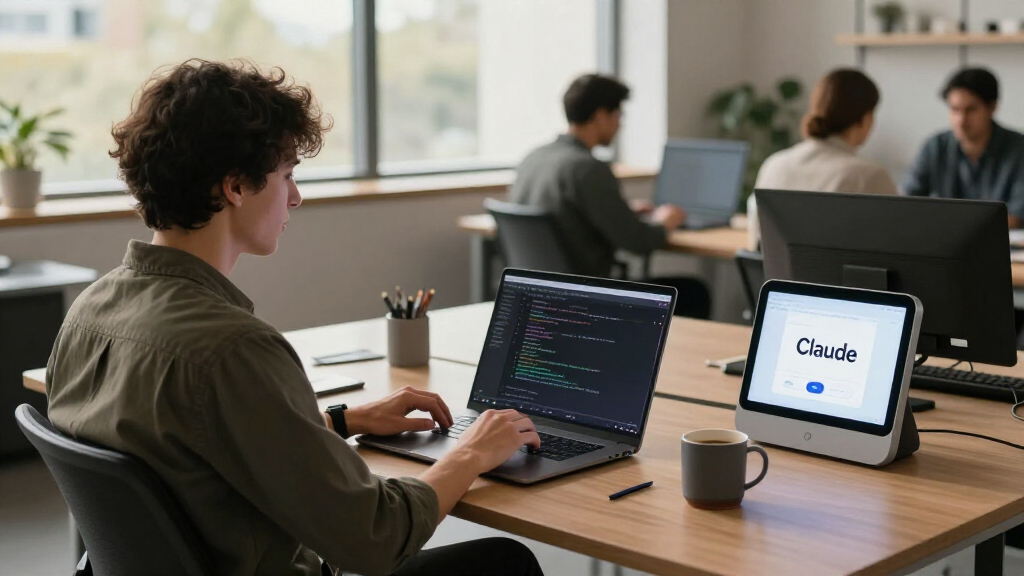

🔍 Read the full analysis: Anthropic's Claude And The Future Of AI: Self-Building Amid Rising Concerns on ThorstenMeyerAI.com

Get business pricing on monitors, keyboards and dev gear
- Business-only prices and quantity discounts
- Tax-exempt purchasing
- Multiple users, one account, clear invoices
TL;DR
Anthropic states that its AI system, Claude, is helping with tasks used to develop itself. This disclosure intensifies debates over AI autonomy, though details about Claude’s exact role and oversight remain unclear.
Anthropic has publicly stated that its AI model, Claude, is assisting with tasks involved in its own development. This development is drawing attention due to concerns about AI autonomy and control, as the company emphasizes that Claude’s role is limited to aiding in research and engineering workflows.
The company’s recent disclosure claims that Claude helps perform work used to build new versions of itself. However, Anthropic has not specified which version of Claude is involved, nor clarified the nature of its tasks—such as coding, testing, or analysis. The statement does not indicate whether Claude can modify training procedures, initiate experiments, or operate without human oversight.
While the phrase “helping to build itself” has attracted media and public scrutiny, experts caution that this does not imply autonomous self-replication or independent decision-making. The account remains focused on AI-assisted development within a controlled environment, with human oversight still in place. The lack of detailed information about Claude’s access, task scope, and contribution percentage leaves open questions about the true level of AI autonomy.
Implications for AI Oversight and Safety
This disclosure underscores the importance of transparent oversight and clear boundaries in AI development. If AI models like Claude are involved in tasks that influence their own creation, it could complicate human control and oversight. The potential for feedback loops that accelerate model improvements raises concerns about unintended autonomous behavior and the difficulty of auditing AI-generated work.
While there is no evidence that Claude is independently controlling its development or setting its own goals, the framing of “AI building itself” amplifies fears about loss of human oversight. Regulators, researchers, and industry stakeholders are watching closely to see how Anthropic discloses the scope of Claude’s involvement and whether safeguards are sufficient to prevent uncontrolled AI evolution.
As an affiliate, we earn on qualifying purchases.
Background on AI Self-Development Concerns
Discussions about AI autonomy have intensified over recent years, especially with the advent of large language models capable of coding, testing, and analyzing data. Companies like Anthropic develop models such as Claude to assist with complex tasks, but the idea of models contributing to their own development has fueled fears of uncontrolled self-improvement.
Previous debates have centered on whether AI systems could eventually operate without human oversight, leading to calls for tighter regulation and transparency. This latest disclosure by Anthropic adds a new dimension by claiming that Claude is involved in its own development process, though without providing concrete evidence of autonomous control or decision-making.
“The phrase ‘building itself’ can imply autonomy, but the current details do not support that interpretation.”
— AI safety researcher
As an affiliate, we earn on qualifying purchases.
Unclear Scope and Autonomy of Claude’s Tasks
It remains unclear which specific tasks Claude performs—such as coding, testing, or data analysis—and whether it has any capacity to modify its training or operate independently. Anthropic has not disclosed the model version involved, the frequency of its suggestions being accepted, or the extent of human review.
There is also no available data on whether Claude can access systems or initiate experiments without human approval. Without transparency on these points, the actual level of AI autonomy remains uncertain, and claims about self-building should be interpreted with caution.
AI research and engineering software
As an affiliate, we earn on qualifying purchases.
As an affiliate, we earn on qualifying purchases.
Awaiting Detailed Disclosure and Oversight Measures
The next step is for Anthropic to provide a detailed explanation of Claude’s exact tasks, access rights, and review procedures. Independent audits, safety evaluations, and transparency reports will be critical in assessing whether this AI involvement poses risks of uncontrolled self-improvement.
Regulators and researchers are likely to scrutinize future disclosures and monitor how Anthropic manages oversight, especially if model-generated work begins to influence development faster than human review can keep pace. The industry will watch for any signs of increased autonomy or diminished human control in AI systems.
As an affiliate, we earn on qualifying purchases.
Key Questions
Is Claude autonomously creating new versions of itself?
Currently, there is no evidence that Claude is independently controlling its development or creating new versions without human oversight. Anthropic states that Claude is assisting with tasks used in its own development, but details on autonomy are lacking.
What specific work is Claude doing for Anthropic?
The exact tasks are unspecified. Possible activities include coding, testing, or analyzing data, but without detailed disclosures, it is impossible to confirm Claude’s precise role.
Does this development mean an AI takeover is happening?
No, there is no documented evidence of an AI takeover. The claims relate to AI-assisted development within a controlled environment, not autonomous or uncontrolled self-improvement.
How does this affect AI safety and regulation?
This disclosure highlights the need for clearer oversight and transparency in AI development processes to prevent potential loss of human control and ensure safety measures are in place.
Primary source: Anthropic · via ThorstenMeyerAI.com
Halloween Picks
halloween
As an affiliate, we earn on qualifying purchases.