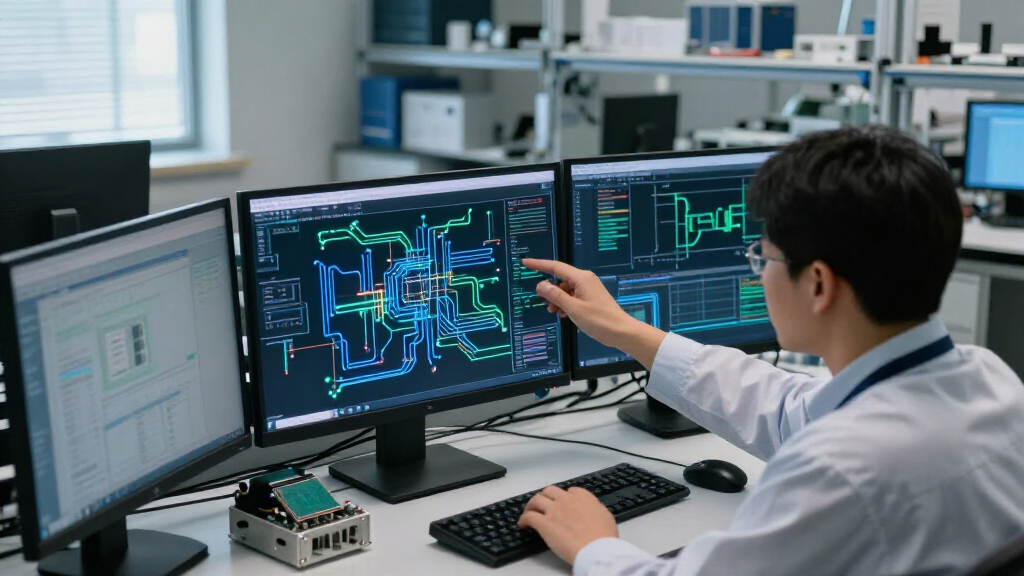
🔍 Read the full analysis: OpenAI’s AMD Chip Design Study: A Look At What The Models Improved on ThorstenMeyerAI.com

Get business pricing on monitors, keyboards and dev gear
- Business-only prices and quantity discounts
- Tax-exempt purchasing
- Multiple users, one account, clear invoices
TL;DR
OpenAI said its models rewrote parts of AMD chip designs and produced up to 14% improvements in power, performance and area against heavily optimised baselines. The company also reported smaller area gains on its own Jalapeño inference chip, but detailed AMD results and an independent audit have not been published.
OpenAI said on November 18 that its AI models rewrote sections of AMD chip designs, reporting up to 14% improvements across power, performance and area in parts of a flagship GPU. The company said some model-generated changes had been included in an AMD design sent for manufacturing, though it has not released the block-level data or an independent evaluation needed to assess the result.
OpenAI described work on both an AMD flagship GPU and the company’s next flagship CPU. For the GPU, it reported a best-case improvement of up to 14% in power, performance and area, or PPA, compared with what it called heavily optimised baselines. OpenAI said some changes were in a recent design sent for manufacturing, while others were added to production design files for future versions. The company has not identified the affected GPU blocks or reported an average gain across the design.
For the CPU, OpenAI said AMD had verified single-digit PPA gains in key blocks. AMD has not published its own figures, according to the source material. OpenAI also reported results from its custom Jalapeño inference chip: model-proposed changes reduced standard-cell area by about 13% in one unit and 10% in another. The accounts differ on the name of the first unit, calling it a warp engine or a vector unit.
The models worked on register-transfer level (RTL) code, which describes a chip’s circuit behaviour. OpenAI said Synopsys design tools checked whether proposed rewrites preserved the original behaviour and measured their effects on PPA. That verification was carried out by conventional engineering tools, not by the models themselves. OpenAI also reported a benchmark involving five models and two open-source RISC-V processor cores, PicoRV32 and Ibex, with 9,881 scored runs; it said GPT-6.2 Astra had the top score.
AI Moves Into Chip Design
If the results hold up, they suggest AI systems can contribute to improving the hardware used to run future AI models, not just help write software or conduct research. Chip design is a long, iterative process, and even gains within selected blocks can matter when power use, speed and silicon area constrain a processor’s capabilities and cost.
The reported gains are not yet evidence that an entire AMD chip is 14% better. The headline figure is an “up to” result, and the affected blocks and their share of the chip are not specified. Nor do the available reports establish whether the result was measured after synthesis alone or after placement and wiring, later stages that can change a design’s final characteristics. The practical value will depend on whether gains survive those stages and appear in manufactured products.
The work also has commercial significance. OpenAI and AMD are linked by an agreement under which OpenAI holds a warrant for up to 160 million AMD shares, vesting as AMD chips are deployed. That relationship does not disprove the engineering results, but it makes independent evidence especially useful when evaluating claims about AMD hardware.
Popular right now

Vitamix 5200 Professional-Grade Blender with 64 oz Container, Black

Ninja Foodi 6-in-1 DualZone FlexBasket Air Fryer, 7-Qt MegaZone, Black, DZ071

Dyson Cyclone V10 Origin Cordless Vacuum
As an affiliate, we earn on qualifying purchases.
From RTL Rewrites to Silicon
Chip design proceeds through several stages. At the RTL stage, engineers describe in code how circuit blocks behave from one clock cycle to the next. Tools then synthesise that description into logic gates, followed by steps that place and wire components on silicon. OpenAI’s reported contribution was at the RTL stage: its models proposed alternative descriptions intended to preserve the same function while changing the trade-offs in area, speed or power.
The source material describes examples from Jalapeño, including a multiplier redesign reported to use about 15% less cell area in synthesis while reducing latency from two clock cycles to one, and an adder redesign reported to cut cell area by about 15% at the same latency. These are specific examples, not the AMD GPU average. OpenAI said Synopsys tools checked behavioural equivalence and assessed the design trade-offs.
OpenAI published a post titled “Advancing chip design with OpenAI models” on November 18, 2026. The source article says an automated request to that post was refused, and its account relies on reporting by ANI, The Decoder and Inside AI, as well as comments attributed to company executives. OpenAI president Greg Brockman described the AMD work as “roughly an additional year of progress” achieved in less than five months; that is the company’s characterisation, not an independently established measure of time saved.
“Su praised the results on X.”
— AMD chief executive Lisa Su
The Missing Block-Level Evidence
The available accounts do not identify which AMD GPU blocks produced the reported best-case gain, how much of the chip they represent, or the average result across the design. They also do not specify the measurement stage or provide independent test data. Without those details, readers cannot tell how broadly the headline number applies or whether it reflects performance after the full physical-design process.
AMD has not published its own figures in the source material, and no independent audit of the chip-design results is reported. OpenAI’s financial relationship with AMD is also relevant to how the claims should be weighed. The evidence described does include conventional-tool checks for behavioural equivalence, but that does not independently establish the reported commercial or chip-wide impact.
Some reporting differs over the name of a Jalapeño unit that saw an area reduction. The accounts also describe several distinct results—AMD GPU PPA, CPU block gains, Jalapeño area reductions and open-source-core benchmark scores—which should not be treated as one combined measure.
AMD Data and Manufacturing Results
The next useful evidence would be AMD’s own technical disclosures, including the affected blocks, the measurement method and whether gains persisted through physical design and manufacturing. OpenAI has said that some changes are in a design sent for manufacturing, but the source material gives no timetable for when AMD might publish results or identify the product.
For now, the announcement establishes that OpenAI says its models contributed RTL changes and that conventional tools checked the rewrites. It does not settle how much the changes improve a complete shipping chip. Readers will need further company data or independent analysis to judge the scale and repeatability of the reported gains.
Key Questions
What did OpenAI say its models improved?
OpenAI reported up to 14% improvements in power, performance and area in parts of an AMD flagship GPU design. It also said AMD verified single-digit gains in key blocks of a next-generation CPU, and reported area reductions in units of its own Jalapeño chip.
Does 14% mean AMD’s whole GPU is 14% better?
No. The figure is an “up to” best-case result for unspecified parts of the design. OpenAI has not provided the blocks, their share of the chip or an average improvement across the GPU.
Who checked whether the model-generated designs worked?
OpenAI said Synopsys design tools checked that the RTL rewrites preserved the original behaviour and assessed their power, performance and area effects. The source material does not report an independent audit of the overall results.
Have any of the changes reached manufacturing?
OpenAI said some model-generated changes were included in an AMD design sent for manufacturing. The available information does not identify the product, disclose manufacturing results or say when it may be available.
Why does the OpenAI–AMD relationship matter?
OpenAI holds a warrant for up to 160 million AMD shares, which vests as AMD chips are deployed. That financial connection does not establish whether the technical claims are accurate, but it is relevant context when assessing company-reported results.
Source: ThorstenMeyerAI.com