Integrating solar panels on electric buses allows you to harness sunlight directly, boosting sustainability and reducing grid dependence. By installing onboard or overhead solar canopies, you can extend your bus’s range, lower operational costs, and lower greenhouse emissions. Large depot systems and innovative infrastructure can maximize space and energy efficiency. While challenges exist, such as limited surface area and high costs, upcoming advancements promise even greater benefits—find out more to see how this technology is evolving.

Get business pricing on monitors, keyboards and dev gear
- Business-only prices and quantity discounts
- Tax-exempt purchasing
- Multiple users, one account, clear invoices
Key Takeaways
- Solar panels on buses extend operational range and reduce grid reliance by generating onboard renewable energy.
- Integrating solar canopies with charging stations optimizes urban space and minimizes land-use conflicts.
- Large depot solar systems, like in Beijing, support extensive electric bus networks and lower energy costs.
- Solar-powered infrastructure decreases greenhouse emissions and enhances system resilience in urban transit.
- Challenges include limited rooftop surface area, high battery costs, and intermittent solar output requiring careful planning.
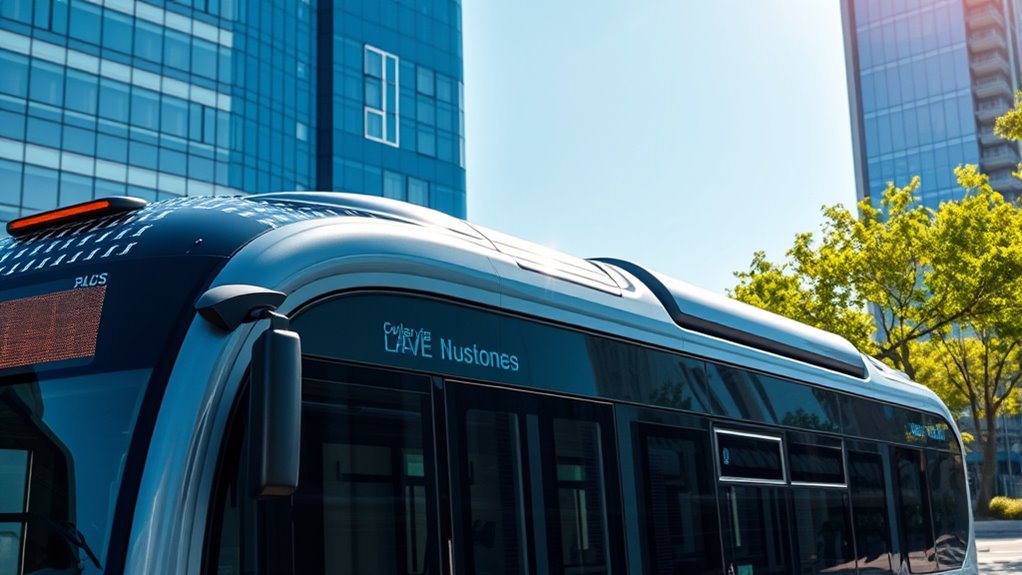
Have you ever wondered how solar panels can enhance the sustainability of electric buses? The answer lies in innovative integrations that directly boost efficiency, reduce costs, and lessen environmental impact. Today, many transit agencies are adopting solar-roofed electric buses that incorporate onboard panels, generating energy directly from sunlight. This setup helps decrease dependence on the grid, especially during peak hours, and can even extend the bus’s range.
Transit fleets are also combining solar canopies with overhead charging stations, making best use of limited urban space and improving energy management. For example, cities like Beijing have deployed large depot-based solar systems with thousands of panels, alleviating strain on the city’s power grid and providing clean energy to support their vast bus networks. Additionally, solar-powered infrastructure can improve overall system resilience and operational efficiency. Incorporating renewable energy sources into transit systems is a vital step toward achieving long-term sustainability.
Overhead charging structures paired with solar canopies further reduce land-use conflicts in crowded urban environments, enabling transit authorities to maximize their infrastructure’s utility. Some buses are even equipped with Vehicle-to-Everything (V2X) technology, allowing them to act as mobile energy storage units. These buses can supply excess solar energy back to the grid during peak demand, enhancing urban energy resilience.
Integrating solar power into bus systems not only improves sustainability but also offers tangible savings. By generating onsite solar power at depots, agencies cut their peak-hour energy costs and reduce reliance on expensive grid electricity. When combined with optimization models that favor solar over batteries—due to lower unit costs—you can see how overall system costs drop by around 4% compared to traditional grid-only models. Moreover, advancements in solar panel efficiency continue to amplify the benefits of these installations.
However, integrating solar isn’t without limitations. The rooftop surface area on buses constrains how much solar capacity each can carry, often requiring additional charging strategies. Battery costs remain a barrier to large-scale energy storage, and the intermittent nature of solar output complicates reliable energy management without backup systems.
Compatibility issues with existing depot infrastructure also pose challenges, as retrofitting requires careful planning. Despite these hurdles, the environmental benefits are clear: replacing diesel-powered buses with solar-assisted electric models considerably reduces greenhouse gas emissions and lowers urban carbon footprints.
Solar canopies and decentralized energy generation also help minimize habitat disruption and improve land-use efficiency. Case studies from around the world, such as Beijing’s extensive bus depot solar projects and scaled-up installations like CapMetro’s 7,000-panel system, demonstrate the scalability and adaptability of these solutions. Additionally, employing cost-effective strategies can further enhance deployment success and financial viability.
Computer simulations help optimize panel placement and storage ratios, further enhancing economic viability. Future developments, including expanded Vehicle-to-X technology and advanced solar battery innovations, promise to make these systems even more efficient and cost-effective.
As policies evolve to incentivize renewable energy adoption, the integration of solar panels on electric buses will become an increasingly crucial part of sustainable urban transit.
As an affiliate, we earn on qualifying purchases.
Frequently Asked Questions
What Is the Expected Lifespan of Solar Panels on Electric Buses?
You’re wondering about the lifespan of solar panels on electric buses. Typically, these panels last around 25 years under ideal conditions.
While vibrations and weather might cause microcracks or efficiency drops, they don’t usually shorten their lifespan considerably. Regular cleaning and maintenance help keep them efficient.
Most warranties cover 20–25 years, aligning well with the expected lifespan, though end-of-life recycling is standard practice.
How Do Solar Panels Affect Bus Maintenance Routines?
Think of solar panels as the steady heartbeat of your bus’s energy system. They require regular cleaning to keep efficiency high, and periodic inspections to guarantee durability.
You’ll also need to check electrical systems connected to them. Luckily, electric buses need less engine maintenance, so overall upkeep becomes simpler.
With routine care, solar panels help your bus run smoothly, reduce downtime, and save costs over time.
Are Solar Panels Effective in Cloudy or Rainy Weather Conditions?
You might wonder if solar panels work well in cloudy or rainy weather. They do experience reduced energy output—about 10-25% of full sunlight efficiency—but modern panels still generate some power from scattered light.
Rain cleans the panels, improving efficiency afterward. Plus, onboard batteries and hybrid systems help you keep the bus running smoothly even when weather isn’t ideal, making solar panels a resilient energy source in various conditions.
What Is the Cost Difference Between Buses With and Without Solar Panels?
You’re wondering about the cost difference between buses with and without solar panels. Without solar, an electric bus costs around $259,000 or more.
Adding solar panels increases the initial price due to extra equipment like PV systems and batteries. Solar-assisted models are cheaper than full solar-electric buses, but overall, expect a higher upfront investment—potentially thousands of dollars—depending on the size and capacity of the solar system you choose.
How Do Solar Panels Impact Overall Bus Weight and Performance?
You might wonder how solar panels affect bus weight and performance. When you use lightweight polymer-based panels, they reduce weight by about 50% compared to traditional materials, helping prevent performance issues.
However, adding panels increases the bus’s weight, which can raise energy consumption and reduce range. Balancing panel weight with efficiency is vital, as lighter designs improve overall performance and help you maximize solar energy benefits without compromising bus operation.
As an affiliate, we earn on qualifying purchases.
Conclusion
By blending bold, bright solar panels with bustling buses, you bring brilliance to your journey. This synergy not only sustains your ride but also supports sustainability. Seamlessly integrating solar solutions showcases smart, sustainable strides, steering society toward a cleaner, greener future. So, seize the chance to spark a shining shift—solar-powered buses symbolize a sustainable, savvy step forward. Let this luminous leap lead your longing for a cleaner, clearer cityscape.
solar-powered EV charging station
As an affiliate, we earn on qualifying purchases.
As an affiliate, we earn on qualifying purchases.
As an affiliate, we earn on qualifying purchases.
Halloween Picks
halloween
As an affiliate, we earn on qualifying purchases.