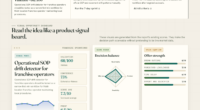
📊 Full opportunity report: The Question No To-Do App Can Answer on ThorstenMeyerAI.com — validation score, market gap, and execution plan.

Get business pricing on monitors, keyboards and dev gear
- Business-only prices and quantity discounts
- Tax-exempt purchasing
- Multiple users, one account, clear invoices
TL;DR
Threlmark is a new project management tool that ranks and manages tasks across multiple projects using AI-driven scoring and flow management. However, it cannot answer the fundamental question of what the single most important task is for the user.
Threlmark, a new project management tool, has been launched to help users prioritize their work across multiple projects by scoring and ranking tasks automatically. While it excels at organizing and visualizing work, it cannot answer the fundamental question: “What is the single most important thing I should do next?” This limitation reflects the tool’s design focus and highlights a core challenge in task management technology.
Threlmark is designed as a command deck for managing multiple projects, with features including project-specific boards, a portfolio view that ranks tasks across all projects, and AI-assisted scoring based on impact, evidence, fit, and effort. Tasks are prioritized automatically, with the system emphasizing flow management—limiting work in progress, flagging aging tasks, and tracking completion pace. The tool’s core innovation lies in its scoring system, which turns subjective priorities into objective, adjustable scores, fostering more transparent decision-making.
Despite these capabilities, Threlmark does not provide an answer to the question of which single task is most important at any given moment. This is a deliberate design choice, as the developers emphasize that prioritization is inherently subjective and context-dependent. Instead, the tool offers a ranked list of work based on measurable criteria, leaving the ultimate judgment of importance to the user.
Threlmark also emphasizes data privacy, storing all information locally without cloud dependencies, and aims to reduce common productivity pitfalls like starting too many tasks without finishing them. Its flow management features include limiting active work and tracking task duration, helping users focus on completing work rather than just starting new tasks.
The question no to-do app can answer
Of everything you’re building, what’s the single most important thing to do next? To-do apps track tasks. Boards track status. Neither ranks the most valuable work across every project — and tells you where to point your next hour.
Your plans live in too many places
One project’s tasks are in a notes app, another’s in a spreadsheet, a third only in your head. You start faster than you finish. The honest question has no good answer anywhere.
Priority becomes a number, not an argument
Rate four simple axes 1–5. Threlmark turns them into one priority score — impact weighted heaviest, only effort subtracts. Drag any slider and watch the score move.
The priority score, computed live
Now your backlog is ordered by consistent, visible logic you can argue with — not gut feel or recency.
max(0, rounded)
One honest ranking across everything
Every item from every project, ranked together — so the top is genuinely the most valuable work you could do anywhere right now. In-progress work floats up (finishing beats starting); blockers get nudged up (bottlenecks cost most).
Portfolio · top work across all projects
status-weighted · auto-rankedThe real disease is “too much started, nothing finished”
A tidy board can hide it. Threlmark adds flow signals that quietly tell the truth — no methodology to learn, just the board plus a few honest numbers.
WIP limits
Cap how many items are “in development.” Over the limit, the column turns red.
Aging & stale flags
Every card shows how long it’s sat in its column. Too long in dev (>7d) → flagged stale. No more cards rotting for two months.
Throughput & cycle time
How many items you actually finish per week, and how long things really take. Your real pace, not your optimistic one.
Hand it to an AI — and let it tell you when it’s done
You decide what and when; the AI does the building; the board keeps itself honest about what actually shipped — without you dragging cards around by hand.
The handoff-and-report loop
Generate a brief, paste it into Claude or Codex — and the brief tells the agent to report back automatically.
Generate brief
What to build, files it touches, what “done” means, how to verify.
→Hand to AI
Paste into Claude / Codex. Card optionally moves to Development.
→Agent reports
done / blocked / failed — with a summary & proof checks passed.
→Card self-moves
A “done” report moves the card to Done. Flow counts brief → shipped.
Why Threlmark Can’t Decide Your Top Priority
This limitation is significant because it underscores a fundamental challenge in productivity tools: determining what truly matters is a subjective decision that cannot be fully automated. Threlmark’s inability to identify the single most important task highlights the importance of human judgment in prioritization. For users, this means the tool can support decision-making but cannot replace the nuanced understanding of what should come next, especially in complex or dynamic work environments.
Understanding this boundary is crucial for users who rely on such tools for productivity. It clarifies that while Threlmark can help organize, score, and visualize work, the ultimate choice of what to focus on remains a human responsibility. This distinction can prevent over-reliance on automation and encourage more deliberate decision-making.
task management app with AI scoring
As an affiliate, we earn on qualifying purchases.
As an affiliate, we earn on qualifying purchases.
The Limits of Automation in Task Prioritization
Many existing project management tools focus on organizing tasks or visualizing workflows but lack sophisticated prioritization mechanisms. Threlmark builds on recent advances in AI and flow management to offer a more dynamic approach—scoring tasks based on impact, evidence, fit, and effort, and providing a portfolio view that consolidates work across projects. However, the core challenge of identifying the single most important task remains unresolved in the broader productivity landscape.
Historically, prioritization has been a subjective process, often reliant on individual judgment, team consensus, or managerial discretion. Threlmark’s approach attempts to quantify this process but recognizes that the ultimate decision involves context, intuition, and strategic considerations that cannot be fully captured by algorithms.
“Our tool helps you see what’s most valuable based on measurable criteria, but it can’t tell you what’s most important in your specific situation—that’s still a human call.”
— Thorsten Meyer, creator of Threlmark
As an affiliate, we earn on qualifying purchases.
Unanswered Questions About Threlmark’s Limits
It remains unclear how well Threlmark’s scoring system aligns with individual or team priorities in real-world scenarios. User feedback is still emerging, and there is no evidence yet on whether the tool effectively guides users to the single most impactful task in complex, fast-changing environments. Additionally, how users adapt their decision-making processes around the tool’s suggestions is still being observed.
Furthermore, it is not yet confirmed whether future updates will attempt to incorporate more subjective or strategic elements into the ranking, or if the core design will remain focused on measurable criteria alone.
As an affiliate, we earn on qualifying purchases.
Next Steps for Threlmark Development and Adoption
Developers plan to gather user feedback to refine the scoring algorithms and improve integration with existing workflows. Future updates may include features to help users explicitly identify their top priority, possibly integrating strategic or contextual inputs. Meanwhile, early adopters will continue testing the tool’s effectiveness in managing multiple projects and supporting decision-making.
Expect ongoing case studies and user reports to clarify how well Threlmark supports real-world prioritization and whether it can evolve to answer the question it currently cannot—what is the single most important task at any moment.
As an affiliate, we earn on qualifying purchases.
Key Questions
Can Threlmark tell me what my most important task is right now?
No, Threlmark cannot determine the single most important task for you. It provides a ranked list based on measurable criteria but leaves the final prioritization decision to the user.
How does Threlmark decide which tasks are most important?
It scores tasks based on impact, evidence, fit, and effort, then ranks them accordingly. The system emphasizes objectivity but does not make subjective importance judgments.
Is Threlmark suitable for individual users or teams?
It is designed for both solo founders and small teams, helping prioritize across multiple projects and manage flow effectively.
Will future versions include features to identify the single most important task?
Developers have not confirmed specific plans, but future updates may explore incorporating more strategic inputs to assist with this decision.
Does Threlmark store data in the cloud?
No, all data is stored locally on the user’s computer, ensuring privacy and control over information.
Source: ThorstenMeyerAI.com
Fall Picks
fall essentials
As an affiliate, we earn on qualifying purchases.