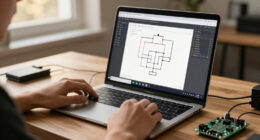
🔍 Read the full analysis: What Does It Mean For AI When Claude Uses Real Lab Equipment? on ThorstenMeyerAI.com

Get business pricing on monitors, keyboards and dev gear
- Business-only prices and quantity discounts
- Tax-exempt purchasing
- Multiple users, one account, clear invoices
TL;DR
Anthropic is developing plans for its Claude AI model to operate real laboratory equipment, marking a significant step toward autonomous scientific experimentation. Details remain limited, with no official confirmation or timeline yet provided.
Anthropic is reportedly working to enable its Claude AI model to control real laboratory equipment, according to a report from The Neuron. This development aims to shift AI from purely advisory roles to active participation in physical scientific workflows, potentially transforming how experiments are conducted and accelerating research cycles. For more context, see the original analysis. While details are scarce, the move signals a significant step toward integrating AI directly into laboratory operations. For a deeper dive, see the original coverage.
The report indicates that Anthropic is exploring ways for Claude to interact with laboratory hardware, such as controlling instruments, running experiments, and handling reagents. This aligns with efforts to enable AI to operate real lab gear, as detailed in this analysis. This would extend Claude’s capabilities beyond software interactions—where it can navigate screens and operate digital tools—to physical manipulation of lab devices. However, Anthropic has not officially announced any product, partnership, or specific timeline for deployment.
Over the past year, Anthropic has expanded Claude’s agentic capabilities, including enabling the model to see screens, move cursors, and interact with software. The reported effort to control lab equipment aligns with this trajectory, as the company aims to embed AI more deeply into scientific workflows. Still, the report does not specify which instruments, labs, or research domains are involved, nor whether the effort is at prototype, testing, or planning stages. It remains unclear if Anthropic is developing hardware integrations internally, partnering with existing vendors, or simply signaling future ambitions.
Implications of AI Operating Physical Lab Devices
If realized, this capability could revolutionize scientific research by automating repetitive, error-prone tasks such as pipetting, calibration, and data collection. AI-controlled lab equipment could enable experiments to run continuously, reduce human labor, and democratize access to sophisticated protocols for labs lacking specialized technicians. This shift would also intensify competition among AI firms, as companies like OpenAI and Google DeepMind explore autonomous scientific systems. However, it raises safety concerns, as AI controlling hazardous chemicals or sensitive instruments must be carefully managed to prevent accidents or errors. For Anthropic, known for its emphasis on safety, the development of such systems could reinforce its reputation as a cautious innovator in frontier AI applications.
As an affiliate, we earn on qualifying purchases.
Evolution Toward Autonomous Laboratory AI
Anthropic’s move toward enabling Claude to operate lab equipment continues a broader trend in AI and robotics. Over recent years, academic labs and startups have demonstrated robot chemists and self-driving laboratories capable of designing, executing, and analyzing experiments with minimal human input. Large language models have been integrated into these systems to translate natural-language instructions into machine commands. Yet, until now, few companies with the resources and safety focus of Anthropic have publicly aimed to make AI directly responsible for physical experimentation. The company’s recent capabilities in software manipulation suggest a logical progression toward hardware control, but concrete implementations remain unconfirmed.
“Anthropic’s reported efforts to have Claude operate real lab gear mark a significant step toward autonomous scientific experimentation.”
— Thorsten Meyer, AI researcher
laboratory experiment control software
As an affiliate, we earn on qualifying purchases.
As an affiliate, we earn on qualifying purchases.
Unconfirmed Details and Development Stage
It remains unclear whether Anthropic has developed functioning prototypes, is conducting live trials, or is only at the research and planning phase. No specific instruments, laboratories, or partners have been publicly identified. The timeline for any potential deployment or publication has not been disclosed, and it is unknown whether the company is working independently or collaborating with existing lab-automation vendors. As such, the reported efforts are currently speculative and represent a direction rather than a finished product.
As an affiliate, we earn on qualifying purchases.
Next Steps and Indicators of Progress
The most immediate signals to watch will be official statements from Anthropic, such as blog posts, research papers, or product announcements confirming lab-control capabilities. Additionally, hiring patterns for robotics engineers, lab automation specialists, or scientific hardware experts could indicate active development. Partnerships with universities, biotech firms, or lab automation companies would also serve as strong evidence that the project has moved beyond conceptual stages. Until then, the development remains an ambitious but unconfirmed direction.
As an affiliate, we earn on qualifying purchases.
Key Questions
What would it mean if Claude can operate lab equipment?
If successful, it would allow AI to automate complex experimental procedures, potentially reducing costs, increasing speed, and expanding access to advanced research techniques across laboratories worldwide.
Are there safety concerns with AI controlling lab hardware?
Yes, controlling hazardous chemicals or sensitive instruments carries risks, and safety protocols would need to be integrated into any operational system to prevent accidents or errors.
Has Anthropic officially announced this capability?
No, the effort has not been officially confirmed by Anthropic. The reports are based on industry sources and suggest a direction rather than a completed product.
Which labs or instruments might be involved?
Details about specific labs, instruments, or research domains are not yet available. The scope and partners remain undisclosed.
When might we see a real-world demonstration?
There is no publicly announced timeline. Future announcements from Anthropic will clarify whether and when the project moves into operational testing or deployment stages.
Primary source: Anthropic · via ThorstenMeyerAI.com
Halloween Picks
halloween
As an affiliate, we earn on qualifying purchases.