
🔍 Read the full analysis: What IBM’s CEO Means By A Volume Bet On On-Prem AI on ThorstenMeyerAI.com

Get business pricing on monitors, keyboards and dev gear
- Business-only prices and quantity discounts
- Tax-exempt purchasing
- Multiple users, one account, clear invoices
TL;DR
IBM CEO Arvind Krishna argued on the company’s October 21 earnings call that open-weight models can deliver about 90% of frontier-model effectiveness at a fraction of the token cost, and that large enterprises could begin with two or three racks. An October 26 Artificial Analysis comparison puts the leading downloadable model at 80% of the leading proprietary model; owning hardware may save money only if it is used heavily, and staffing and infrastructure costs remain outside the basic comparison.
IBM Chief Executive Arvind Krishna said on October 21 that open-weight AI models can be “90% as effective” as leading proprietary models at a fraction of their token cost, making on-premises deployment worth considering for large enterprises. The pitch matters to companies weighing control of sensitive data against the cost of buying and operating AI infrastructure, but an October 26 benchmark comparison puts the best downloadable model at 80% of the leading proprietary model, and the economics depend on how consistently hardware is used.
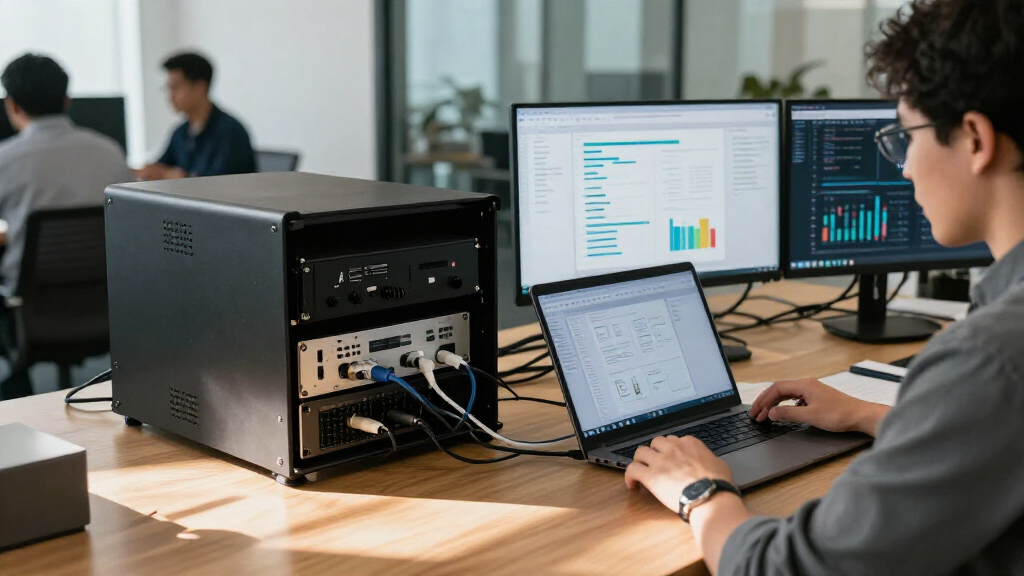
During a question-and-answer session on IBM’s third-quarter earnings call, Krishna said open models could cost “25% to 10% of the token cost of the frontier models” while being “90% as effective.” He said a large enterprise could start with two or three racks. The examples he gave included summarizing email, reviewing contracts, answering customer calls and drafting messages—work he said may not require the most capable model.
Krishna also framed local deployment as a control issue. He said banks and trading firms may want to run AI “in a way that is sovereign,” so outside parties cannot access underlying data or logs. Open-weight models, he said, give organizations permission and intellectual-property rights to run models on premises or in private clouds. IBM has a commercial interest in this argument: it sells on-premises systems and expects AI demand to support sales of its Spyre accelerator cards.
The comparison cited in the source material used the Artificial Analysis Intelligence Index, which applies the same ten evaluations across models and distinguishes downloadable weights. Read on October 26, the index listed MiMo-V2.6-Pro at 46.3 as the top model with downloadable weights and Claude Opus 5.5 at 57.6 as the top proprietary model. That makes the open model about 80% of the leader on this index, not 90%. The index’s values are benchmark scores, not a direct measure of performance on every company’s work.
IBM's 90% claim, checked
Open weights reach 80% of the leader
Krishna says open-weight models are "90% as effective". On an independent index the best model you can download today reaches 80% of the best closed one, up from about half two years ago.
Best open model as a share of the best closed
Artificial Analysis Intelligence Index, current version, best downloadable vs. best proprietary model at each date.
What Krishna said
Illustrations from the earnings call, not a named benchmark.
- Late 2024"70" vs. "20 or 30"Krishna, Q3 call, 21 Oct · no named benchmark
- Late 2025"70 to 50"Krishna, Q3 call, 21 Oct · no named benchmark
- Now"90% as effective"Krishna, Q3 call, 21 Oct · no named benchmark
Top downloadable models today
Intelligence Index score and licence type. Read the licence before the leaderboard.
| Model | Index | Licence |
|---|---|---|
| MiMo-V2.6-Pro Xiaomi | 46.3 | MIT |
| DeepSeek V4.1 Flash 1017 DeepSeek | 45.1 | MIT |
| GLM-5.3 Z AI | 44.8 | own commercial licence |
| Step 5 Preview StepFun | 43.7 | own commercial licence |
| Muse Spark Open Meta | 38.9 | licence with conditions |
In points the gap did not shrink: 7.5 points at the end of 2024, 11.3 today. Closed models moved too.
Sources: Artificial Analysis, Intelligence Index v4.3.2 (read 26 Oct 2026), IBM Q3 2026 earnings call transcript (21 Oct 2026), Artificial Analysis on Kimi K3.1 Pro (23 Oct 2026).
Powered by Thorsten Meyer AI
The Economics of Owning AI Hardware
Krishna’s “volume bet” is that a company can make fixed infrastructure costs worthwhile by running enough AI work through its own equipment. The source’s price comparison illustrates why utilization matters: an eight-GPU H200 server lists from $172,643, while renting the same GPU class on AWS is listed at $63.30 per hour. On those figures, purchase cost is recouped in about 114 days at full load, but takes about 15 months at 25% load. Those are simplified estimates, before staffing, cooling and networking.
That difference can change a procurement decision. A company with steady, predictable workloads may be able to keep expensive accelerators busy and spread their cost across many requests. A business with irregular demand could pay for idle capacity, while also taking responsibility for maintenance and the people needed to operate the systems. Krishna acknowledged that expertise is part of the constraint, asking, “Where are my kernel engineers? Where are the people who worry about the underlying network?”
The same trade-off applies to model quality and price. Lower inference costs may make open models attractive for routine internal tasks, while more demanding work still goes to a proprietary service. But benchmark scores cannot establish that any particular open model will handle a company’s tasks accurately, safely or cheaply enough. Enterprises need to account for evaluation, integration and operating costs, not just the price per token.
Popular right now

TCL 85 Designer Series QD-Mini LED TV (Model 85A400U) with Google Smart TV

Shark AI Ultra Robot Vacuum with Self-Empty Base

Bose QuietComfort Headphones (2nd Gen), Wireless Noise-Cancelling Over-Ear Headphones, Eucalyptus Green
As an affiliate, we earn on qualifying purchases.
How Open Models Compare Today
The Artificial Analysis figures cited in the source show the open-to-proprietary score ratio rising from 51% at the end of 2024 to 74% at the end of 2025, 68% at the end of June 2026 and 80% on October 26, 2026. The trend supports Krishna’s broad point that downloadable models have narrowed the benchmark gap. It does not establish his “90%” figure as a general result: the current score difference is 11.3 points, compared with 7.5 points at the end of 2024, because the proprietary leader also improved.
One model could alter the comparison if its weights become available. Kimi K3.1 Pro scored 55.1 on the cited index, close to Claude Opus 5.5’s 57.6, but Moonshot had only promised to release the weights “by Nov 4.” Until they are released, it is not an open-weight model. The source also notes that Kimi is a 2.8-trillion-parameter model, which may require data-centre-scale resources to run.
Licensing is another part of the decision. The source identifies MiMo-V2.6-Pro and DeepSeek V4.1 Flash 1017 as MIT-licensed, while other models have custom or conditional terms. A model’s weights being downloadable does not automatically mean every commercial use is unrestricted; organizations need to check the specific licence as well as the benchmark and hardware requirements.
What the Cost Claims Leave Out
The figures do not establish that on-premises AI will be cheaper for every enterprise. The server payback estimate excludes staff, cooling and networking, and it depends on utilization. The source does not provide a full cost model for those items or comparable workloads, so the listed purchase and rental prices should be treated as a narrow hardware comparison rather than a complete ownership calculation.
Krishna’s “90%” claim is not tied to a named benchmark in the reported remarks. The Artificial Analysis comparison offers one independent reference point, but it cannot determine how models perform on a particular company’s documents, customer requests or compliance requirements. The source also reports IBM’s claim that its llm-d project can run large models at five to ten times lower cost, but says that claim could not be independently checked.
Prices and model availability can change, and Kimi K3.1 Pro’s promised weight release was still pending on October 26. IBM’s commercial interest is also relevant when weighing its projections: the source notes that IBM expects on-premises demand to help Spyre sales and that mainframe revenue fell 20% in the quarter. Neither point by itself verifies or disproves the broader economics of local AI.
The Next Tests for On-Prem AI
The near-term test is whether promised model weights arrive and what their licences permit. Moonshot’s stated target was November 4 for Kimi K3.1 Pro; until release, its score should not be counted as an available open-weight option. Enterprises considering local deployment will also need to compare models against their own tasks and measure performance at realistic request volumes.
IBM’s argument will be tested through customer deployments and the costs of running them, including accelerator utilization, networking, cooling and specialist staff. The source provides Krishna’s recommendation and illustrative hardware prices, but not evidence that a broad set of customers has achieved the projected savings. Further disclosures about IBM’s AI infrastructure business and independently measured operating costs would help show how often the volume case holds.
Key Questions
What does IBM mean by a volume bet on on-premises AI?
It means buying and operating AI hardware can make financial sense if a company runs enough work on it to keep the equipment busy. The cited estimates show a much longer payback at 25% utilization than at full load.
Did the benchmark show open models are 90% as capable?
No. The October 26 Artificial Analysis comparison cited in the source put the leading downloadable model at 46.3 and the leading proprietary model at 57.6, or about 80% by score. The 90% figure was Krishna’s claim, not the result of that comparison.
Why might an enterprise run a model on its own infrastructure?
Krishna cited control over sensitive data and logs, as well as potentially lower token costs. Local deployment also gives the organization responsibility for its hardware, software, staffing and security.
Does buying an H200 server automatically cost less than renting GPUs?
No. The source’s payback estimate depends on utilization and excludes staff, cooling and networking. Companies with intermittent workloads may find renting more practical, while steady workloads may make ownership more attractive.
Is Kimi K3.1 Pro an open-weight model?
Not as of the October 26, 2026 information in the source. Moonshot had promised to release its weights by November 4, but the weights had not yet shipped.
Source: ThorstenMeyerAI.com