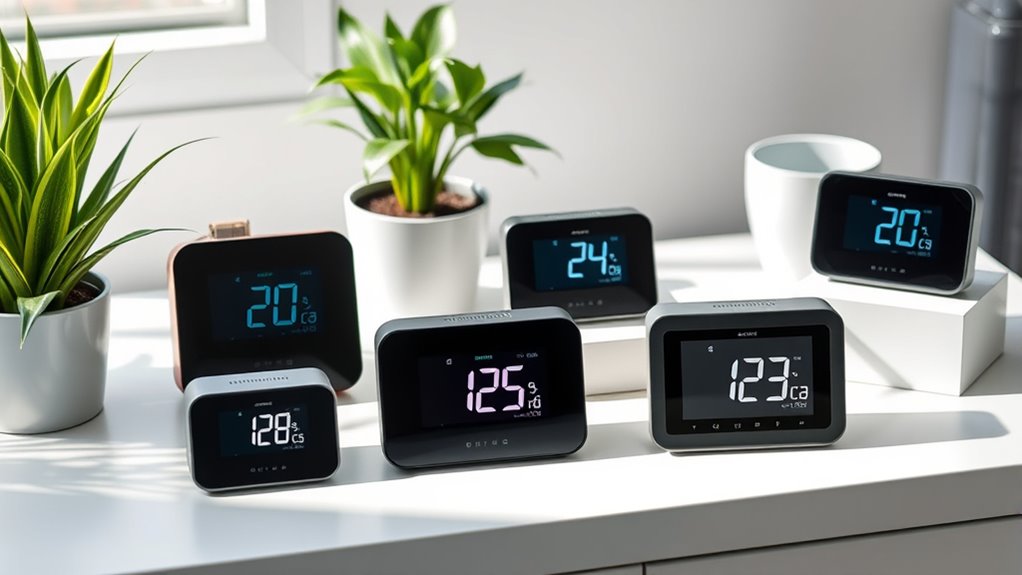

An air quality monitor with a CO2 sensor can help you spot when a room needs fresh air, but the right pick depends on which readings and features matter to you. I rank the Aranet4 as the best overall for focused, portable CO2 tracking, while the SwitchBot Meter Pro CO2 stands out for connected home monitoring and the Lecoolife 16-in-1 for its large display and broader sensor lineup. The main tradeoff is between a dedicated CO2 monitor, which can keep readings easy to interpret, and a multi-sensor unit, which tracks more conditions but may add complexity. Sensor type, portability, display readability, and app features also separate these options. Read on for the full breakdown and help matching a monitor to your space.

Get business pricing on monitors, keyboards and dev gear
- Business-only prices and quantity discounts
- Tax-exempt purchasing
- Multiple users, one account, clear invoices
Key Takeaways
The Aranet4 leads for focused CO2 monitoring: its dedicated, portable format suits buyers who want to follow CO2 levels without sorting through a long list of air-quality readings.
Large-screen models favor at-a-glance awareness: the Lecoolife 16-in-1 and the separate 7-inch 16-in-1 monitor are aimed at readers who prefer a prominent display and multiple measurements in one place.
More sensors do not automatically mean a better CO2 monitor: 10-in-1 and 16-in-1 models cover more indoor conditions, but buyers should check which readings they will use and whether the display remains easy to read.
Portable models suit room-to-room checks: the Temtop portable CO2 monitor and Lwyinp 5-in-1 are more relevant when placement changes matter than a wall-plug design or a large stationary display.
Smart features serve a different purpose from standalone readings: SwitchBot and GoveeLife appeal to buyers who want connected monitoring, while a simpler meter may be a better fit for someone who mainly needs a clear local CO2 reading.
| Plug-in CO2 Detector Wall, 3-in-1 Air Quality Monitor with Digital Display |  | Best Plug-In CO2 Pick | Power: Plug-in; no batteries | Measurements: CO2, temperature, and humidity | Sensor type: NDIR | VIEW ON AMAZON | See Our Full Breakdown |
| SwitchBot Meter Pro CO2 Indoor Air Quality Monitor |  | Best for Flexible Placement | Measurements: CO2, temperature, and humidity | CO2 range: 400–9000 ppm | CO2 accuracy: ±(50 ppm + 5% of reading) | VIEW ON AMAZON | See Our Full Breakdown |
| YNAK 16-in-1 Indoor Air Quality Monitor with 5.5-Inch Display | 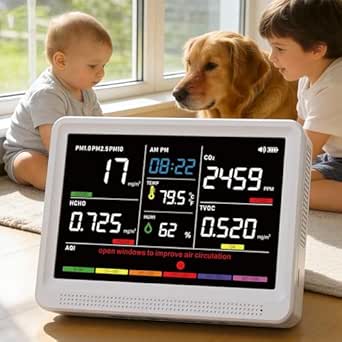 | Best for Broad Pollutant Checks | Monitored parameters: CO2, PM2.5, PM1.0, PM10, HCHO, TVOC, temperature, humidity, and AQI | Display: 5.5-inch LED screen | Battery capacity: 2500mAh | VIEW ON AMAZON | See Our Full Breakdown |
| AirKnight Premium 10-in-1 Indoor Air Quality Monitor with VOC, CO2, Formaldehyde, AQI, PM2.5/PM10, Temperature & Humidity Sensors |  | Best for Portable Multi-Reading Use | Sensors: CO2, PM2.5, PM10, TVOC, formaldehyde, temperature, humidity, and AQI | Display: Large LCD screen | Battery: 3000mAh rechargeable lithium-polymer | VIEW ON AMAZON | See Our Full Breakdown |
| ZEMEOLLO 10-in-1 Indoor Air Quality Monitor |  | Best for Longer Cordless Sessions | Model: ZLJC2 | Measurements: CO2, HCHO, TVOC, benzene, PM2.5, PM10, temperature, AQI, and PM0.3–1 | Display: Color LED screen | VIEW ON AMAZON | See Our Full Breakdown |
| GoveeLife H5140 Smart Air Quality Monitor and CO₂ Detector |  | Best for Connected CO₂ Tracking | CO₂ sensor: SCD4x photoacoustic NDIR | CO₂ accuracy: ±(40 ppm + 5%) | Refresh rate: 5 seconds | VIEW ON AMAZON | See Our Full Breakdown |
| Lwyinp 10-in-1 Indoor Air Quality Monitor |  | Best for Broad Portable Readings | Model: MT13S | Measurements: CO₂, HCHO, TVOC, AQI, PM2.5, PM1.0, PM10, temperature, humidity, clock | Connectivity: Bluetooth | VIEW ON AMAZON | See Our Full Breakdown |
| Lwyinp 5-in-1 Portable Air Quality Monitor |  | Best for a Compact Five-Metric Check | Model: M08A | Measurements: CO₂, HCHO, TVOC, temperature, humidity | Sensor technology: NDIR and electrochemical | VIEW ON AMAZON | See Our Full Breakdown |
| Zemeollo 10-in-1 Smart Indoor Air Quality Monitor |  | Best for Cord-Free Local Monitoring | Model: FAS-SA2 | Listed sensors: CO₂, HCHO, TVOC, benzene, PM2.5, PM10, temperature, AQI | Accuracy: Error margin under ±5% | VIEW ON AMAZON | See Our Full Breakdown |
| Temtop Portable Indoor CO₂ Monitor with Temperature and Humidity |  | Best for Specified CO₂ Readings | Model: C1-JP | Sensor: NDIR | CO₂ range: 400–5000 ppm | VIEW ON AMAZON | See Our Full Breakdown |
| Lecoolife 16-in-1 Indoor Air Quality Monitor with 7″ Display and NDIR CO2 Sensor |  | Best for Broad Air-Quality Coverage | Model: AK22B | Display: 7 inches; adjustable brightness | Sensor technology: NDIR CO2 sensor | VIEW ON AMAZON | See Our Full Breakdown |
| 16-in-1 Indoor Air Quality Monitor with 7-Inch Display |  | Best for Simple, Large-Screen Monitoring | Display: 7-inch LED | Monitored readings: CO2, PM2.5, PM1.0, PM10, HCHO, TVOC, temperature, humidity, and AQI | Display brightness: Three settings | VIEW ON AMAZON | See Our Full Breakdown |
| CO2 Monitor for Home – Photoacoustic Sensor |  | Best for CO2-Focused Home Monitoring | Model: UN0601S | Sensor: Swiss-made photoacoustic CO2 sensor | CO2 detection range: 400–5000 ppm | VIEW ON AMAZON | See Our Full Breakdown |
| Aranet4 Indoor Air Quality Monitor |  | Best Premium Compact Monitor | Sensor: NDIR | Measurements: CO2, temperature, relative humidity, and atmospheric pressure | Display: E-ink | VIEW ON AMAZON | See Our Full Breakdown |
| air quality monitor co2 sensor | Display | Measurements | Model |
|---|---|---|---|
| Plug-in CO2 Detector Wall | 1.83-inch color screen; three brightness settings | CO2, temperature, and humidity | — |
| SwitchBot Meter Pro CO2 Indoor | — | CO2, temperature, and humidity | — |
| YNAK 16-in-1 Indoor Air Qualit | 5.5-inch LED screen | — | — |
| AirKnight Premium 10-in-1 Indo | Large LCD screen | — | — |
| ZEMEOLLO 10-in-1 Indoor Air Qu | Color LED screen | CO2, HCHO, TVOC, benzene, PM2.5, PM10, temperature, AQI, and PM0.3–1 | ZLJC2 |
| GoveeLife H5140 Smart Air Qual | — | CO₂, temperature, humidity | — |
| Lwyinp 10-in-1 Indoor Air Qual | High-definition color screen with 3-color air-quality indicators | CO₂, HCHO, TVOC, AQI, PM2.5, PM1.0, PM10, temperature, humidity, clock | MT13S |
| Lwyinp 5-in-1 Portable Air Qua | High-definition color screen with 3-color visualization | CO₂, HCHO, TVOC, temperature, humidity | M08A |
| Zemeollo 10-in-1 Smart Indoor | HD LED color screen | — | FAS-SA2 |
| Temtop Portable Indoor CO₂ Mon | — | — | C1-JP |
| Lecoolife 16-in-1 Indoor Air Q | 7 inches; adjustable brightness | — | AK22B |
| 16-in-1 Indoor Air Quality Mon | 7-inch LED | — | — |
| CO2 Monitor for Home | — | — | UN0601S |
| Aranet4 Indoor Air Quality Mon | E-ink | CO2, temperature, relative humidity, and atmospheric pressure | — |
More Details on Our Top Picks
Plug-in CO2 Detector Wall, 3-in-1 Air Quality Monitor with Digital Display
I’d choose this plug-in model for a fixed room where I want a quick CO2 check without keeping another device charged. Its NDIR sensor refreshes every two seconds, and the display also shows temperature and humidity, giving useful context when a room feels stuffy. The adjustable 85dB alarm and flashing light can make rising CO2 harder to miss than on a monitor that relies on occasional screen checks. Compared with the battery-powered SwitchBot Meter Pro CO2, this one is simpler to power but less flexible to position: it needs a wall outlet and has no stated app connection. Its 60g body and universal voltage suit travel, though outlet placement may put the screen at an awkward height. It detects CO2, not carbon monoxide, so it cannot replace a CO alarm.
Pros:- NDIR CO2 sensing with readings refreshed every two seconds
- Shows CO2, temperature, and humidity together
- Customizable audible and flashing-light alarm
- No battery charging or replacement needed
Cons:- Must be positioned at a wall outlet, limiting placement flexibility
- Monitors CO2 only and does not detect carbon monoxide
- No app or remote notification feature is specified
Best for: People who want a continuously powered CO2, temperature, and humidity display in a room with a convenient wall outlet.
Not ideal for: Buyers who need a portable monitor they can place on a desk, or anyone seeking carbon monoxide detection or app-based alerts.
- Power:Plug-in; no batteries
- Measurements:CO2, temperature, and humidity
- Sensor type:NDIR
- CO2 accuracy:±5% from 400–4999 ppm
- Refresh rate:2 seconds
- Display:1.83-inch color screen; three brightness settings
- Alarm:85dB sound and flashing red light; adjustable threshold
- Voltage and weight:110–240V; 60g
Our verdict“Pick this for straightforward, always-powered CO2 monitoring near an outlet, but choose the SwitchBot Meter Pro if portable placement matters more.”
SwitchBot Meter Pro CO2 Indoor Air Quality Monitor
The SwitchBot Meter Pro suits buyers who want CO2 readings where they actually spend time, rather than being tied to an outlet. Its rechargeable battery is rated for up to 12 months, and the unit can sit on its adjustable bracket or mount on a wall. A large display combines CO2 with temperature, humidity, date, time, and a comfort indicator, making it more informative at a glance than the simpler plug-in CO2 detector. Its one-second response and Swiss-made NDIR sensor are useful for tracking changing room conditions, while app notifications add remote awareness only if paired with a SwitchBot Hub. That extra hub requirement is the main catch: compared with the AirKnight AT1000, this offers a defined smart-home route, but neither is a broad substitute for a dedicated multi-pollutant monitor. Battery charging details are not specified.
Pros:- Swiss-made NDIR sensor with one-second response time
- Portable placement with wall-mount holes and adjustable bracket
- Battery life rated for up to 12 months
- Large display includes environmental readings and comfort information
Cons:- App notifications require a separate SwitchBot Hub
- Battery type and charging method are not specified
- Does not list particulate, VOC, or formaldehyde measurements
Best for: Homeowners or office users who want a movable CO2 monitor with a long stated battery life and already use, or plan to add, a SwitchBot Hub.
Not ideal for: People who want app alerts without buying a hub, or buyers prioritizing PM, VOC, or formaldehyde measurements in the same device.
- Measurements:CO2, temperature, and humidity
- CO2 range:400–9000 ppm
- CO2 accuracy:±(50 ppm + 5% of reading)
- Sensor and response:Swiss-made NDIR sensor; 1-second response
- Temperature accuracy:±0.2 °C / 0.36 °F
- Humidity accuracy:±1.8% RH
- Power:Rechargeable battery; rated for up to 12 months
- Mounting and size:Wall mount or adjustable bracket; 3.62 × 3.62 × 0.98 inches
- Connectivity:App notifications require a SwitchBot Hub
Our verdict“Choose this for flexible, long-running CO2 monitoring and SwitchBot integration, provided you accept the hub requirement for app alerts.”
YNAK 16-in-1 Indoor Air Quality Monitor with 5.5-Inch Display
I’d put the YNAK on the shortlist when CO2 is one part of a wider indoor-air check. Alongside CO2, it lists PM1.0, PM2.5, PM10, formaldehyde, TVOC, temperature, humidity, and AQI, so it covers more categories than the SwitchBot Meter Pro, which focuses on CO2 and basic comfort readings. The 5.5-inch display makes those measurements easier to scan, and the rechargeable battery provides up to 10 hours of cordless use for moving it between rooms. That runtime is practical for spot checks, but it falls well short of the SwitchBot’s stated battery life and means regular charging for all-day use. The description also cautions that touching sensors or exposure to strong odors may affect accuracy, and it does not provide CO2 accuracy figures. I’d treat the extra sensor list as breadth, not a substitute for documented precision.
Pros:- Tracks CO2 plus particulate matter, formaldehyde, and TVOC
- Large 5.5-inch display with adjustable brightness
- Audible alerts include a mute option
- USB-C charging and up to 10 hours of cordless use
Cons:- Cordless runtime is limited to up to 10 hours per charge
- CO2 measurement accuracy is not specified in the supplied product data
- Sensor readings may be affected by touching the sensors or strong odors
Best for: People who want one portable screen to check CO2 alongside particulates, VOCs, and formaldehyde in different rooms.
Not ideal for: Buyers who need a published CO2 accuracy specification or uninterrupted cordless monitoring beyond a short session.
- Monitored parameters:CO2, PM2.5, PM1.0, PM10, HCHO, TVOC, temperature, humidity, and AQI
- Display:5.5-inch LED screen
- Battery capacity:2500mAh
- Cordless runtime:Up to 10 hours
- Charging:USB-C; adapter included
- Temperature accuracy:±1 to ±3 °F
- Humidity accuracy:±2% to ±3% RH
- Alerts:Audible alerts with mute option
Our verdict“Choose the YNAK when broad pollutant coverage and a large display matter more than long battery life or clearly stated CO2 accuracy.”
AirKnight Premium 10-in-1 Indoor Air Quality Monitor with VOC, CO2, Formaldehyde, AQI, PM2.5/PM10, Temperature & Humidity Sensors
The AirKnight AT1000 is a good fit for buyers who want a portable monitor for more than CO2, but prefer a straightforward LCD and plug-and-play setup over a large, elaborate interface. It lists CO2, PM2.5, PM10, TVOC, formaldehyde, temperature, humidity, and AQI, giving it a wider pollutant scope than the SwitchBot Meter Pro. Its 3000mAh rechargeable battery supports moving the unit among a home, classroom, office, or car, although the supplied information does not state a runtime, so I can’t compare endurance directly with the YNAK’s up-to-10-hour rating. Unlike the SwitchBot, it has no stated app or wireless monitoring, which keeps the experience local to the device. Support and an optional extended warranty may reassure buyers, but the listed data gives no sensor accuracy figures for judging measurement precision.
Pros:- Displays CO2 alongside particulate, VOC, formaldehyde, and comfort readings
- Portable design with a 3000mAh rechargeable battery
- Plug-and-play setup and large LCD screen
- US-based phone support and optional extended warranty
Cons:- No wireless connectivity or dedicated app for remote monitoring
- Battery runtime is not specified in the supplied product data
- Sensor accuracy figures are not provided
Best for: People who want a portable, local-readout monitor for CO2 and several other air indicators across rooms or shared spaces.
Not ideal for: Buyers who need remote app alerts, published sensor accuracy, or a confirmed cordless runtime before choosing a monitor.
- Sensors:CO2, PM2.5, PM10, TVOC, formaldehyde, temperature, humidity, and AQI
- Display:Large LCD screen
- Battery:3000mAh rechargeable lithium-polymer
- Format:Portable handheld unit
- Setup:Plug and play
- Wireless connectivity:No app or wireless connectivity listed
- Support:US-based phone support
- Warranty:Free extended warranty available
Our verdict“Pick the AirKnight for portable, broad air-quality readings with local operation, but skip it if app access or documented accuracy is a priority.”
ZEMEOLLO 10-in-1 Indoor Air Quality Monitor
The ZEMEOLLO stands out for buyers who want to move a multi-sensor monitor around without plugging it in every few hours. Its 2000mAh battery is rated for up to 20 hours, double the YNAK’s stated cordless runtime, making it the stronger choice for a long day of room-to-room checks. The color screen reports CO2 alongside HCHO, TVOC, benzene, PM2.5, PM10, temperature, AQI, and PM0.3–1, with threshold alerts to call attention to readings. That breadth is useful, but the supplied data does not give accuracy figures for each sensor, so buyers focused on dependable CO2 measurements have less to evaluate than they do with the SwitchBot Meter Pro. It also defaults to Celsius; switching units takes a button press. I’d choose it for runtime and coverage, not for a documented accuracy advantage.
Pros:- Battery rated for up to 20 hours of use
- Measures CO2 and a broad set of additional air indicators
- Color display shows readings and threshold alerts
- Portable design with USB charging
Cons:- Accuracy figures are not specified for every sensor
- Temperature defaults to Celsius and requires a button press to switch units
- No app or remote monitoring feature is listed
Best for: People who need a cordless, multi-indicator monitor for extended checks across rooms or locations during the day.
Not ideal for: Buyers who require published accuracy specifications for CO2 and other sensors, or who want app-based remote monitoring.
- Model:ZLJC2
- Measurements:CO2, HCHO, TVOC, benzene, PM2.5, PM10, temperature, AQI, and PM0.3–1
- Display:Color LED screen
- Battery capacity:2000mAh
- Battery life:Up to 20 hours
- Charging:USB charging cable
- Temperature units:Celsius and Fahrenheit; Celsius is the default
- Color:White
Our verdict“Choose the ZEMEOLLO for longer cordless sessions and wide sensor coverage, but favor the SwitchBot if stated CO2 accuracy matters more.”
GoveeLife H5140 Smart Air Quality Monitor and CO₂ Detector
The GoveeLife H5140 is the strongest fit here for buyers who want CO₂ readings tied to alerts and long-term records, rather than a broad survey of pollutants. Its SCD4x photoacoustic NDIR sensor refreshes every five seconds, while app, buzzer, and email alerts can make rising CO₂ easier to act on. The option to export up to two years of history as CSV is a clearer record-keeping advantage than the local-only display on the Zemeollo FAS-SA2. It also shows temperature and humidity, but it does not measure particles or gases such as formaldehyde. The tradeoff is continuous AC power; unlike the portable Zemeollo, it is better suited to a fixed room. The clock also depends on an app connection, and outdoor app calibration may be needed.
Pros:- SCD4x photoacoustic NDIR CO₂ sensing with a five-second refresh rate
- Buzzer, app, and email alert options
- Stores up to two years of history and supports CSV export
- Measures temperature and humidity alongside CO₂
Cons:- Requires continuous AC power, limiting portable use
- Clock display requires an app connection
- Outdoor app calibration may be needed
Best for: People monitoring ventilation in a fixed home office, classroom, or bedroom who want app alerts and exportable CO₂ history.
Not ideal for: Buyers who need a battery-powered monitor, broad pollutant detection, or a clock that works without an app connection.
- CO₂ sensor:SCD4x photoacoustic NDIR
- CO₂ accuracy:±(40 ppm + 5%)
- Refresh rate:5 seconds
- Measurements:CO₂, temperature, humidity
- Power:AC outlet
- Connectivity:App, Alexa, Google Assistant
- Data history:Up to 2 years; CSV export
Our verdict“Choose the GoveeLife H5140 for fixed-room CO₂ monitoring with alerts and exportable history, but skip it if portability or multi-pollutant sensing matters more.”
Lwyinp 10-in-1 Indoor Air Quality Monitor
The Lwyinp MT13S suits buyers who want CO₂ alongside a wide range of air-quality indicators in a portable unit. It lists CO₂, formaldehyde, TVOC, AQI, PM1.0, PM2.5, PM10, temperature, and humidity, with a color-changing display for quick checks. That breadth gives it a different job from the GoveeLife H5140, which offers clearer app alerts and long-term data but covers fewer measurements. The MT13S is described for use at home, in vehicles, or at work, making it the more flexible choice for moving between spaces. However, its Bluetooth connection is needed to calibrate the clock, and the provided details do not give battery life or measurement ranges. Buyers who need confidence in those specifics may prefer a model with more documented CO₂ performance.
Pros:- Lists CO₂, formaldehyde, TVOC, AQI, three particle sizes, temperature, and humidity
- Three-color indicators make threshold changes easier to spot
- Portable design is described for home, vehicle, and workplace use
- Includes sound controls
Cons:- Battery life and measurement ranges are not specified
- Bluetooth is required to calibrate the clock
- The listed features do not include app alerts or data export
Best for: People who want a portable, at-a-glance check of CO₂, particles, and several other air-quality readings across multiple indoor spaces.
Not ideal for: Buyers who need stated CO₂ accuracy, measurement ranges, battery-life details, app-based remote monitoring, or exportable records.
- Model:MT13S
- Measurements:CO₂, HCHO, TVOC, AQI, PM2.5, PM1.0, PM10, temperature, humidity, clock
- Connectivity:Bluetooth
- Display:High-definition color screen with 3-color air-quality indicators
- Power setup:Rechargeable; charging cable included
- Color:Black
Our verdict“Pick the Lwyinp MT13S if pollutant breadth and portability matter more than documented CO₂ accuracy or connected tracking.”
Lwyinp 5-in-1 Portable Air Quality Monitor
The Lwyinp M08A keeps its measurement set focused: CO₂, formaldehyde, TVOC, temperature, and humidity. Its stated NDIR and electrochemical sensor technologies and color-screen indicators give buyers a simple way to check several indoor conditions without the MT13S’s longer list of particle and AQI readings. Compared with the GoveeLife H5140, this Lwyinp is described as portable and includes pollutant measurements beyond CO₂, while GoveeLife is the better-documented pick for alerts, app features, and historical records. The M08A’s tradeoff is less detail about CO₂ performance: the supplied specifications do not state accuracy, range, refresh rate, or battery runtime. Basic functions such as switching units also require button presses, so it is less convenient for buyers who want hands-off monitoring.
Pros:- Measures CO₂, HCHO, TVOC, temperature, and humidity
- Specifies NDIR and electrochemical sensor technologies
- Color display uses three colors to signal air-quality status
- Portable format is described for homes, offices, and cars
Cons:- CO₂ accuracy, range, refresh rate, and battery runtime are not specified
- Basic functions such as unit switching require manual button presses
- No app connectivity or historical data features are listed
Best for: People seeking a portable, straightforward monitor for CO₂, formaldehyde, and TVOC in a home, office, or car.
Not ideal for: Buyers who need published CO₂ accuracy and range, long-term data, app alerts, or particle measurements.
- Model:M08A
- Measurements:CO₂, HCHO, TVOC, temperature, humidity
- Sensor technology:NDIR and electrochemical
- Display:High-definition color screen with 3-color visualization
- Charging:USB charging
- Included items:Monitor, charging cable, user manual
- Color:Black
Our verdict“Choose the M08A for a portable five-metric snapshot, but choose the GoveeLife H5140 if connected alerts and recorded CO₂ trends are priorities.”
Zemeollo 10-in-1 Smart Indoor Air Quality Monitor
The Zemeollo FAS-SA2 is the clearest choice in this group for buyers who want battery-powered, multi-pollutant readings without relying on an app. Its listed sensors cover CO₂, formaldehyde, TVOC, benzene, PM2.5, PM10, temperature, and AQI, while the 2000mAh battery is specified for up to 20 hours of continuous use. That makes it easier to carry between rooms than the AC-powered GoveeLife H5140, though GoveeLife offers app alerts and up to two years of exportable history that Zemeollo does not. The color display and one-click startup favor quick local checks; they do not replace remote notifications or record keeping. The supplied accuracy figure is an error margin under ±5%, but no separate CO₂ range or sensor technology is given.
Pros:- Lists CO₂, HCHO, TVOC, benzene, PM2.5, PM10, temperature, and AQI
- Rechargeable 2000mAh battery is specified for up to 20 hours
- Color LED screen gives local visual alerts
- One-click startup is described as beginning automatic detection
Cons:- No app connectivity or data export is listed
- CO₂ range and sensor technology are not specified
- Battery runtime requires recharging for extended or continuous use
Best for: People who want to move a multi-pollutant monitor between rooms or locations and check readings directly on the device.
Not ideal for: Buyers who need app-based alerts, data export, a stated CO₂ range, or continuous monitoring without recharging.
- Model:FAS-SA2
- Listed sensors:CO₂, HCHO, TVOC, benzene, PM2.5, PM10, temperature, AQI
- Accuracy:Error margin under ±5%
- Display:HD LED color screen
- Battery:2000mAh rechargeable lithium
- Battery life:Up to 20 hours
- Connectivity and charging:USB charging; app connectivity not listed
- Temperature units:Celsius/Fahrenheit switchable
Our verdict“Choose the FAS-SA2 for portable, local checks across several pollutants; choose the GoveeLife H5140 for connected alerts and lasting CO₂ records.”
Temtop Portable Indoor CO₂ Monitor with Temperature and Humidity
The Temtop C1-JP earns its place for buyers who want clearly stated CO₂ range, resolution, and refresh rate in a portable monitor. Its NDIR sensor covers 400–5000 ppm, resolves readings to 1 ppm, and updates every five seconds; those details make it easier to judge whether the device suits a particular monitoring task than the Lwyinp M08A, whose supplied data omits CO₂ range and accuracy. Temtop also tracks temperature and humidity, supports configurable alerts, and offers dimmable illumination and multiple mounting options. Its stated accuracy applies from 400–2500 ppm, so it should not be read as the same accuracy claim across the full range. This is a focused CO₂ monitor rather than a broad pollutant tester, and it does not detect carbon monoxide. For real-time monitoring, the description advises using it while plugged in.
Pros:- NDIR CO₂ sensor with a stated 400–5000 ppm range
- 1 ppm CO₂ resolution and five-second refresh rate
- Configurable alerts and dimmable display illumination
- Portable design with multiple mounting options and up to 70 days of standby battery life
Cons:- Does not detect carbon monoxide
- Real-time monitoring is advised while plugged in
- The stated accuracy applies to 400–2500 ppm, not the full listed range
Best for: People who prioritize documented CO₂ range and resolution, with temperature and humidity readings for a home, office, or other indoor space.
Not ideal for: Buyers who need carbon monoxide detection, formaldehyde or particle readings, or confidence in continuous unplugged operation.
- Model:C1-JP
- Sensor:NDIR
- CO₂ range:400–5000 ppm
- CO₂ accuracy:±40 ppm + 5% of reading (400–2500 ppm)
- CO₂ resolution and refresh:1 ppm; 5 seconds
- Temperature and humidity ranges:-10°C to 60°C; 0–99% RH
- Standby battery life:Up to 70 days
- Carbon monoxide detection:Not supported
Our verdict“Choose the Temtop C1-JP for a focused CO₂ monitor with detailed published readings, but not for carbon monoxide or broad pollutant detection.”
Lecoolife 16-in-1 Indoor Air Quality Monitor with 7″ Display and NDIR CO2 Sensor
The Lecoolife is the strongest fit here for buyers who want CO2 alongside a broad set of indoor pollutants, rather than a dedicated carbon-dioxide readout alone. Its 7-inch display gives multiple readings room to remain legible, and the NDIR CO2 sensor, adjustable brightness, and buzzer with mute function make it suited to a shared living or work space where readings need to be seen and acted on. Compared with the U UNNI CO2 Monitor, it tracks more categories, including particulate matter and formaldehyde; the U UNNI keeps the focus on CO2, temperature, and humidity. That breadth brings more sensor-care demands: strong odors can affect readings, and manual calibration may be needed. Choose it for an at-a-glance overview, not if you want a minimal, low-maintenance CO2 monitor.
Pros:- NDIR sensor technology for CO2 monitoring
- Tracks a wide range of air-quality and environmental metrics
- Large 7-inch display has adjustable brightness
- Real-time buzzer alerts can be muted
Cons:- Strong odors or perfumes may contaminate or affect sensor readings
- May need periodic manual calibration to maintain accuracy
Best for: Households or small offices that want CO2 readings plus particulate, formaldehyde, TVOC, temperature, and humidity data on one large screen.
Not ideal for: Buyers who mainly need simple CO2 tracking or do not want to keep the sensors away from strong odors and handle periodic calibration.
- Model:AK22B
- Display:7 inches; adjustable brightness
- Sensor technology:NDIR CO2 sensor
- Monitored metrics:CO2, PM1.0, PM2.5, PM10, HCHO, TVOC, temperature, humidity, and AQI
- Alerts:Real-time buzzer alerts with mute function
- Weight:1.5 pounds
- Package dimensions:8.03 x 5.75 x 2.83 inches
Our verdict“Choose the Lecoolife if you want a large-screen overview of CO2 and multiple indoor air indicators and can accommodate sensor care.”
16-in-1 Indoor Air Quality Monitor with 7-Inch Display
This model suits buyers who want multiple live air readings on a prominent display without needing an app-based history or a highly specialized CO2 instrument. Its 7-inch LED screen offers three brightness settings, while seven AQI alert functions and a mute option let users adapt notifications to a bedroom, office, or shared room. Compared with the Lecoolife, the listed feature set is less specific about its CO2 sensor technology and calibration, so I would favor the Lecoolife when NDIR is a deciding requirement. This monitor does offer a practical time display with 12- or 24-hour formatting, but time is not an air-quality measurement despite appearing in its parameter list. Keep sensors away from strong odors and avoid touching them; buyers wanting detailed CO2-focused features should compare it with the U UNNI monitor.
Pros:- Displays several air-quality readings in real time
- 7-inch LED screen has three brightness settings
- Seven AQI alert functions and a mute option
- Shows time in either 12-hour or 24-hour format
Cons:- Product details do not identify the CO2 sensor technology
- Sensors need protection from strong odors and handling
- Time is listed among parameters but is not an air-quality measurement
Best for: People who want a large, easy-to-read display for several indoor readings and configurable AQI alerts, without relying on an app.
Not ideal for: Buyers who require a specifically identified CO2 sensor technology, detailed calibration information, or a compact monitor.
- Display:7-inch LED
- Monitored readings:CO2, PM2.5, PM1.0, PM10, HCHO, TVOC, temperature, humidity, and AQI
- Display brightness:Three settings
- AQI alerts:Seven alert functions
- Alarm:Mute option
- Time display:12- or 24-hour format
Our verdict“Pick this monitor for a large display and flexible AQI alerts, but choose a model with specified CO2 sensor details if sensor technology is a priority.”
CO2 Monitor for Home – Photoacoustic Sensor
The U UNNI stands apart from the broad-reading Lecoolife and 16-in-1 display models by putting CO2 monitoring first, with temperature and humidity as useful supporting readings. Its Swiss-made photoacoustic sensor has a stated detection range of 400–5000 ppm and accuracy of ±5% + 50 ppm, giving buyers concrete performance details to compare rather than an unspecified sensor type. Adjustable alarm volume and backlight help tailor it to a quiet bedroom or a brighter work area. USB power keeps it suitable for a fixed spot, while battery backup adds a buffer during power interruptions. Compared with the Aranet4, it provides fewer measurements and no stated app history, but its display, alarm, and backup power address straightforward room monitoring. The tradeoff is a calibration process that may take patience.
Pros:- Photoacoustic CO2 sensor with stated range and accuracy
- Shows CO2, temperature, and humidity in real time
- Three adjustable volume and backlight levels
- USB power with three-AAA battery backup
Cons:- Calibration process may be cumbersome
- Does not list particulate matter, formaldehyde, or TVOC monitoring
- AAA batteries for backup are not included
Best for: Home, RV, or grow-tent owners who want a dedicated CO2 monitor with temperature and humidity readings, audible alerts, and backup power.
Not ideal for: People seeking particulate or VOC monitoring, long-term app graphs, or a calibration process that requires little effort.
- Model:UN0601S
- Sensor:Swiss-made photoacoustic CO2 sensor
- CO2 detection range:400–5000 ppm
- CO2 accuracy:±5% + 50 ppm
- Temperature range:14.2°F–122°F
- Humidity range:20%–95%
- Power:USB with backup for three AAA batteries; batteries not included
- Adjustments:Three volume levels and three backlight levels
Our verdict“Choose the U UNNI for clearly specified, CO2-centered monitoring with useful environmental readings and backup power, if you can manage calibration.”
Aranet4 Indoor Air Quality Monitor
The Aranet4 is the most portable and power-conscious choice in this group for buyers who want CO2 monitoring without a cable on the desk. Its NDIR sensor measures CO2 alongside temperature, relative humidity, and atmospheric pressure; the e-ink display and stated battery life of up to four years suit a monitor that may be moved between rooms or left in place for long periods. Color-coded alerts, an optional buzzer, and app graphs covering up to 90 days add context beyond a momentary reading. Against the U UNNI, the Aranet4 adds pressure readings and app history, while the U UNNI offers a stated CO2 range and accuracy plus USB power with battery backup. The Aranet4’s narrower set of air metrics and reliance on two AA batteries make it a poor fit for buyers who want broad pollutant screening.
Pros:- NDIR sensor measures CO2 in real time
- E-ink screen and battery life of up to four years support cable-free placement
- Color-coded alerts with optional buzzer
- App provides graphs and up to 90 days of history
Cons:- Tracks only CO2, temperature, relative humidity, and atmospheric pressure
- Requires two AA batteries
- App history and graphs are needed for longer-term trend review
Best for: Buyers who want a small, cable-free NDIR CO2 monitor with long battery life, clear alerts, and app-based reading history.
Not ideal for: People who need particulate, formaldehyde, or TVOC readings, or who prefer USB-powered operation over replaceable batteries.
- Sensor:NDIR
- Measurements:CO2, temperature, relative humidity, and atmospheric pressure
- Display:E-ink
- Battery life:Up to four years
- Batteries:Two AA batteries included
- App history:Up to 90 days
- Dimensions:2.76 x 2.76 x 0.94 inches
- Weight:3.67 ounces
Our verdict“Choose the Aranet4 for compact, cable-free CO2 tracking and app history, but look elsewhere for a wider pollutant panel.”

How We Picked
I ranked these monitors by how directly they serve the core need behind the search: understanding indoor CO2 levels. Sensor claims and type, ease of reading the measurement, power and placement options, portability, and the usefulness of any companion app all shaped the order. I also weighed whether a model’s broader sensor set adds practical value or risks crowding the display and making the main CO2 reading harder to find.
The ranking favors products with a clear role rather than treating every extra sensor as an advantage. The Aranet4 comes first as a focused CO2 monitor; connected options such as SwitchBot and GoveeLife suit buyers who value app-based monitoring, while the large-screen multiparameter models fit people who want more measurements visible at once. Portable, plug-in, and less clearly differentiated models rank lower when their strongest use case is narrower or their product information leaves more questions for buyers to resolve. I considered tradeoffs alongside strengths, since a monitor that fits one room and routine may be a poor match for another.
| air quality monitor co2 sensor | Measurements |
|---|---|
| Plug-in CO2 Detector Wall | CO2, temperature, and humidity |
| SwitchBot Meter Pro CO2 Indoor | CO2, temperature, and humidity |
| YNAK 16-in-1 Indoor Air Qualit | — |
| AirKnight Premium 10-in-1 Indo | — |
| ZEMEOLLO 10-in-1 Indoor Air Qu | CO2, HCHO, TVOC, benzene, PM2.5, PM10, temperature, AQI, and PM0.3–1 |
| GoveeLife H5140 Smart Air Qual | CO₂, temperature, humidity |
| Lwyinp 10-in-1 Indoor Air Qual | CO₂, HCHO, TVOC, AQI, PM2.5, PM1.0, PM10, temperature, humidity, clock |
| Lwyinp 5-in-1 Portable Air Qua | CO₂, HCHO, TVOC, temperature, humidity |
| Zemeollo 10-in-1 Smart Indoor | — |
| Temtop Portable Indoor CO₂ Mon | — |
| Lecoolife 16-in-1 Indoor Air Q | — |
| 16-in-1 Indoor Air Quality Mon | — |
| CO2 Monitor for Home | — |
| Aranet4 Indoor Air Quality Mon | CO2, temperature, relative humidity, and atmospheric pressure |
Factors to Consider When Choosing Air Quality Monitor Co2 Sensor
Before choosing a CO2 air quality monitor, decide what decision you want its readings to support: opening a window, comparing rooms, or tracking several indoor conditions. These broader checks can keep you from paying for features that do not improve the way you use the monitor.
Check What the CO2 Sensor Actually Measures
Do not assume that every device called a CO2 monitor measures CO2 in the same way. Look for a stated sensor type, such as NDIR or photoacoustic, and read the product details for how readings are presented and updated. A CO2 reading is useful for tracking changes in a room, but it is not a complete measure of indoor air quality. A monitor that reports VOCs or particles may add context, yet those readings represent different pollutants and should not be treated as interchangeable with CO2. If the product page is vague about its sensor or measurement method, treat that as an information gap rather than filling it with assumptions. Choose a focused sensor when CO2 is your main concern; opt for additional measurements only when you have a plan to use them.
Match the Display to How You Will Check Readings
A monitor’s interface affects whether you will notice a change quickly or ignore the device after setup. Large displays can make readings easier to see across a room, but they take up more space and may show many values at once. Compact units are easier to move or place discreetly, though small screens may require you to stand closer or use an app. Check whether the CO2 value is prominent, whether the screen can be read from your usual viewing distance, and whether alerts rely on color, sound, or notifications. A dense dashboard can be useful for an air-quality hobbyist and distracting for someone who only wants a quick ventilation cue. Prioritize the clearest presentation of the measurement you plan to act on.
Plan for Placement and Room-to-Room Use
Think about where the monitor will live before choosing between a plug-in, tabletop, or portable form. A fixed device can provide a consistent reading in one frequently occupied room, while a portable model can help compare a bedroom, office, and shared living area. Readings are most useful when the monitor is placed where people spend time, not tucked beside a window, vent, or appliance that could distort the local picture. If you expect to move it often, check power requirements and whether it can operate away from an outlet. Buyers who want a whole-home view may need more than one monitoring point rather than repeatedly relocating a single unit. Choose a form factor that fits your routine, not just the room where the product photo places it.
Decide Whether App Connectivity Adds Real Value
Connected features help when you want to check readings remotely, review changes, or fit the monitor into an existing smart-home routine. They add little for buyers who will look at a screen in the room and respond immediately to what it shows. Before choosing an app-enabled model, confirm which features require an account, network access, or a compatible hub, since those details can shape daily use. Also check whether the device still shows useful information if your phone or internet connection is unavailable. A local display paired with an app offers more flexibility than either interface alone, but it can also mean extra setup and notifications. Buy connectivity for a specific habit you expect to keep, not for the feature list alone.
Treat Multi-Sensor Counts as a Starting Point
Models advertised with 10 or 16 measurements may combine environmental readings, pollutant estimates, and derived air-quality scores. A longer list does not tell you how each value is measured, how clearly it is displayed, or whether it will change what you do. Identify the measurements that matter in your home, then verify that the product specifically lists them and explains their use. Temperature and humidity can help describe room conditions, while particle or gas readings address other questions from CO2 monitoring. Avoid choosing by the largest sensor count if the main CO2 result becomes harder to find or interpret. Paying for a narrower, more legible meter can be a sensible choice when CO2 is the one reading you will act on.
Check Power, Alerts, and Ongoing Practicalities
Power and alert design can matter as much as the sensor once a monitor is in regular use. Confirm whether the device needs an outlet, uses replaceable or rechargeable power, and can stay on in the spot you have chosen. If alerts are part of your plan, check whether you can set thresholds and whether warnings appear on the device, in an app, or through sound. Frequent alarms that cannot be adjusted may become background noise, while an alert that only reaches a phone may be easy to miss. Look for clear instructions on calibration, sensor care, and any upkeep the manufacturer specifies. A monitor that fits your power access and notification preferences is more likely to remain useful over time.
Frequently Asked Questions
Should I choose a CO2-only monitor or a multi-sensor air quality monitor?
Choose a CO2-focused monitor if your main goal is tracking room ventilation and you want the reading to stay prominent. A multi-sensor model can be a better fit if you also want information such as temperature, humidity, particles, or VOCs, but those measurements answer different questions. Check the sensor details rather than relying on a total sensor count, since product labels do not explain how useful each reading will be in your home. If you expect to act only on CO2, a simpler interface can make the device easier to use consistently. If several measurements matter to you, check that the display and app make each one understandable.
Is an NDIR CO2 monitor the right choice for a home?
NDIR is a sensor type commonly listed on indoor CO2 monitors, including one of the large-display models in this roundup. It can help distinguish a device intended to measure CO2 from one that only reports a broad air-quality score, but the sensor label alone does not answer every buying question. Review the stated measurement range, display behavior, power needs, and manufacturer guidance for the particular unit. Also compare the reading format with how you plan to use the device, such as checking ventilation during occupancy. A clear product specification is more useful than choosing by sensor terminology without checking the rest of the monitor.
Do I need an app to get useful CO2 readings?
No. A monitor with a clear built-in display can provide useful room readings without requiring you to open an app. App access is more valuable if you want to check conditions remotely, follow changes over time, or connect with other smart-home devices. Before buying, verify which functions are available on the monitor itself and which depend on the app, a network connection, or a hub. Consider whether phone alerts fit your routine or would become easy to dismiss. For straightforward checks in one room, a readable local display may be all you need.
Can one portable monitor tell me about air quality throughout my home?
A portable monitor can let you take readings in different rooms, but it does not provide simultaneous information from the whole home. Conditions can change with room size, occupancy, ventilation, and where the device is placed. If you move one monitor between rooms, allow it to settle according to the manufacturer’s instructions before comparing readings. Keep placement consistent and avoid putting it directly beside a vent, open window, or other localized source. If you need ongoing coverage in multiple rooms, consider whether separate monitoring points would better match that goal.
Which type of CO2 monitor is easiest for a first-time buyer?
For a first purchase, favor a model that makes the CO2 reading easy to find and does not demand setup you do not need. A large screen can make several measurements visible, while a dedicated monitor can reduce clutter if CO2 is your sole priority. Decide whether you want a simple local display or connected alerts before comparing extra features. Check that the product explains its sensor, power needs, and any calibration or maintenance guidance in plain terms. The easiest option is the one whose readings and controls fit your routine, not necessarily the one with the most measurements.
Conclusion
For most buyers who want a dedicated, portable way to follow CO2, I recommend the Aranet4 as the best overall. The best value in function depends on which feature matters most: consider the Temtop portable monitor for room-to-room checks or the GoveeLife H5140 if connected monitoring is your priority. For a more feature-rich presentation, the Lecoolife 16-in-1 is my best premium-style pick among the large-screen options. New buyers who want a broad dashboard may prefer a clearly laid-out multi-sensor model, while someone who wants fewer distractions should choose a focused CO2 meter. For smart-home use, compare SwitchBot and GoveeLife; for portability, compare Aranet4, Temtop, and the Lwyinp 5-in-1. Pick the device whose sensor, display, and placement match the decision you want to make in your home.
Fall Picks
fall essentials
As an affiliate, we earn on qualifying purchases.