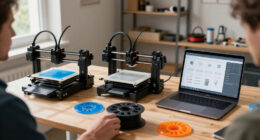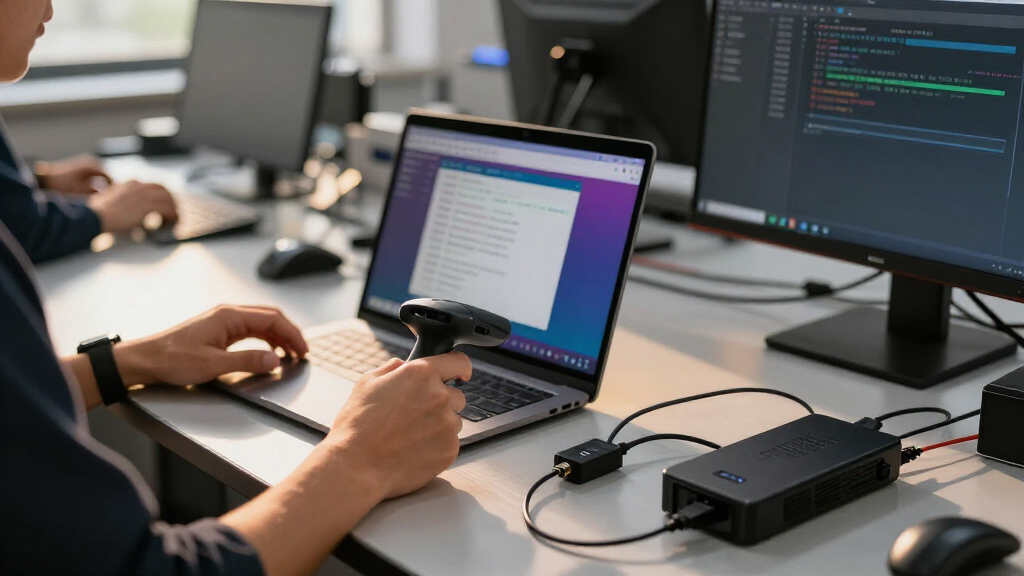

This checklist is for teams and individual testers assembling a lab for USB, embedded, and hardware QA. It covers tools that can help evaluate connections and signals, plus slots where choosing a product depends on your specific setup.

Get business pricing on monitors, keyboards and dev gear
- Business-only prices and quantity discounts
- Tax-exempt purchasing
- Multiple users, one account, clear invoices
The sections follow the picks provided: a USB protocol analyzer, logic analyzer, programmable USB hub, USB power meter, serial adapter, and JTAG debugger. Some listed product names may not clearly match the testing role, so check the device’s documented capabilities before treating it as a fit.
Use each section to define the job first, then compare the candidate with your ports, protocols, and test workflow. Confirm connector type, operating-system support, software requirements, and electrical limits from the manufacturer before connecting lab equipment.
USB protocol analyzer
A USB protocol analyzer belongs on the checklist when your work involves examining USB behavior, but the right tool depends on what you need to observe. Decide whether your task concerns charging, data communication, or both, and identify the USB versions and connector types in your devices. A product name alone does not establish that a tester can capture or decode protocol traffic.
The listed pick is the ChargerLAB Power-Z KM003C USB-C Charging Tester. Its name identifies it as a USB-C charging tester, so verify that its documented functions match your intended analyzer role before buying. A common mistake is assuming a charging tester provides the same visibility as a protocol capture tool. Check supported standards, measurement ranges, pass-through behavior, software compatibility, and whether the connection path works with your host, cable, and device. Confirm that any adapters preserve the signals you need to test.
What to look for:
- Documented USB functions that match the test objective
- USB-C connector and pass-through compatibility
- Supported voltage and current ranges for the planned setup
- Software and operating-system requirements
- Clear limits on what data or signals the device can inspect
ChargerLAB Power-Z KM003C USB-C Charging Tester
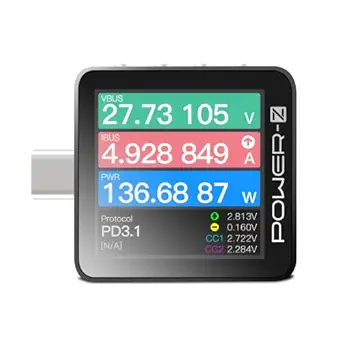
A USB-C tester for measuring voltage, current, capacity, and energy, and for checking E-markers, PDOs, and charging protocols. It supports up to 50 V and 6 A, features a 1.54-inch rotating LCD, and connects to a PC for data analysis.
Pros:
- Supports multiple electrical, capacity, and protocol tests
- Handles up to 50 V and 6 A
- Large rotating display and PC software support
Cons:
- Designed for USB-C testing, limiting compatibility with other connector types
- PC software and manual must be obtained from the official website
Best for: Teams checking whether a USB-C charging tester fits their charging workflow
Not ideal for: Testers who need documented USB protocol capture or decoding
Bottom line: Consider the ChargerLAB Power-Z KM003C only after confirming its documented functions cover the measurements and USB behavior your tests require.
Logic analyzer
A logic analyzer can support debugging when a test requires observing multiple digital signals together. Start by listing the interfaces and signal lines in scope, then determine how many channels must be captured at once. Channel count is only one part of fit: voltage thresholds, sample rate, capture depth, trigger options, and decoding support can all affect whether a unit suits a particular investigation.
The InnoMaker LA5032 32-Channel USB Logic Analyzer is the listed candidate. Verify its official specifications against your board’s signal levels and target buses before connecting it. A frequent buying mistake is choosing a high channel count without checking input limits or software support. Also consider the probe connection, grounding approach, host connection, and whether the included leads can reach the points you need. Confirm that the analysis software works on the lab computer and supports the workflows your team actually uses.
What to look for:
- Enough channels for simultaneous signals in the test plan
- Input thresholds and voltage limits compatible with the board
- Sample rate and capture depth for the signals being inspected
- Trigger and protocol-decoding features needed by the workflow
- Probe, grounding, and software compatibility
InnoMaker LA5032 32-Channel USB Logic Analyzer

Captures digital signals across 32 channels at up to 500 MHz, with 10G samples per channel and 6.25 ns glitch detection. Decodes more than 20 protocols, including MIPI DSI LP, I2C, SPI, UART, CAN, and JTAG, and includes a PWM generator and connection accessories.
Pros:
- Supports 32 synchronous channels and high-speed sampling
- Decodes more than 20 protocols
- Works with Windows, macOS, and Linux
- Includes a PWM generator and connection accessories
Cons:
- Requires a wired connection
- Software is specified as English-language
Best for: Labs that need to inspect several digital lines at once
Not ideal for: Workflows whose signal levels or decoding needs exceed the documented support
Bottom line: Check the LA5032’s input limits, capture specifications, and software support against your target hardware before adding it to the bench.
Programmable USB hub
A programmable USB hub can be useful when tests need repeatable control over connected devices or ports. Before selecting one, write down how many downstream connections you need, which USB generations and data rates matter, and whether the test must control individual ports. Also decide whether the hub will be used for data testing, power cycling, or both; those requirements can call for different capabilities.
The supplied pick is “Programmable Motorized Electric Turntable for 3D Scanning and Display.” That product name describes a turntable, not a USB hub, so it does not establish suitability for this checklist slot. Treat compatibility as unconfirmed and look for a product whose documentation explicitly describes USB hub functions, host and downstream ports, per-port control if required, and supported operating systems. Avoid assuming that a USB connector or motorized control makes a device a programmable hub. Confirm power delivery and isolation details against the devices you plan to connect.
What to look for:
- Explicit documentation identifying the product as a USB hub
- Required number and type of downstream ports
- Per-port control or reset functions if needed
- Supported USB data rates and host compatibility
- Power delivery, protection, and operating-system details
Programmable Motorized Electric Turntable for 3D Scanning and Display with USB/B

This programmable motorized turntable is designed for 360-degree product display, photography, and 3D scanning. It supports USB and Bluetooth control, multiple rotation modes, and precise step positioning.
Pros:
- Supports programmable control via USB and Bluetooth with CT command interface
- Offers five rotation modes and precise 0.1-degree step positioning for photography and 3D scanning
- High load capacity supports up to 45 kg in continuous rotation mode
- Includes remote controller with origin setting and saved configurations
Cons:
- Bluetooth control requires custom app development, with only an Android demo and source code provided
- Positioning/stepped mode reduces maximum load to 20 kg
- May be too complex for basic turntable display needs
Best for: Labs needing repeatable control of connected USB devices
Not ideal for: Anyone relying on the listed turntable as a USB hub
Bottom line: The named turntable is not identified as a USB hub, so choose a documented hub that meets the port-control and compatibility requirements.
USB power meter
A USB power meter can help characterize the electrical behavior of a USB connection, but the required measurements depend on the test. First specify the connector, expected voltage and current, whether the device must pass data through, and whether readings need to be logged. These details narrow the field and help avoid selecting a meter that interrupts a connection or omits a needed measurement.
No product is specified for this slot, so use your test plan to guide the search. Check measurement accuracy and range in the manufacturer’s documentation, along with supported charging standards and connector direction. A common mistake is assuming every inline meter preserves data communication or negotiates every charging mode. Confirm whether the meter works between your particular host, cable, and device, and whether its display or logging method suits the lab. Keep expected operating limits within the meter’s documented ratings.
What to look for:
- Voltage and current ranges suited to the intended tests
- Connector types and orientation matching the setup
- Data pass-through if communication must continue
- Documented support for relevant charging standards
- Logging or display features that fit the workflow
Serial adapter
A serial adapter is useful only when its interface matches the equipment and signals being tested. Identify the serial standard, connector, pinout, logic voltage, and host connection first. “Serial” can refer to different electrical interfaces, so connector shape alone is not enough to establish compatibility. If your work requires a particular driver, terminal, or operating system, include that in the requirements.
The supplied pick is “USB Computer Speakers with USB-C Adapter and Monitor Clip.” Its name describes speakers and an adapter, not a serial interface, so it does not establish that it can connect to serial hardware. Do not treat a USB-C adapter as a serial converter without documentation. Look for a product that explicitly names the required serial standard and lists pin assignments, voltage levels, driver support, and supported systems. Check whether the target uses a header, screw terminal, or another connector, and plan the wiring before purchase.
What to look for:
- Explicit support for the required serial standard
- Compatible logic voltage and pinout
- Connector style matching the target device
- Drivers and host operating-system support
- Wiring or isolation details required by the test
USB Computer Speakers with USB-C Adapter and Monitor Clip

These wired stereo speakers connect to compatible computers through USB or USB-C and feature dual drivers with a passive radiator for loud sound and bass. Their adjustable clamp fits monitors 0.1 to 1 inch thick, and the speakers can also rest on a desk.
Pros:
- USB-C adapter supports devices with USB-C ports
- Monitor clamp helps save desk space
- Compact speakers can also rest on a desk
- System-controlled volume avoids separate speaker buttons
Cons:
- Incompatible with monitors and TVs as playback devices
- No separate speaker volume controls
- Wired connection only
Best for: Labs connecting a host to documented serial interfaces
Not ideal for: Anyone expecting the listed speakers to provide serial conversion
Bottom line: The named speakers do not identify a serial interface, so choose an adapter whose documented standard, voltage, and pinout match the target.
JTAG debugger
A JTAG debugger should be selected around the target processor or board and the development workflow. Confirm that the target exposes a compatible debug interface, identify its connector and pinout, and check the supported device families. Debug access can depend on board design and software support, so a connector that appears to fit does not by itself confirm compatibility.
No product is listed for this slot. Start by checking the target’s documentation for its debug interface, voltage levels, and any required adapter cable. Then compare debugger support for the target, host operating systems, and development tools your team uses. A common mistake is buying based only on connector shape or a broad claim of JTAG support. Verify supported protocols and device coverage in current manufacturer documentation, and confirm that the board exposes the needed signals. If several boards are in scope, check each one separately.
What to look for:
- Documented support for the target device or family
- Interface and protocol compatibility with the board
- Connector, pinout, and voltage-level match
- Host operating-system and toolchain support
- Required cables and board-level debug access
Build the lab in order of the tests you need to run most: define the target and signals, confirm compatible instruments, then add supporting adapters and meters. Prioritize documented fit for the USB-C tester and logic analyzer, and resolve the hub and serial-adapter mismatches before purchasing. Add a USB power meter or JTAG debugger once their measurement and target requirements are written down.
A useful checklist starts with clear test needs and verified compatibility. Confirm details in manufacturer documentation, keep connector and voltage requirements with each test plan, and revise the equipment list as your devices and workflows change. That gives you a practical path to assembling a reliable, test-ready lab.
Halloween Picks
halloween
As an affiliate, we earn on qualifying purchases.