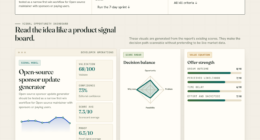

📊 Full opportunity report: The Six Chokepoints: How AI Stopped Being a Utility and Became a Lever on ThorstenMeyerAI.com — validation score, market gap, and execution plan.
TL;DR
In 2026, control over AI infrastructure shifted from a neutral utility model to a system dominated by a few powerful entities. Six key chokepoints now enable concentrated leverage, affecting access, power, and innovation.
In 2026, a series of decisive actions and events revealed that AI no longer functions as a neutral utility but is increasingly controlled through a small number of chokepoints, shifting power to a few entities. This marks a fundamental change in how AI infrastructure and capabilities are managed and accessed, with significant implications for the industry and global power dynamics.
Over the course of 2026, several high-profile incidents and policy moves demonstrated that control over critical AI infrastructure is now concentrated among a limited set of actors. For example, a government swiftly shut down a frontier model worldwide within approximately ninety minutes, and a defense ministry turned war-related data into a rentable asset with restrictions. Additionally, the world’s largest AI company leased its supercomputers to rivals under clauses allowing retraction, illustrating how ownership and access are now revocable and controlled.
The shift is evident across six key chokepoints: power generation, compute resources, data, model access, distribution channels, and capital. Entities capable of rapidly deploying large-scale power, renting massive GPU clusters, owning unique data assets, controlling model usage rights, managing distribution interfaces, and funding AI development now hold disproportionate influence. This trend signifies a move away from a broadly accessible AI infrastructure toward a model of scarcity, control, and strategic leverage.
The Six Chokepoints
For a decade AI was sold as a utility — abundant, neutral, always on. In 2026 it became a lever: scarce, controlled, revocable. Here are the six places power actually sits — and who started to squeeze.
Every layer is concentrating into fewer hands, and 2026 is the year the holders stopped treating their leverage as theoretical. A kill switch wasn’t discussed — it was pulled. The utility you’re allowed to forget about; the lever, you have to watch who’s holding. Optionality just became architecture.
Implications of AI Control Concentration in 2026
The transition from AI as a utility to an arena of concentrated leverage fundamentally alters the landscape of technological innovation, national security, and economic power. Fewer entities controlling critical chokepoints can restrict access, influence development trajectories, and reshape competitive dynamics. This shift raises concerns about monopolization, geopolitical tensions, and the resilience of open innovation in AI.
high-performance GPU cloud computing
As an affiliate, we earn on qualifying purchases.
As an affiliate, we earn on qualifying purchases.
2026 Breaks the Utility Metaphor for AI
For about a decade, AI was marketed as a utility—broadly available, neutral, and persistent—similar to electricity. This narrative justified massive investments and fostered a perception of AI as infrastructure for all. However, in 2026, several events challenged this view: a government shutdown a frontier model within minutes, a defense agency turned war footage into a licensed resource, and a major AI firm leased supercomputing capacity with clauses to reclaim it. These actions exposed the reality that control over AI infrastructure is now centralized and revocable, shifting power to a select few.
“The swift shutdown of a frontier model demonstrated that AI control is now a matter of national security and strategic interest.”
— A senior government official
AI infrastructure management tools
As an affiliate, we earn on qualifying purchases.
As an affiliate, we earn on qualifying purchases.
Unclear Aspects of AI Control Dynamics in 2026
While key incidents demonstrate increased control, the full extent of how these chokepoints are being exploited and consolidated remains unclear. It is also uncertain how emerging regulations, geopolitical tensions, and technological innovations will influence future control structures. The long-term impact on open AI development and innovation is still evolving and subject to further developments.
secure data storage for AI
As an affiliate, we earn on qualifying purchases.
As an affiliate, we earn on qualifying purchases.
Future Developments in AI Control and Accessibility
Moving forward, expect increased regulatory scrutiny, potential efforts to decentralize control, and strategic moves by governments and corporations to secure or expand their chokepoints. The industry may see shifts toward more controlled, revocable access models, with ongoing debates about balancing innovation with strategic leverage. Monitoring policy changes and technological trends will be crucial to understanding how AI’s control landscape evolves.
enterprise AI model access control
As an affiliate, we earn on qualifying purchases.
As an affiliate, we earn on qualifying purchases.
Key Questions
What are the six chokepoints in AI control?
The six chokepoints are power generation, compute resources, data assets, model access rights, distribution channels, and capital funding.
Why is control over AI infrastructure shifting now?
2026 revealed that control can be exercised rapidly through policy, contractual clauses, and technological capabilities, with entities capable of quickly deploying or restricting resources gaining disproportionate influence.
How does this change affect AI innovation?
Concentration of control may limit open access, slow innovation, and favor established players, raising concerns about monopolization and geopolitical tensions.
Are there efforts to decentralize AI control?
It is still uncertain; some policymakers and industry players are exploring decentralization and open models, but current trends favor consolidation.
What are the risks of this shift for global security?
Centralized control can lead to vulnerabilities, strategic manipulation, and escalation of geopolitical conflicts, especially if critical AI infrastructure is restricted or weaponized.
Source: ThorstenMeyerAI.com