TL;DR

Get business pricing on monitors, keyboards and dev gear
- Business-only prices and quantity discounts
- Tax-exempt purchasing
- Multiple users, one account, clear invoices
A webcam-based blink tracker is being tested to help remote workers reduce eye strain by encouraging regular breaks. The app estimates blink rate on-device and nudges users to take 20-20-20 breaks. Validation through pilot testing is ongoing.
A webcam-based blink-rate tracker is being developed to help remote knowledge workers reduce eye strain by encouraging regular breaks. The tool uses on-device computer vision to estimate blink rate and prompts users to take 20-20-20 breaks when blinking drops below healthy levels. This innovation aims to address the widespread issue of digital eye strain among remote workers, especially as screen time continues to rise.
The proposed application is designed for individuals who spend more than eight hours daily on laptops. It leverages existing webcam technology and computer vision algorithms to objectively monitor blink rates without transmitting video data externally, addressing privacy concerns. The system logs daily eye comfort scores and provides nudges to take breaks, specifically the 20-20-20 rule, which recommends looking at something 20 feet away for 20 seconds every 20 minutes of screen time.
According to IdeaNavigator AI, the app’s initial version will focus on a simple, per-seat subscription model aimed at both individual remote workers and small teams. A two-week pilot involving twenty remote workers is planned to validate whether the app effectively increases break adherence and improves self-reported eye comfort. The goal is to establish whether this approach can become a scalable solution for reducing digital eye strain.
Potential Impact on Remote Worker Eye Health
This development could offer a practical, accessible way for remote workers to manage digital eye strain proactively. By providing real-time, objective feedback on blink rate, it addresses the current gap where workers only notice symptoms after they become severe. If validated, this technology could reduce eye discomfort, headaches, and fatigue, improving overall productivity and well-being for millions of remote employees worldwide.
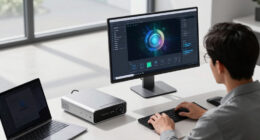
webcam blink tracker for eye health
As an affiliate, we earn on qualifying purchases.
As an affiliate, we earn on qualifying purchases.
Rising Screen Time and Eye Strain Challenges
The shift toward remote and hybrid work models has significantly increased daily screen time for knowledge workers. Many experience dry, tired eyes and headaches but lack objective signals to manage their eye health effectively. Current solutions often rely on self-awareness or manual reminders, which are inconsistent. The use of webcams and computer vision for health monitoring is a recent trend, with several startups exploring similar approaches to digital wellness. This initiative builds on these advances, aiming to create a simple, privacy-preserving tool for eye health management.
“Using on-device computer vision to estimate blink rate could be a game-changer for remote workers’ eye health.”
— an anonymous researcher
digital eye strain prevention device
As an affiliate, we earn on qualifying purchases.
As an affiliate, we earn on qualifying purchases.
Uncertainties Around Effectiveness and Adoption
It is not yet confirmed how effective the blink-tracking app will be in improving eye comfort or whether users will consistently follow break prompts. The results of the upcoming pilot study are still pending, and broader adoption may face challenges related to user privacy concerns, usability, and integration with existing workflows.
As an affiliate, we earn on qualifying purchases.
Next Steps in Validation and Deployment
The immediate next step is to conduct the planned two-week pilot with twenty remote workers, assessing whether the app increases break adherence and improves eye comfort. Based on pilot results, developers may refine the app and prepare for wider rollout. Further research may explore long-term health benefits and integration with other digital wellness tools.
As an affiliate, we earn on qualifying purchases.
Key Questions
How does the blink-tracking app protect user privacy?
The app processes video data entirely on the user’s device, avoiding external video transmission, thereby safeguarding privacy while monitoring blink rate.
Will the app work on all webcams and devices?
The initial version is designed to work with standard webcams on common laptops and desktops, but compatibility may vary depending on hardware and software updates.
Can this technology replace manual eye health monitoring?
It aims to complement existing practices by providing objective, real-time data, but should not replace professional eye health assessments when needed.
When will the app be available for general use?
Widespread availability depends on pilot outcomes, but a commercial version could be launched within the next year if validation is successful.
Are there any known limitations or risks?
Potential limitations include accuracy variations across devices and user acceptance. Privacy and usability are key considerations under review during testing.
Source: IdeaNavigator AI
Fall Picks
fall essentials
As an affiliate, we earn on qualifying purchases.