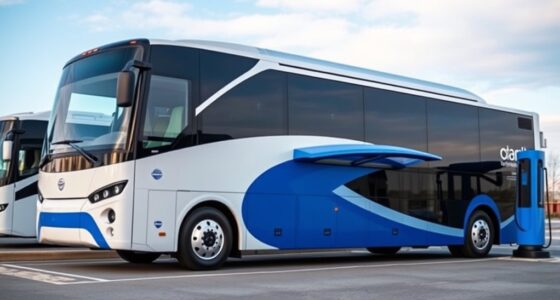
To charge your electric VW Bus, you can use public charging stations or set up a home charger for convenience. Public chargers come in Level 1 and Level 2 options, with Level 2 offering faster charging. For home, install a dedicated EVSE or outlet for overnight topping off. The vehicle’s battery management system guarantees safe, efficient charging while monitoring progress. Keep exploring to discover detailed tips for smooth charging everywhere you go.
Key Takeaways
- Locate compatible public charging stations or install a dedicated home charger for convenient, efficient charging.
- Use the vehicle’s charging port and follow station instructions to connect and start charging safely.
- Monitor real-time charging progress and battery health via the vehicle’s system or mobile app.
- Choose Level 1 for slow overnight charging or Level 2 for faster top-ups during longer stops.
- Ensure proper installation and safety measures for home charging stations, possibly requiring professional assistance.

Charging your electric VW Bus is a straightforward process that guarantees you’re always ready to hit the road. Whether you’re at home or on the go, understanding how to efficiently charge your vehicle ensures you get the most out of its capabilities. The first step is locating a reliable charging station, which can be found at public charging spots, shopping centers, or dedicated EV charging networks. When you arrive at a charging station, simply connect your VW Bus to the charger using the appropriate cable. Most stations are designed for ease of use, with clear instructions or user-friendly interfaces. Once plugged in, your vehicle’s battery management system kicks into action, overseeing the charging process to optimize battery health and safety. This system monitors temperature, voltage, and current levels, preventing overcharging and ensuring your battery remains in peak condition over time.
If you’re charging at home, you’ll need a dedicated wall outlet or a home charging station, often called an EVSE (Electric Vehicle Supply Equipment). Installing a home charging station might require professional help, but it offers the convenience of charging overnight, providing you with a full battery each morning. When you plug in your VW Bus, the onboard charger communicates with your home’s electrical system to deliver a controlled flow of electricity. The battery management system then manages the charging rate, balancing speed with battery longevity. Many home chargers allow you to set schedules or monitor charging remotely through an app, giving you control over when and how your vehicle charges.
On the road, charging stations vary in power output. Level 2 chargers typically offer faster charging times, making them ideal for longer stops or quick top-ups, while Level 1 chargers, generally using standard household outlets, provide slower charging suitable for overnight or extended parking. As you charge, your vehicle’s battery management system continuously assesses the battery’s status, adjusting charging parameters to maximize lifespan and safety. It also provides real-time updates on charging progress, so you know when your VW Bus is ready to go.

AIMILER Level 2 Electric Vehicle (EV) Charger(WIFI APP/Plug-play), 32A, 25ft Cable ETL Certified, 220V-240V NEMA 14-50P Plug EVSE w/ J1772 Connector, Portable EV Car Charging Stations for Home Level 2
- Power Plug Compatibility: 240V Nema 14-50 plug included
- Universal J1772 Connector: Compatible with North American EVs/PHEVs
- Fast Charging Capability: Up to 7.68kWh with adjustable amperage
As an affiliate, we earn on qualifying purchases.
As an affiliate, we earn on qualifying purchases.
Frequently Asked Questions
How Long Does It Take to Fully Charge an Electric VW Bus?
Charging your electric VW bus depends on your charging protocols and the charger type. Using a Level 1 charger, it might take 12-24 hours for a full charge, while a Level 2 charger can do it in 4-8 hours. Fast chargers can even top it up in under an hour. To maximize battery longevity, avoid frequent fast charging and stick to moderate speeds when charging overnight.
Can I Install a Home Charging Station Myself?
Did you know that over 40% of new EV owners consider DIY installation? You can install a home charging station yourself, but safety considerations are vital. If you’re comfortable with electrical work, it’s possible, but you must follow local codes and manufacturer instructions carefully. Otherwise, hiring a professional ensures a safe, compliant setup. Always prioritize safety to avoid potential hazards or voiding warranties.
What Is the Maximum Range per Charge?
Your electric VW Bus’s maximum range per charge depends mainly on its battery capacity and charging efficiency. With a larger battery, you’ll enjoy a longer drive before needing to recharge. Typically, you can expect around 150-200 miles per full charge, but this varies based on driving conditions and how efficiently you use power. To maximize your range, drive smoothly and optimize charging habits to maintain battery health.
Are There Fast Charging Options Available?
Yes, fast charging options are available thanks to the expanding charging infrastructure and advances in battery technology. You can quickly recharge your electric VW Bus at compatible DC fast chargers, often in around 30 minutes, making long trips more practical. As the charging infrastructure grows and battery technology improves, you’ll find fast charging stations more accessible, ensuring you spend less time waiting and more time enjoying your journey.
How Does Cold Weather Affect Charging Times?
Cold weather can dramatically slow down your charging times, making it feel like you’re waiting forever for your VW Bus to juice up. It’s because cold temperatures severely impact battery performance and charging efficiency, causing your battery to work overtime. You might find yourself spending twice as long charging or even shorter range on a single charge. To minimize this, pre-warm your vehicle or use a heated garage whenever possible.

ISO Cable Adapter CAN Bus Decoder Box Plug Connector Car Android Radio Wiring Harness Compatible for VW Golf7 2015-2020
- Compact and Organized Layout: Neat layout saves installation space
- Vehicle Wiring Integration: Connects entire vehicle wiring system
- Reliable Signal Transmission: Ensures control and sensing signals
As an affiliate, we earn on qualifying purchases.
As an affiliate, we earn on qualifying purchases.
Conclusion
Charging your electric VW Bus is simple, whether at home or on the road. Embrace the convenience, enjoy the freedom, and stay connected to your journey. Keep your bus charged, keep your adventures going, and keep your spirit alive. With the right knowledge, every charge becomes a step toward new destinations, new memories, and new beginnings. Power up confidently, drive boldly, and let your electric VW Bus take you wherever your heart desires.

Public EV DC Fast Charger, Electric Vehicle Charging Station with RFID APP Plug&Charge, Multi Port Charging Pile Compatible with CHAdeMO Standard for Highway Parking Lot
- Base configuration with customizable options: Includes optional accessories and personalized quotes
- Suitable for highway and public parking: Ideal for highway service areas and commercial lots
- Multiple start methods: RFID card, mobile app, and Plug&Charge
As an affiliate, we earn on qualifying purchases.
As an affiliate, we earn on qualifying purchases.

40A Level 2 EV Charging Station,J1772 9.6kW RFID 25ft WiFi App
- Fast Level 2 Charging: Up to 9.6kW power for quick charging
- Wide Vehicle Compatibility: Compatible with most J1772 EVs
- WiFi App & RFID Control: Remote monitoring and secure access
As an affiliate, we earn on qualifying purchases.
As an affiliate, we earn on qualifying purchases.