
📊 Full opportunity report: Revolutionize Your Industrial Checks With Smartphone Photo Gauge Reads on IdeaNavigator AI — validation score, market gap, and execution plan.

Get business pricing on monitors, keyboards and dev gear
- Business-only prices and quantity discounts
- Tax-exempt purchasing
- Multiple users, one account, clear invoices
TL;DR
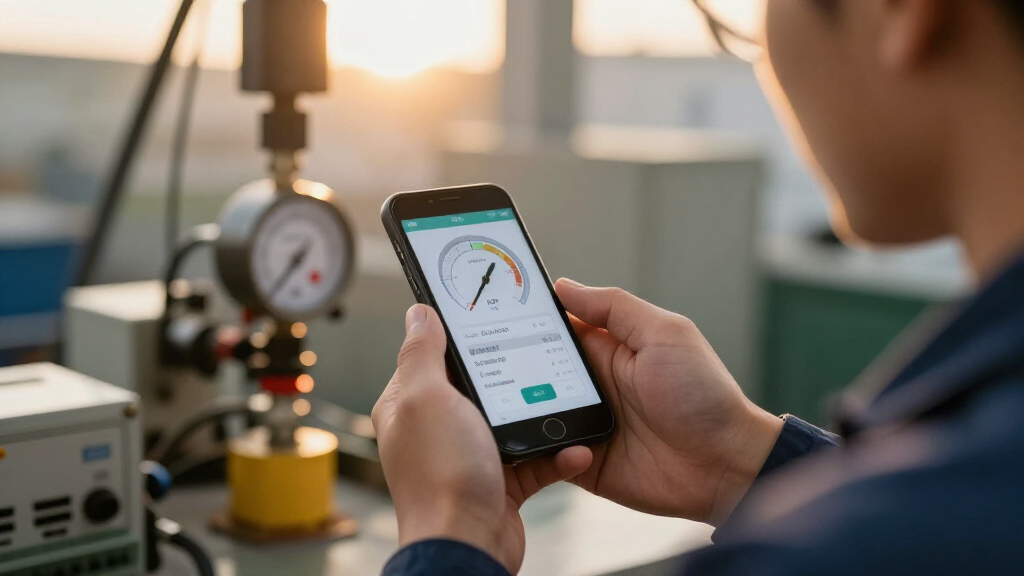
Industrial facilities are testing a new workflow where technicians photograph gauges with smartphones. AI reads the data, logs it automatically, and flags anomalies, potentially replacing manual clipboard rounds. This innovation aims to improve accuracy and maintenance insights without costly sensor retrofits.
Industrial facilities are piloting a new workflow that replaces manual gauge readings with smartphone photos and AI analysis, aiming to improve accuracy and data trend tracking without installing new sensors. This development could significantly streamline maintenance routines for legacy equipment, reducing errors and enabling early failure detection.
The initiative targets plant and facilities managers whose technicians perform daily rounds by visually inspecting analog gauges, sight glasses, and counters. Traditionally, these readings are transcribed onto paper, filed, and rarely used for trend analysis, which can mask developing failures. The new approach involves technicians photographing each gauge during their rounds using a smartphone. An AI-powered app then reads the gauge value from the photo, compares it against expected ranges, logs the data with timestamps and location tags, and flags anomalies immediately. This process creates a digital record that can be analyzed over time, providing a continuous trend history that was previously unavailable without costly IoT sensor retrofits. The pilot program involves running parallel gauge readings—one via traditional clipboard methods and another via smartphone photos—across three facilities over a month. The goal is to compare error rates, early anomaly detection, and overall efficiency. The approach leverages recent advances in vision models capable of reliably reading analog dials, sight glasses, and counters from ordinary phone images, making legacy equipment a data source without physical modifications. Market experts see this as a potential game-changer for industrial operations, especially in environments where retrofitting sensors is prohibitively expensive or impractical. The solution is offered as a subscription service, tiered by gauge count per facility, with the promise of reducing manual errors and enabling predictive maintenance practices that were previously difficult to implement with manual logs alone.Potential Impact on Industrial Maintenance Efficiency
This innovation could significantly improve how industrial facilities monitor equipment health, enabling early detection of failures and reducing downtime. By digitizing manual readings and creating accurate, trendable data, plants can shift from reactive to predictive maintenance strategies. Additionally, the approach offers a low-cost alternative to retrofitting legacy equipment with IoT sensors, which often involves high installation and maintenance costs. If successful, this workflow could be adopted widely, transforming routine checks into automated, data-driven processes that enhance safety, reduce operational costs, and improve overall asset management.
As an affiliate, we earn on qualifying purchases.
Legacy Equipment and the Need for Better Data
Many industrial plants rely on analog gauges and sight glasses to monitor critical parameters like pressure, temperature, and fluid levels. These gauges are often decades old, with no embedded sensors or digital interfaces. Traditionally, technicians perform manual rounds, recording readings on paper or digital devices, but these logs are rarely analyzed systematically. Errors in transcription, missed readings, and lack of trend data hinder predictive maintenance and early failure detection. While IoT sensors could solve these issues, retrofitting legacy equipment is costly and disruptive. Recent advances in AI-powered vision models, capable of reading analog dials from phone photos, present a promising alternative that leverages existing equipment without physical modifications.
As an affiliate, we earn on qualifying purchases.
Unconfirmed Aspects and Implementation Challenges
It is not yet clear how accurately the AI reads gauges across different environments, gauge types, and lighting conditions. The pilot program is ongoing, and results regarding error rates, anomaly detection sensitivity, and operational integration are still being collected. Additionally, questions remain about the scalability of the solution, data security, and how well the system integrates with existing maintenance management platforms. Long-term reliability and user acceptance are also still to be validated.
As an affiliate, we earn on qualifying purchases.
Next Steps in Pilot Testing and Broader Deployment Plans
The pilot program will continue for at least one more month, with detailed analysis comparing traditional and photo-based readings. If results show a significant reduction in errors and early detection of issues, the developers plan to expand testing to more facilities and refine the app’s algorithms. Successful pilots could lead to commercial rollout, offering facilities a low-cost, high-impact tool for digitalizing manual inspections. Further, integration with existing maintenance systems and data analytics platforms is expected to be prioritized to maximize utility and adoption.
As an affiliate, we earn on qualifying purchases.
Key Questions
How accurate are the AI readings compared to manual transcription?
Preliminary results suggest that AI readings from phone photos are comparable in accuracy to manual transcription, with the potential for fewer errors. The ongoing pilot aims to quantify this precisely across different gauge types and environments.
Can this system detect all types of gauge anomalies?
The system is designed to flag readings outside expected ranges and immediate anomalies. Its ability to detect more subtle issues depends on the accuracy of the AI reading and the predefined thresholds set by plant operators.
What are the costs associated with adopting this workflow?
The solution is offered as a per-facility subscription tiered by gauge count, making it a potentially lower-cost alternative to sensor retrofits. Exact pricing details are still being finalized.
Will this replace all manual rounds or just specific types?
Initially, the focus is on replacing clipboard transcription for legacy analog gauges. Broader adoption may extend to other manual inspection tasks if pilot results are positive.
What are the privacy and security considerations?
The system logs photos and data locally and uploads only necessary information to cloud servers for analysis. Data security protocols are being developed to protect sensitive operational data.
Source: IdeaNavigator AI
Fall Picks
fall essentials
As an affiliate, we earn on qualifying purchases.