📊 Full opportunity report: US GLP-1 Dose And Price Index: Compare Pharmacy Options on IdeaNavigator AI — validation score, market gap, and execution plan.

Get business pricing on monitors, keyboards and dev gear
- Business-only prices and quantity discounts
- Tax-exempt purchasing
- Multiple users, one account, clear invoices
TL;DR
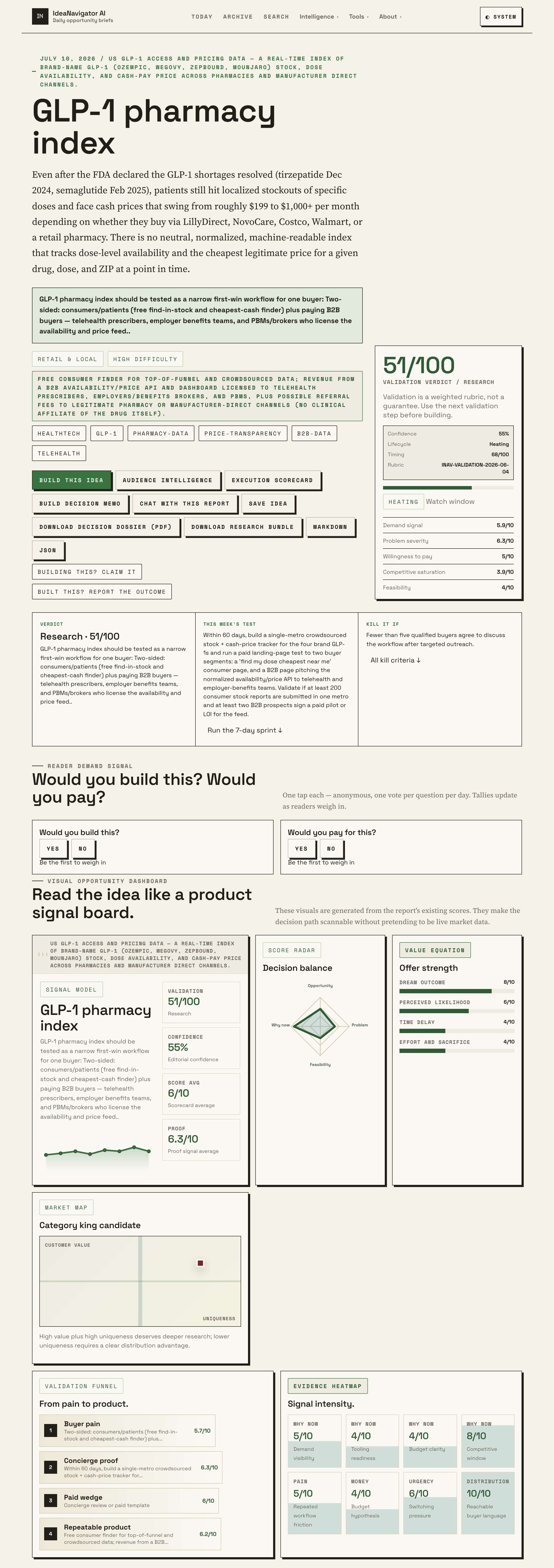
IdeaNavigator AI has proposed a US tool to compare cash prices and dose availability for four brand-name GLP-1 drugs by ZIP code. The proposal describes a free consumer search service supported by crowdsourced stock reports, with a paid data feed for business customers. No tool, pilot, buyer commitment or operating index is confirmed in the proposal.
IdeaNavigator AI has proposed a US index that would let patients compare reported stock and cash prices for four brand-name GLP-1 drugs by drug, dose and ZIP code. The concept pairs a free consumer search tool with a paid data feed for telehealth providers and employer-benefits buyers, but the proposal does not confirm that a product, pilot or commercial partnership exists. (Source: IdeaNavigator AI proposal.)
The IdeaNavigator AI proposal says the index would cover Ozempic, Wegovy, Zepbound and Mounjaro. A patient would enter a drug, dose and location to see participating or reported pharmacy availability and compare legitimate cash-pay options. IdeaNavigator AI says monthly cash prices can range from roughly $199 to more than $1,000, depending on the drug, dose and channel. The proposal does not give a date, product-by-product breakdown or methodology for that range, so it should be read as an estimate rather than a current quote.
For an initial version, the proposal suggests combining crowdsourced stock reports with publicly available price information from manufacturer direct channels, Costco, Walmart and retail pharmacies, alongside a discount-price layer. Users could also receive alerts when a particular dose is reported in stock. The proposal does not name pharmacies that have agreed to share live inventory, or describe how reports would be checked, timestamped or removed when they become stale.
The business model described by IdeaNavigator AI would make the consumer finder free and sell a normalized availability-and-price feed or dashboard to telehealth prescribers, employers, benefits brokers and pharmacy benefit managers. The proposal also identifies referral fees from legitimate pharmacy or manufacturer-direct channels as a possible revenue stream. These are proposed revenue routes; the material does not establish that any buyer has signed a contract or that referral arrangements are in place.
A Shift From Shortage to Search
The idea addresses a practical gap that can persist even when a drug is no longer listed as nationally scarce: a patient may need a specific dose at a nearby pharmacy, while published prices vary across direct-to-consumer programs, discount listings and retail channels. A searchable, time-stamped comparison could reduce the effort required to check several sources individually. Whether it would save patients money or time depends on whether its listings are accurate, current and broad enough to reflect real local options.
The proposed business feed targets a different need. Employers and benefits teams face pressure to understand and manage spending on GLP-1 medicines; the proposal describes these drugs as roughly 20% of pharmacy spend for employers, but supplies no survey, sample or time period for that figure. If validated, a consistent dataset could help buyers compare local cash prices and availability. An index alone would not establish insurance coverage, clinical eligibility or the right treatment for an individual patient.
For patients, the service would need to distinguish a reported stock sighting from a confirmed reservation or sale. A listing that is cheap but out of date may waste a trip, while an advertised price may depend on eligibility or purchase conditions. A useful comparison would show when a price was checked, what it includes and whether the pharmacy confirmed the dose is available.
How GLP-1 Access Fragmented
The IdeaNavigator AI proposal describes a market that has changed since the federal shortage determinations for some GLP-1 medicines. It says the FDA declared the tirzepatide shortage resolved in December 2024 and the semaglutide shortage resolved in February 2025. Those dates do not establish that every pharmacy has every dose in stock; the concept is premised on local or dose-specific gaps continuing after the national shortage status changed.
The proposal points to multiple cash-pay channels, including LillyDirect and NovoCare, as well as Costco, Walmart and retail pharmacies. It also cites compounding deadlines as a factor in the changing market and names a TrumpRx portal in February 2026. These references help explain why a comparison service might be proposed, but the supplied material does not document the current terms, availability or prices at each channel.
According to IdeaNavigator AI, the proposed scope is a US brand-drug access index, not a guide to all weight-loss medicines or a clinical recommendation service. The first test would cover four products in a single metro area, then assess whether consumers submit stock reports and whether business buyers show willingness to pay. IdeaNavigator AI sets a 60-day validation window and targets 200 consumer reports plus two paid pilots or letters of intent. Those figures are proposed success criteria, not results already achieved.
Accuracy, Coverage and Demand
The IdeaNavigator AI proposal establishes no launch date, operating website, pharmacy data agreement, completed pilot or paying customer. It also does not specify which metro area would be tested, how many pharmacies would be included, how reports would be verified or how frequently prices and inventory would refresh. Until those details are available, readers cannot assess whether the index could provide reliable coverage for a given location or dose.
The stated price range needs more detail before it can support a direct comparison. The proposal does not identify the products, doses, eligibility rules, fees or purchase terms behind the roughly $199-to-$1,000-plus monthly range. It also does not clarify whether each figure is a manufacturer price, retail cash price, discount-card estimate or another type of offer. The basis for the employer pharmacy-spend estimate is likewise not provided.
It remains unknown whether crowdsourced reports would reflect pharmacy-confirmed inventory, whether participating channels would permit automated collection of public prices, and how the service would handle conflicting listings. The proposal does not describe privacy practices for location or alert data, nor does it say how referrals would be disclosed. These details could affect user trust and the usefulness of the feed to business customers.
The Proposed 60-Day Test
IdeaNavigator AI proposes building a single-metro tracker for the four named brand drugs, combining consumer stock reports with normalized cash-price listings. Its suggested test would run two landing pages: one for people searching for the cheapest nearby dose, and another pitching a data feed to telehealth and employer-benefits buyers. The proposal sets a target of at least 200 consumer reports and two paid pilots or letters of intent within 60 days.
Those milestones would indicate early interest if reached, but they would not by themselves show that the listings are consistently accurate, that savings are available across regions or that the business can scale. The next meaningful evidence would include a named launch market, clear listing timestamps and verification rules, disclosed price conditions, and confirmation of any paid pilots. No test results or next public milestone are supplied in the proposal.
Source: IdeaNavigator AI
Key Questions
Has the GLP-1 pharmacy index launched?
The supplied material describes a proposed product. It does not confirm a launch, working website or operating pilot.
Which medicines would the proposed index cover?
The suggested first version would track Ozempic, Wegovy, Zepbound and Mounjaro by drug, dose and ZIP code.
Are the prices in the proposal current quotes?
No. The material gives a rough range of $199 to more than $1,000 per month but does not provide dates, dose-level examples or purchase conditions. Patients would need to check the current terms with each seller.
How would the proposed index make money?
IdeaNavigator AI proposes licensing an availability-and-price feed or dashboard to telehealth providers and benefits buyers, with possible referral fees from legitimate pharmacy or manufacturer-direct channels. No revenue agreements are confirmed.
What would count as an early validation?
The proposed 60-day test would seek 200 consumer stock reports in one metro and two paid pilots or letters of intent from business prospects. Those are targets, not reported outcomes.
Source: IdeaNavigator AI
Fall Picks
fall essentials
As an affiliate, we earn on qualifying purchases.