📊 Full opportunity report: From Home Improvement To ADU Construction: Backyard Home Ideas on IdeaNavigator AI — validation score, market gap, and execution plan.

Get business pricing on monitors, keyboards and dev gear
- Business-only prices and quantity discounts
- Tax-exempt purchasing
- Multiple users, one account, clear invoices
TL;DR
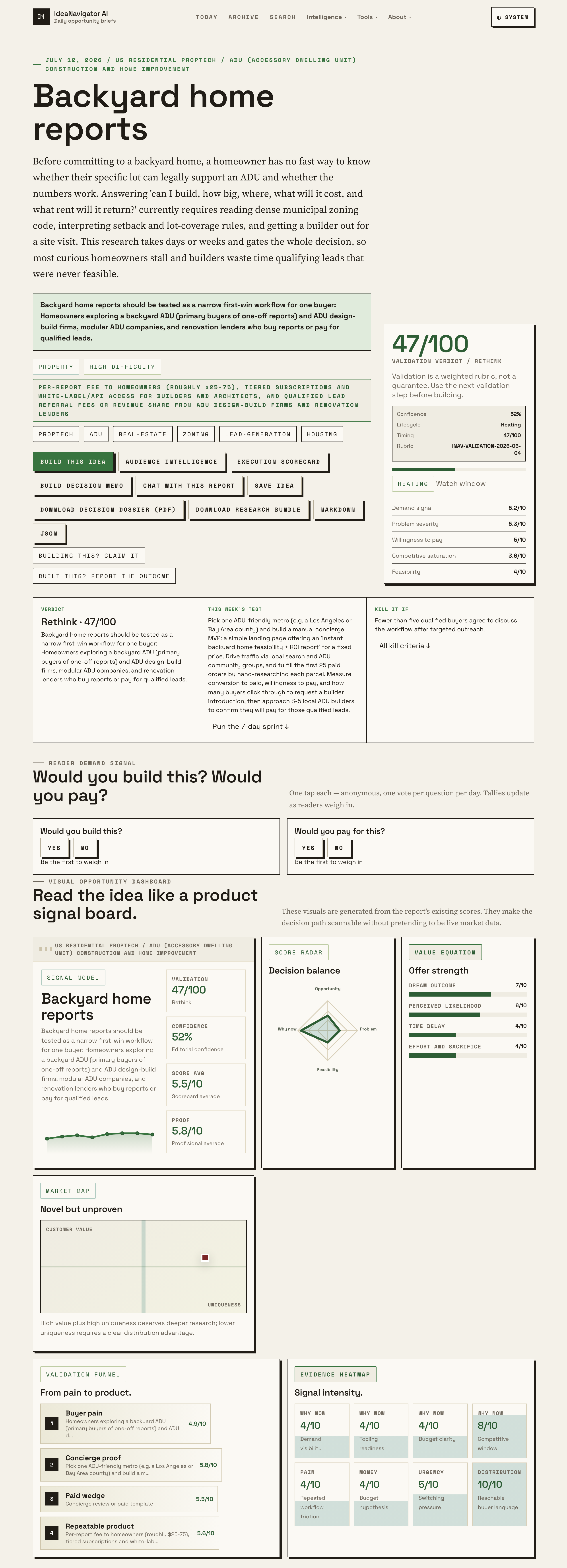
IdeaNavigator AI has outlined a business concept for reports that estimate whether a specific property can support an accessory dwelling unit, or ADU, and whether the project could make financial sense. The proposal describes a one-market pilot, but provides no evidence that a service has launched or that customers or builders have agreed to pay.
IdeaNavigator AI has proposed a paid report service to help homeowners assess whether their property could support a backyard accessory dwelling unit and what it might cost or earn. The concept targets a practical hurdle for prospective builders: determining how local rules, lot conditions and project economics apply to one address before arranging a site visit or committing to construction.
According to the IdeaNavigator AI proposal, the report would draw on county parcel data, including lot boundaries, lot size and existing building footprints, and compare those details with state ADU law and a curated set of local rules. For an initial market, the plan calls for manually maintaining rules in a limited number of California counties rather than attempting nationwide coverage from the start.
The proposed homeowner-facing PDF could estimate permitted ADU types and size, setbacks, lot coverage and buildable area. It could also give a build-cost range and projected rental income based on local comparisons. The proposal describes these as estimates; it does not provide a tested accuracy rate, a specific methodology for calculating costs or rents, or a named launch location.
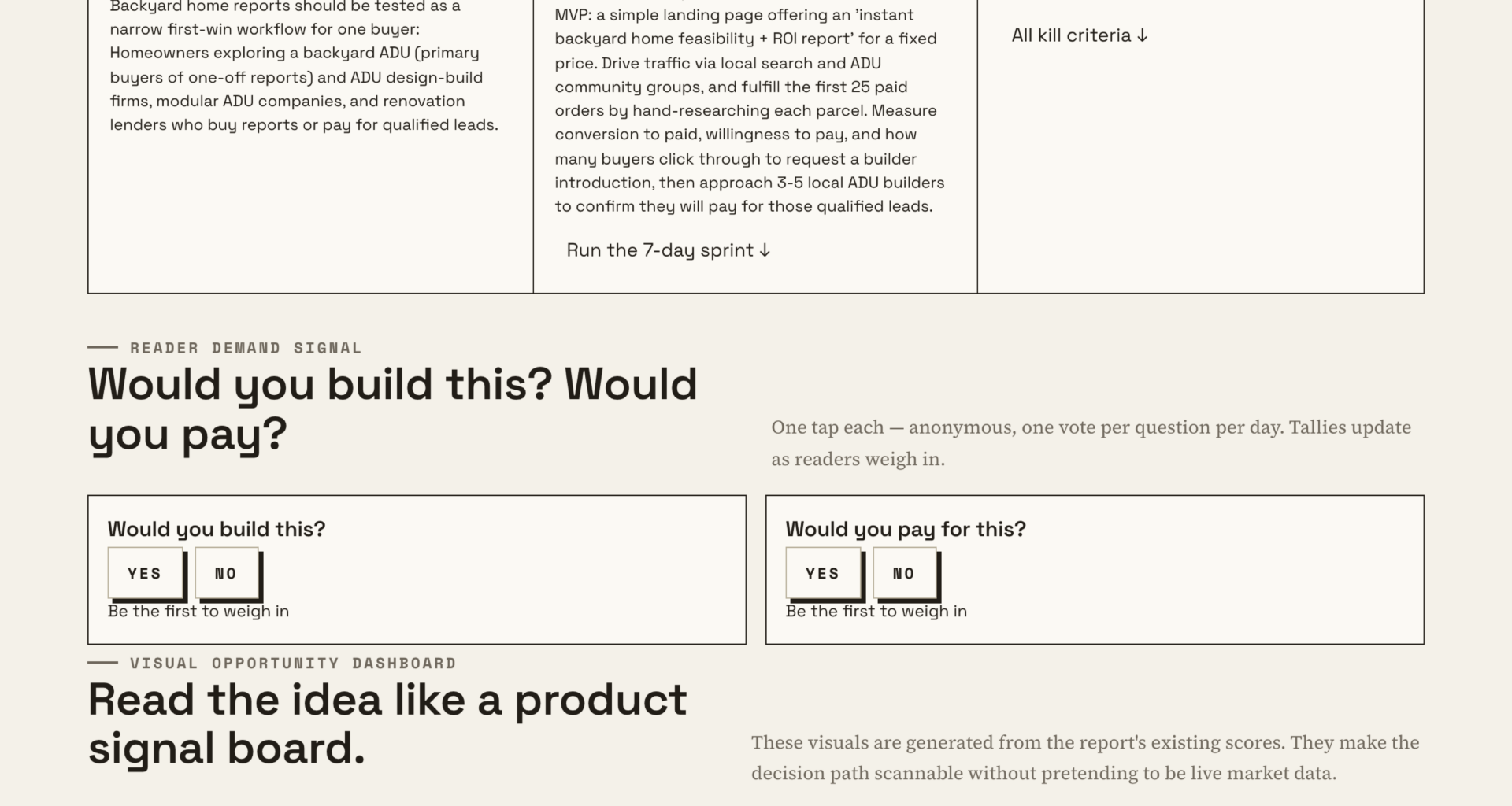
The suggested test is a concierge pilot: advertise a fixed-price report in one ADU-friendly metro, then research the first 25 paid property requests manually. The proposal says the team would track purchases and requests for builder introductions, then approach three to five local firms to determine whether they would pay for qualified leads. Those steps are proposed validation measures, not reported results.
A Faster First Check for Homeowners
The concept addresses an early decision that can stall a backyard home project: whether a particular lot appears to meet relevant rules and whether the possible costs and rental income merit further investigation. A clear, address-specific starting point could help homeowners decide whether to contact a designer, builder or local planning office.
For ADU firms, a report that filters out properties with obvious constraints might reduce time spent on initial lead qualification. The business case depends on whether its assessments are reliable enough to help buyers and whether builders find the resulting leads valuable. Neither customer demand nor builder willingness to pay has been established in the proposal.
The plan combines a direct homeowner fee, suggested at $25 to $75 per report, with possible subscriptions or white-label access for builders and architects. Referral fees from design-build companies or renovation lenders are another proposed revenue stream. These are pricing and monetization ideas, not confirmed products or commercial agreements.
California’s ADU Rules and Demand
The IdeaNavigator AI proposal points to California’s statewide ADU legislation, which began in 2016, and subsequent rule changes as reasons that property-specific guidance could be useful. It says other states and cities are also following, but does not identify particular laws outside California or describe how a service would keep its rules current across jurisdictions.
As market context, the proposal says Los Angeles County permitted more than 45,000 ADUs in 2023 and that ADUs account for roughly one in five new housing units produced in California. It does not provide citations or define the measurement behind the statewide share, so those figures are presented here as claims in the proposal rather than independently verified data. The material also cites a US housing shortage estimated in the millions, without specifying an estimate or date.
The proposal argues that parcel records and language-model tools for interpreting codes make automated reports more practical. Its own launch plan, however, relies on hand-curated local rules and manual fulfillment. That approach could test demand in a small area before broader automation, while leaving the cost and effort of expansion unanswered.
Accuracy, Coverage and Buyer Demand
No operating service, launch date, pilot results or customer interviews are described in the IdeaNavigator AI proposal. It is not clear which city or county would be selected, how parcel information would be checked against current site conditions, or how reports would handle exceptions and conflicting local requirements.
The proposal does not show how cost bands or rental projections would be calculated, how often they would be updated, or whether a report would be reviewed by a qualified professional. It also leaves open how users would be told that an initial feasibility estimate is not a permit approval or a substitute for site-specific professional advice. Customer conversion, willingness to pay and builder demand remain untested.
A 25-Report Market Test
The IdeaNavigator AI proposal identifies the next step as choosing one California market and offering a fixed-price feasibility report through a landing page promoted in local search and ADU community groups. The first 25 orders would be researched by hand, allowing the team to measure paid conversion, price acceptance and requests for builder introductions.
After that test, the plan calls for speaking with three to five local ADU builders about paying for qualified leads. No schedule or decision threshold is given, and the material does not say whether this pilot has begun. The next reported development would be evidence from those homeowner purchases and builder discussions.
Source: IdeaNavigator AI
Key Questions
Is a backyard ADU feasibility report service available now?
The IdeaNavigator AI material describes a proposed business concept and a possible pilot. It does not confirm that a service has launched or that reports can currently be purchased.
What would the proposed report estimate?
It could assess ADU types, size and site constraints, then provide estimated construction costs and rental income. These would be estimates, and the proposal gives no accuracy data or detailed calculation method.
How much might a homeowner pay?
The suggested one-off price is $25 to $75. That range is part of the proposal, not a confirmed price for an existing product.
How would the idea be tested?
The proposed pilot would manually fulfill the first 25 paid requests in one metro, track buyer behavior and ask three to five local builders whether they would pay for qualified leads.
Source: IdeaNavigator AI
Fall Picks
fall essentials
As an affiliate, we earn on qualifying purchases.