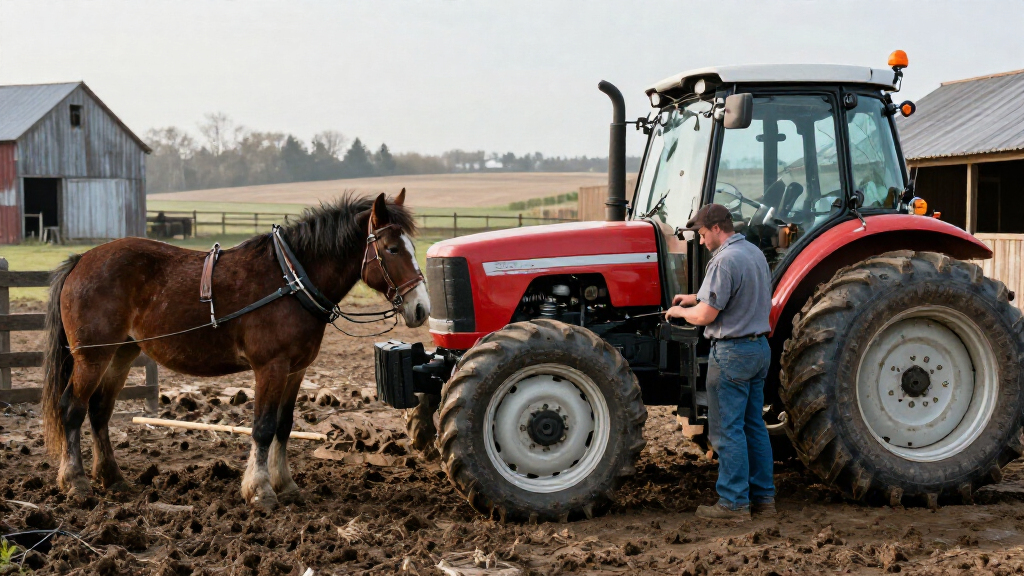

🔍 Read the full analysis: The Tractor's Rise: A Turning Point For Working Animals on ThorstenMeyerAI.com

Get business pricing on monitors, keyboards and dev gear
- Business-only prices and quantity discounts
- Tax-exempt purchasing
- Multiple users, one account, clear invoices
TL;DR
U.S. farm horses and mules peaked at 26.7 million in 1918, then fell to 3.1 million by 1960 as tractors and other machinery spread. The change freed land used to grow animal feed and sharply reduced farm employment, but the historical analogy to automation today has limits.
A historical report published November 4, 2026, traces how tractors displaced working horses and mules on American farms: their numbers fell from a peak of 26.7 million in 1918 to 3.1 million in 1960. The shift transformed farm production and employment, offering a documented case of mechanization as economists debate how automation may affect workers today.
The figures cited in the report come from the U.S. Census Bureau’s Historical Statistics of the United States, Colonial Times to 1970, which reprinted Department of Agriculture estimates. Horses alone peaked at 21.4 million in 1915; the combined number of horses and mules reached its high point three years later, at 21.2 million horses and 5.5 million mules. These were estimates of animals on farms, not a count of every horse in the country.
Keeping those animals required land as well as labor. In 1915, about 93 million acres of harvested cropland—more than a quarter of the reported 340 million acres—grew feed for horses and mules. The report says the figure remained about 90 million acres in 1920, then fell to roughly 5 million acres by 1960. Its account contrasts animals, which needed feed year-round, with tractors, which required fuel when operated.
Tractors spread rapidly over the following decades. The report lists about 1,000 tractors in 1910, 246,000 in 1920 and 4.69 million in 1960. Around 1955, it says, the estimated numbers crossed: 4.35 million tractors compared with 4.31 million horses and mules. The source cautions that census tractor counts used slightly different dates, and that from 1951 the Agriculture Department counted horses and mules together.
Mechanization Reshaped Farm Work
The change was not simply a substitution of one power source for another. As tractors and related equipment spread, fewer workers could produce more agricultural output, while land once devoted to animal feed could be used for other crops. The report cites an Agriculture Department estimate that one farm worker supplied 7.1 people in 1910, rising to 47.1 in 1970. That figure includes people abroad supplied through exports.
Farm employment fell as this productivity grew. The report gives a peak of 13.6 million farm workers in 1916 and 4.5 million in 1970, during a period when the overall U.S. labor force doubled. Those totals show a large change in the sector, but do not by themselves explain every worker’s path. The report says new employment was concentrated in cities, meaning many people had to move as agricultural work contracted.
The history matters to current debates because it shows that a major technology shift can reduce demand for particular kinds of work while increasing output and changing where jobs are found. It does not prove that today’s automation will produce the same outcome: the affected tasks, workers, institutions and pace of change differ.
Popular right now

Shark IY143H Cordless Pet Stick Vacuum

Bose QuietComfort Ultra Headphones (2nd Gen), Wireless Noise Cancelling Over-Ear Headphones, Driftwood Sand

TCL 75-Inch Class 4-Series 4K UHD HDR Smart Google TV (75S446, 2022)
As an affiliate, we earn on qualifying purchases.
From Fordson to Farm Machinery
Tractors existed before World War I, but the report describes early models as heavy, expensive and best suited to large farms. In 1917, Ford introduced the Fordson. The Henry Ford museum describes it as “the first mass-produced and inexpensive lightweight tractor” designed for small farmers, and says it “rapidly became the most popular tractor in America.” The report records the 100,000th Fordson leaving the assembly line on February 21, 1920.
Tractors were part of a broader wave of farm mechanization. The report lists about 4,000 combine harvesters on U.S. farms in 1920, 190,000 in 1940 and 1.042 million in 1960. Combines cut, threshed and cleaned grain in one pass; corn pickers, balers and milking machines also spread, alongside fertilizer and improved seed. These changes mean the horse-to-tractor comparison cannot capture the effects of every technology involved.
The analogy to workers is older than today’s automation debate. In 1983, economist Wassily Leontief compared workers with horses displaced by tractors. The report notes that Leontief also identified a major difference: horses could not vote. That observation points to the political and social forces shaping how people respond to job loss—forces that have no direct equivalent in the replacement of farm animals.
The Limits of the Horse Analogy
The historical counts establish the scale and timing of the decline, but the supplied material does not track the individual destinations of displaced farm workers or provide a detailed account of how the decline affected different communities. It says farmers stopped breeding replacements and the working population aged out; it does not describe a single mass removal event. The report’s farm-employment totals also do not identify which occupations absorbed former farm workers.
The comparison with present-day automation remains an analogy, not a forecast. The source mentions John Deere’s 16-camera autonomy kit, announced in February 2025 for tillage on selected large tractors, and says China reported that about 74% of ploughing, sowing and harvesting was mechanized in 2023. Those claims are not accompanied here by details on how the rates were measured, how widely the tractor kit is used, or how either development has affected jobs. The extent to which autonomous equipment will change farm employment is therefore unclear.
Tracking Automation’s Farm Effects
The historical report’s next point is not a scheduled policy decision or new research milestone. It raises questions that require current evidence: how widely autonomous tractors are deployed, which tasks they can perform without human intervention, and whether their use changes farm staffing, costs or output. The source does not provide a date for further data or a follow-up announcement.
For readers assessing the comparison, the relevant developments to watch are new adoption figures and research that measures employment outcomes alongside productivity. Until those are available, the U.S. horse-to-tractor record is best treated as evidence of how one earlier technology changed agriculture—not as a direct prediction of what will happen to workers facing automation now.
Key Questions
How many horses and mules worked on U.S. farms at the peak?
The report cites an estimated 26.7 million horses and mules on farms on January 1, 1918: 21.2 million horses and 5.5 million mules.
How much did farm horse and mule numbers fall?
The estimated count dropped from 26.7 million in 1918 to 3.1 million in 1960. The report describes the fall as almost 90%.
What happened to the animals as tractors spread?
According to the report, farmers stopped breeding replacements and the working population aged out. It does not describe a single mass event or provide detailed figures on the animals’ individual fates.
Does the history show what automation will do to workers today?
No. It documents how mechanization changed U.S. farming, land use and employment, but the report describes the comparison with present-day automation as an analogy, not a law or a forecast.
Source: ThorstenMeyerAI.com