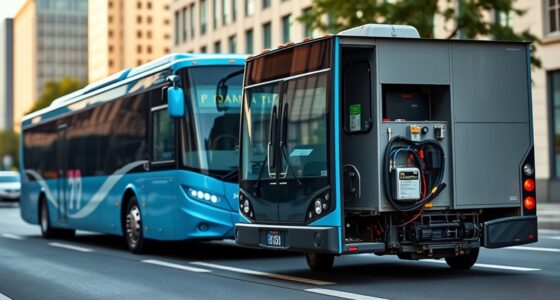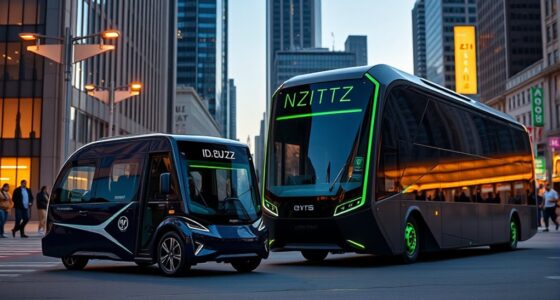
Choosing between battery swapping and fast charging depends on your fleet’s needs and budget. Swapping offers rapid turnaround, minimizing downtime but requires high initial investment and compatible batteries. Fast charging is more flexible, easier to deploy, and less costly upfront, though it takes longer to recharge vehicles. Your decision should consider operational efficiency, scalability, and infrastructure costs. Explore further to see which option best suits your fleet’s long-term goals and operational demands.

Get business pricing on monitors, keyboards and dev gear
- Business-only prices and quantity discounts
- Tax-exempt purchasing
- Multiple users, one account, clear invoices
Key Takeaways
- Battery swapping offers rapid turnaround times, minimizing vehicle downtime compared to the longer charging periods of fast chargers.
- Fast charging infrastructure is less costly upfront and easier to deploy incrementally across multiple locations.
- Swapping is more suitable for large fleets needing quick vehicle redeployment, but requires significant initial investment.
- Fast charging provides operational flexibility with lower initial costs, though longer charging times may impact fleet efficiency.
- Technological advancements in batteries and charging reduce recharge times and costs, influencing long-term efficiency of both options.
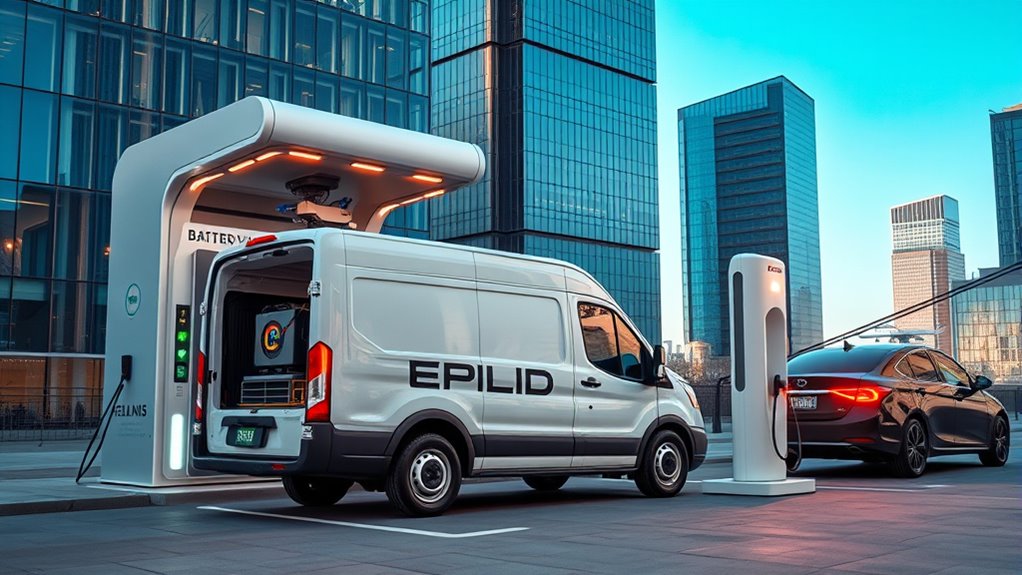
As electric vehicle technology advances, drivers are faced with a key choice: whether to rely on fast charging stations or opt for battery swapping. For fleet operators, this decision impacts operational efficiency, costs, and infrastructure planning. Battery swapping involves exchanging depleted batteries for fully charged ones at designated stations, offering quick turnaround times. Fast charging, on the other hand, requires charging stations where batteries are replenished on-site, which can take anywhere from 15 to 30 minutes or more. Both options aim to reduce downtime, but they differ markedly in upfront costs and long-term infrastructure needs.
Battery swapping can be attractive because it minimizes vehicle downtime, especially for fleets that need rapid turnarounds. However, the approach demands a substantial initial investment in infrastructure — specialized swapping stations, compatible battery designs, and inventory management systems. The cost of batteries plays a big role here, as fleet operators must purchase or lease multiple batteries to keep swapping stations stocked. While battery costs are decreasing over time, the upfront investment in batteries and swapping equipment remains high. This can be a barrier for smaller fleets or those with limited capital, as they need to balance the expense of acquiring batteries versus the operational savings from quick swaps.
Fast charging stations, by contrast, generally require less specialized infrastructure. They can be integrated into existing fueling stations or be deployed as standalone sites, making them more flexible and potentially less costly upfront. The main expense centers on installing high-power chargers capable of delivering rapid recharge times. Although fast charging infrastructure is less costly compared to battery swapping stations, the ongoing cost of electricity and the wear and tear on batteries from frequent fast charging can add up. Also, the longer charging times compared to swapping mean vehicles may spend more time stationary, which can hinder fleet efficiency unless multiple chargers are available to accommodate high utilization.
From an efficiency standpoint, battery swapping offers unparalleled quick turnaround, but the heavy investment in infrastructure and batteries makes it less scalable without significant capital. Fast charging is more adaptable and easier to deploy incrementally, but recharge times can limit how quickly fleet vehicles are back on the road. Furthermore, advancements in battery technology are expected to influence both options’ long-term viability. Ultimately, your choice depends on your fleet’s size, budget, and operational needs. If rapid turnaround is vital and you can afford the infrastructure, swapping might be better. If flexibility, lower initial costs, and incremental growth matter more, fast charging could be the more practical solution.
electric vehicle battery swapping station
As an affiliate, we earn on qualifying purchases.
As an affiliate, we earn on qualifying purchases.
Frequently Asked Questions
What Are the Long-Term Cost Differences Between Swapping and Fast Charging?
You’ll find that long-term, battery swapping tends to lower overall costs because it reduces downtime and maintains battery lifespan by avoiding frequent fast charging stress. Although initial replacement costs may be higher, swapping minimizes battery degradation, saving you money over time. Fast charging can accelerate battery wear, leading to higher replacement costs. So, if you prioritize long-term savings, swapping could be more cost-effective for your fleet.
How Do Battery Life Cycles Compare Between Swapping and Fast Charging Methods?
Imagine your fleet’s batteries as delicate flowers, each bloom slowly fading with time. Fast charging accelerates battery degradation, shortening life cycles and causing more frequent replacements. In contrast, swapping gently preserves battery health, extending their longevity. You’ll notice that with swapping, your batteries maintain peak performance longer, thanks to lower stress from charging speed. This means less downtime and costs, helping your fleet run smoothly and efficiently over time.
What Infrastructure Is Required for Large-Scale Deployment of Each Method?
For large-scale deployment, you need a network of battery stations or fast chargers, depending on the method. Battery swapping requires strategically located battery stations with automated systems and a reliable power grid to guarantee quick exchanges. Fast charging demands extensive charging stations connected to the power grid, capable of handling high electricity loads efficiently. Both setups need robust infrastructure, maintenance, and energy management to support fleet operations effectively.
How Do These Methods Impact Vehicle Design and Maintenance?
Imagine your electric delivery van needs quick turnaround. Battery swapping simplifies vehicle design by using standardized battery modules, reducing downtime. It also requires robust cooling systems to keep batteries safe during swaps. Fast charging, on the other hand, demands larger wiring and cooling for rapid power intake, potentially increasing maintenance complexity. Both methods influence vehicle design and maintenance, but battery swapping offers easier upkeep with fewer long-term modifications.
Are There Environmental Benefits Associated With Either Battery Swapping or Fast Charging?
You’ll find that both battery swapping and fast charging offer environmental benefits. Battery swapping can enhance recycling benefits by allowing easier reuse and recycling of battery components, reducing waste. Fast charging helps cut emission reductions by enabling quicker turnaround times, encouraging more EV use and fewer internal combustion engines on the road. Both methods, when optimized, contribute to a greener fleet, supporting sustainable transportation and reducing your overall carbon footprint.
As an affiliate, we earn on qualifying purchases.
Conclusion
Choosing between battery swapping and fast charging is like picking the right gear for a race—you need what keeps you moving efficiently. Battery swapping offers quick turnaround, perfect for fleets needing maximum uptime, while fast charging provides a flexible option for less time-sensitive needs. Think of it as a relay race: sometimes, passing the baton quickly is best; other times, a steady pace wins. Evaluate your fleet’s rhythm, and pick the method that keeps you ahead of the pack.
As an affiliate, we earn on qualifying purchases.
battery swapping equipment for fleets
As an affiliate, we earn on qualifying purchases.
As an affiliate, we earn on qualifying purchases.
Halloween Picks
halloween
As an affiliate, we earn on qualifying purchases.