
To estimate an electric bus’s range based on route profiles, start by knowing the battery capacity and your bus’s average energy consumption per mile or km. Adjust those numbers for route specifics like elevation, traffic, and typical driving style, which can increase or decrease energy use. Use route data or past experience to refine your estimates, ensuring you consider real-world factors. Keep exploring to discover how to optimize your calculations for better accuracy.

Get business pricing on monitors, keyboards and dev gear
- Business-only prices and quantity discounts
- Tax-exempt purchasing
- Multiple users, one account, clear invoices
Key Takeaways
- Collect detailed route data including distance, elevation changes, and traffic conditions.
- Analyze historical energy consumption for similar routes to establish baseline efficiency.
- Adjust energy consumption estimates based on route profile, considering hills and stop frequency.
- Incorporate real-time factors like weather and passenger load to refine range predictions.
- Use battery capacity divided by adjusted energy consumption to calculate an accurate, route-specific range.
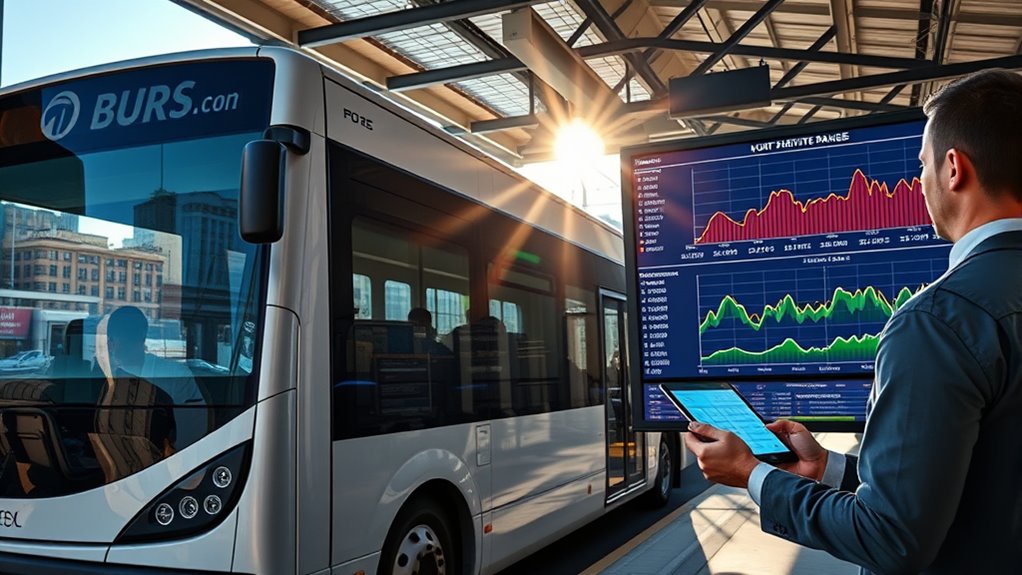
Understanding how far an electric bus can travel on a single charge is essential for planning efficient routes and ensuring reliable service. To do this accurately, you need to consider two critical factors: battery capacity and energy consumption. Battery capacity, usually measured in kilowatt-hours (kWh), determines the total amount of energy stored in the bus’s battery, directly influencing its maximum range. Meanwhile, energy consumption, often expressed in kWh per mile or kilometer, indicates how much energy the bus uses over a specific distance. By analyzing these two elements, you can estimate how far the bus will go before needing a recharge.
Start by assessing the bus’s battery capacity. Larger batteries can store more energy, naturally extending the potential range. However, the actual range also depends on how efficiently the bus uses that energy during operation. This is where understanding energy consumption becomes vital. For example, if your electric bus has a 300 kWh battery and consumes about 2.5 kWh per mile, you can calculate its approximate range by dividing the total energy capacity by the energy consumption per mile: 300 kWh ÷ 2.5 kWh/mile = 120 miles. This simple calculation provides a baseline estimate, but remember that real-world conditions will affect actual range.
In real-world scenarios, factors like passenger load, terrain, weather, and driving style influence energy consumption. Heavier loads and hilly routes generally increase energy use, reducing the overall range. Conversely, flat terrain and smooth driving can help maximize efficiency. To refine your calculations, gather data from previous routes or operational tests that reflect typical conditions. Use this data to determine an average energy consumption rate for your specific route profile.
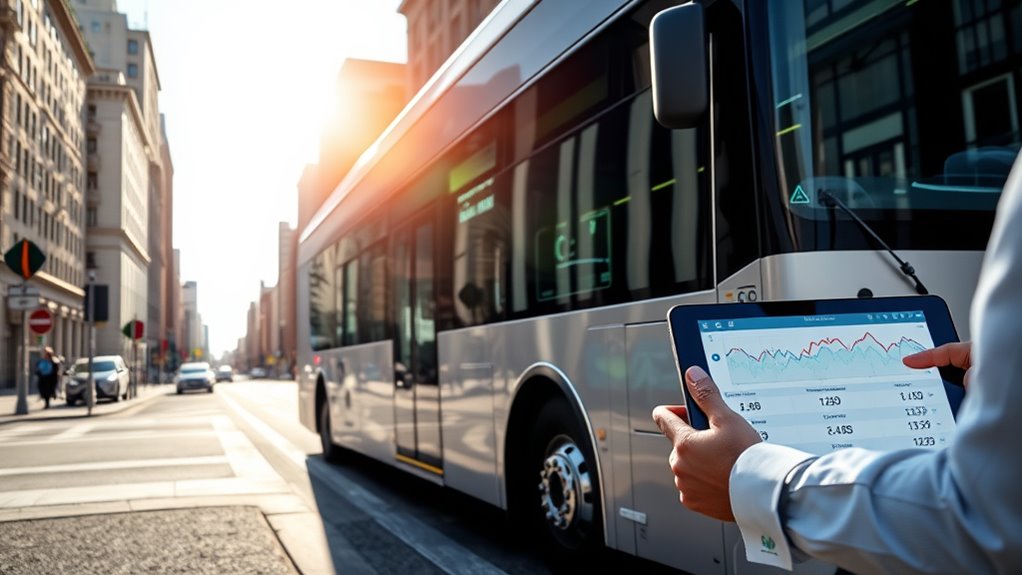
Mapping out your route profile is another crucial step. Break down the route into segments, noting elevation changes, stop-and-go traffic, and average speeds. Longer stops or slower speeds may decrease energy consumption, while rapid acceleration and high speeds could increase it. Adjust your estimated energy consumption based on these factors, then recalculate the expected range accordingly. Incorporating battery technology advancements can further improve accuracy and efficiency in your planning.
Ultimately, calculating an electric bus’s range based on route profiles involves blending technical data with real-world operational insights. By understanding the bus’s battery capacity and carefully analyzing energy consumption in context, you can develop precise range estimates. This allows you to plan routes more effectively, avoid unexpected outages, and optimize your fleet’s performance, ensuring reliable and efficient transit service.
Frequently Asked Questions
How Do Weather Conditions Affect Electric Bus Range?
Weather conditions can substantially impact your electric bus’s range. Cold temperatures cause battery degradation, reducing capacity and making it harder to hold a charge. Hot weather can also drain your battery faster. Additionally, extreme weather may require you to use heating or cooling systems, which increase energy consumption. Make certain your charging infrastructure is robust enough to handle these fluctuations, helping maintain ideal range despite weather challenges.
What Role Does Passenger Load Play in Range Estimation?
Passenger load considerably impacts your electric bus’s range because higher passenger weight and frequent boarding increase energy consumption. When more passengers board, your bus’s motor works harder, draining the battery faster. You should consider peak boarding times and average passenger weight to accurately estimate range. Managing passenger flow or reducing weight can help extend your bus’s operational distance, ensuring reliable service throughout your route.
How Accurate Are Current Range Prediction Models?
Imagine predicting your bus’s journey is like charting a ship’s course; current range prediction models are generally accurate but can drift like weather forecasts. Battery degradation and software calibration impact precision, sometimes causing the model to overestimate or underestimate range. While these models are improving with real-time data, understanding their limits helps you plan routes better, just like checking weather updates before setting sail.
Can Regenerative Braking Significantly Extend Range?
Regenerative braking can considerably extend your electric bus’s range by recapturing energy during deceleration, which improves overall energy efficiency. However, frequent use may accelerate battery degradation over time. By optimizing regenerative braking, you reduce reliance on the battery, helping to preserve capacity and extend range. You’ll benefit from better efficiency, but keep in mind the trade-off with potential long-term battery health impacts.
How Often Should Battery Performance Be Recalibrated?
Battery calibration benefits your bus’s performance, so you should recalibrate regularly, typically every 3 to 6 months. Consistent performance monitoring helps identify when recalibration is needed, ensuring accurate range estimates. By maintaining meticulous monitoring and timely calibration, you optimize battery health, prevent performance pitfalls, and prolong the power potential of your electric bus. Keep an eye on battery behavior to avoid unexpected surprises and sustain superior service.
Conclusion
By understanding your route profile, you can paint a clear picture of your electric bus’s journey ahead. Think of it as mapping out a treasure hunt, where each turn and hill guides you closer to the final destination. With this knowledge, you’re not just guessing your bus’s range—you’re charting a course through a landscape of possibilities. So, embrace the numbers and let your route become a well-trodden path to reliable, eco-friendly travel.
Fall Picks
fall essentials
As an affiliate, we earn on qualifying purchases.