📊 Full opportunity report: Argentina’s Supply-Chain Operations Gain More Global Notice on IdeaNavigator AI — validation score, market gap, and execution plan.

Get business pricing on monitors, keyboards and dev gear
- Business-only prices and quantity discounts
- Tax-exempt purchasing
- Multiple users, one account, clear invoices
TL;DR

IdeaNavigator AI has proposed testing a trade and supply-chain monitoring service using a signal it describes as increased global coverage of Argentina. The proposal cites a GDELT score of 88/100, but offers no underlying coverage data or evidence that the signal reflects a concrete change to trade, logistics or operating conditions.
IdeaNavigator AI has proposed testing a supply-chain monitoring service with a signal it describes as Argentina surging in global coverage, framing the item as a possible early-warning brief for operations leads. The proposal cites a GDELT signal score of 88/100, but does not identify the news event behind the coverage, provide its underlying data, or show that Argentina’s trade or supply-chain conditions have changed.
The concept targets an operations lead managing supply-chain and trade exposure. IdeaNavigator AI says relevant developments are spread across news, forums and filings, making it difficult for those workers to identify which stories could affect their responsibilities and turn them into timely decisions. It argues that a same-day, role-filtered read may be more useful than a generic weekly roundup when geopolitical and trade developments move quickly.
The proposed minimum viable product would monitor GDELT and similar feeds, filter developments for relevance to trade and supply-chain operations, and produce short briefs organized around what changed, why it matters and what a reader might do. The Argentina item is presented as an example for that workflow, rather than as a reported disruption or a confirmed change in operating conditions.
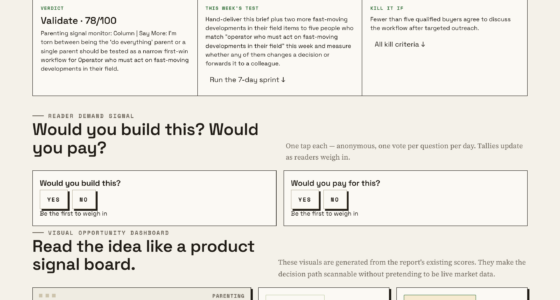
For validation, the proposal recommends delivering the Argentina brief and two other geopolitical or trade briefs to five people matching the intended job profile during one week. The test would track whether a recipient changes a decision or forwards a brief to a colleague. A subscription for operations professionals is suggested as the business model, but there are no reported test results, customer commitments or revenue figures.
Testing Alerts Against Operating Decisions
The proposal addresses a practical challenge for companies with exposure to cross-border sourcing, transport or trade: news volume does not automatically tell an operations team whether a development affects a supplier, route, cost or delivery schedule. A filtered alert could be useful if it connects a verified event to a specific exposure and reaches the right person while there is still time to act.
But increased media coverage is not itself evidence of supply-chain risk. Without the event behind the Argentina signal, the affected industries or routes, and a clear link to operations, a high attention score cannot tell a reader whether to change a sourcing plan or take another step. The proposed trial’s decision-change and forwarding measures could help assess practical value, though five recipients over one week would provide limited evidence about broader demand or performance.
As an affiliate, we earn on qualifying purchases.
From Coverage Signal to Trade Brief
The idea is framed as a response to fragmented information: developments relevant to trade may appear across different types of reporting and records, while a general roundup may not distinguish what matters to a particular role. Its proposed answer is not simply to collect more headlines, but to filter them for an operations audience and state the potential relevance in a concise format.
GDELT is named as one potential feed, and IdeaNavigator AI assigns the Argentina signal a score of 88/100. The proposal does not explain what that score measures, what time period it covers, or how it compares with a baseline. It also does not name a specific political, regulatory, economic or logistics development as the reason for the reported rise in coverage. The score should therefore be treated as a signal cited by the proposal, not as a verified measure of operational impact.
As an affiliate, we earn on qualifying purchases.
The Event Behind the Signal
The available description does not establish what happened in Argentina or what “surges in global coverage” refers to. It supplies no article count, defined coverage window, comparison baseline, named trade measure, affected commodity, company, port or transport route. The 88/100 score cannot be independently interpreted from the information provided.
It is also not clear whether the signal reflects a short-lived spike in attention, sustained coverage or a development with direct commercial consequences. No operations leads are quoted, and there is no evidence that a company has used the proposed brief to alter a decision. The suggested subscription model and potential benefits remain untested claims or plans, not established market results.
As an affiliate, we earn on qualifying purchases.
A Five-Reader Pilot Is Proposed
The next step outlined by IdeaNavigator AI is a one-week hand-delivered test with five operations leads. The team proposing the concept would share three briefs—the Argentina item and two other geopolitical or trade developments—and record whether recipients say the information changed a decision or forward it to a colleague.
No pilot start date, participant list or findings are provided. Any future assessment would need to show not only whether people read or share alerts, but whether the underlying events are verified, the relevance to specific operations is clear, and the brief arrives in time to inform a decision. Until those details and results are available, the Argentina signal remains a proposed test case rather than confirmation of a supply-chain change.
Source: IdeaNavigator AI
trade and logistics news alert service
As an affiliate, we earn on qualifying purchases.
As an affiliate, we earn on qualifying purchases.
Key Questions
What is the reported development involving Argentina?
IdeaNavigator AI describes a rise in global coverage of Argentina as a monitoring signal. It does not identify the underlying event, so the available information does not establish a specific political or trade development.
Does the signal confirm a disruption to supply chains?
No. The proposal does not report a disruption, an affected route or commodity, or a change to trade conditions. Increased coverage alone does not confirm operational impact.
What does the GDELT score of 88/100 mean?
The proposal cites an 88/100 signal but does not explain the scoring method, time window or comparison baseline. Its meaning and significance cannot be assessed from the details given.
How would the proposed monitoring service work?
It would watch GDELT and similar feeds, filter geopolitical and trade developments for an operations audience, and create short briefs covering what changed, why it may matter and what actions could be considered.
Has the service been tested with customers?
No test results or customer commitments are reported. IdeaNavigator AI proposes a one-week trial with five operations leads and would track whether briefs change decisions or are forwarded.
Source: IdeaNavigator AI
Halloween Picks
halloween
As an affiliate, we earn on qualifying purchases.