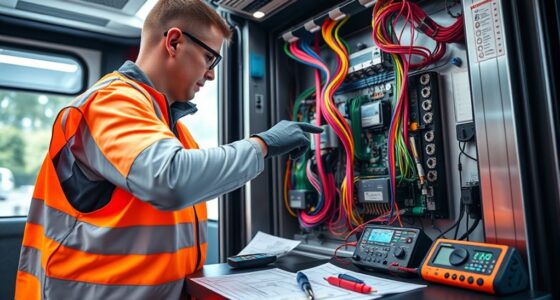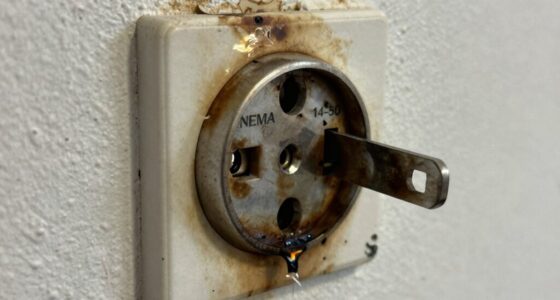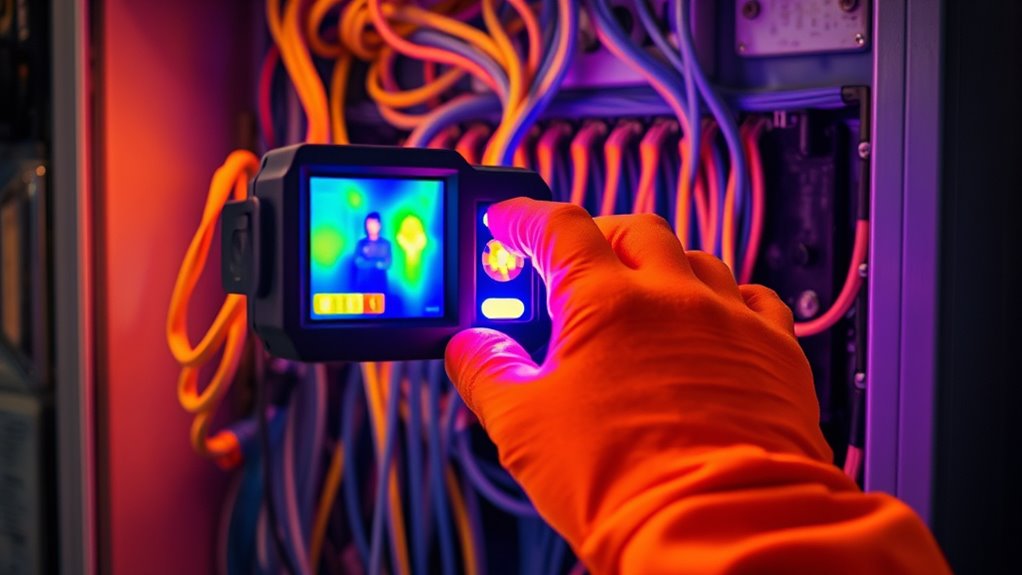

To identify shorts, ground faults, and insulation issues, use fault current analysis and measurement tools like clamp meters and insulation testers. Shorts often cause high fault currents through conductor contact, while ground faults involve current leakage to earth. Insulation faults develop gradually or suddenly, reducing resistance. Proper testing pinpoints the fault location and severity, ensuring protective devices are correctly coordinated. Continuing explore how these techniques help you isolate faults quickly and keep your system safe.
Key Takeaways
- Use clamp meters and ground fault locators to measure current flow and identify abnormal current paths indicating faults.
- Conduct insulation resistance testing to detect deterioration or breakdowns in wiring insulation.
- Analyze fault current levels to distinguish between short circuits, ground faults, and insulation issues.
- Implement selective protective device coordination to isolate specific faults without affecting the entire system.
- Trace fault origins systematically by combining measurement data with system schematics and device settings.
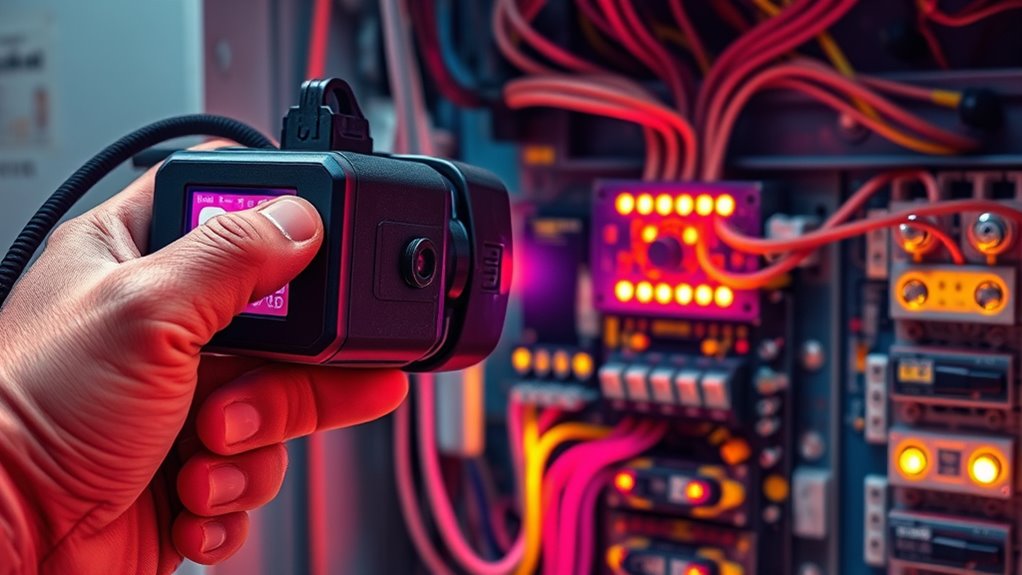
Have you ever wondered how technicians quickly locate and fix electrical faults? It all begins with understanding the importance of protective device coordination and fault current analysis. When a fault occurs—be it a short circuit, ground fault, or insulation breakdown—the electrical system responds rapidly. Protective devices, like circuit breakers and fuses, are designed to trip and disconnect faulty sections. But for these devices to work effectively, they must be properly coordinated. This means selecting and setting devices so that the one closest to the fault trips first, minimizing disruption to the rest of the system and preventing unnecessary outages. Fault current analysis plays a critical role here; it involves calculating the maximum current that could flow during a fault. Knowing this helps engineers choose protective devices with appropriate ratings, ensuring they trip quickly and safely without nuisance trips or failures.
Proper protective device coordination and fault current analysis are key to quick, safe electrical fault detection and resolution.
Once a fault occurs, the technician’s priority is to isolate it swiftly. To do that, they rely on detailed fault current analysis to understand how much current is flowing through different parts of the system during abnormal conditions. This information guides the placement of test points and the selection of test equipment, allowing for precise fault detection. By analyzing the fault current levels, you can pinpoint whether the issue stems from a short circuit—where conductors come into unintended contact—or from a ground fault, where current leaks to the earth, often due to insulation failure. Insulation issues are especially tricky because they can develop gradually, making early detection essential to prevent more severe damage or fire hazards. Additionally, understanding Floating on Water concepts can help in assessing environmental effects on insulation and fault behavior in certain settings.
Technicians often use specialized tools like clamp meters, insulation testers, and ground fault locators during this process. These devices help measure current flow and check insulation resistance, enabling you to trace the fault back to its source. When combined with an understanding of protective device coordination, these measurements become even more effective. For example, if a circuit breaker trips during a fault, analyzing the fault current helps determine whether it was set correctly or if the system needs adjustment. Fault current analysis also ensures that protective devices are not only correctly rated but also properly synchronized, reducing the risk of collateral damage.
In essence, understanding protective device coordination and fault current analysis empowers you to quickly and accurately identify electrical issues. It allows for targeted troubleshooting, minimizing downtime and preventing further damage. Whether dealing with shorts, ground faults, or insulation problems, these tools and concepts form the backbone of efficient electrical fault isolation. By applying them diligently, you can restore safety and functionality with confidence, knowing you’re tackling the problem with precision and expertise.

AstroAI Digital Clamp Meter Multimeter 2000 Counts Amp Voltage Tester Auto-ranging with AC/DC Voltage, AC Current, Resistance, Capacitance, Continuity, Live Wire Test, NCV, Blue
Important Tips – This CM2K0R clamp meter can not test DC Current. To measure the AC Current you…
As an affiliate, we earn on qualifying purchases.
As an affiliate, we earn on qualifying purchases.
Frequently Asked Questions
How Do Environmental Factors Influence Electrical Fault Occurrences?
Environmental factors markedly influence fault prevalence by increasing the likelihood of electrical issues. You’ll find that moisture, temperature fluctuations, and dust cause insulation deterioration and corrosion, making faults more common. High humidity can lead to ground faults, while extreme temperatures cause expansion and contraction, stressing components. By understanding the environmental impact, you can better prevent faults, ensuring safer, more reliable electrical systems. Regular inspections help mitigate these environmental effects effectively.
What Safety Precautions Are Essential During Fault Isolation?
Imagine stepping into a storm where sparks fly unpredictably. You must wear personal protective equipment like insulated gloves and eye protection to shield yourself from hidden dangers. Follow lockout/tagout procedures meticulously to guarantee circuits are dead before working. These safety measures act as your armor, preventing shocks and injuries during fault isolation. By staying vigilant and prepared, you turn a risky task into a controlled, safer operation.
Can Software Tools Predict Potential Electrical Faults?
Software prediction and fault forecasting tools can help identify potential electrical faults before they happen. You can use specialized software that analyzes data patterns and system behaviors to forecast possible shorts, ground faults, or insulation issues. These tools don’t guarantee perfection but markedly improve your ability to anticipate problems, allowing you to take preventive measures. By integrating fault forecasting into your maintenance routine, you enhance safety and reduce unexpected outages.
What Are the Latest Technological Advancements in Fault Detection?
You’re seeing rapid advancements in fault detection thanks to advanced sensors and machine learning algorithms. These sensors constantly monitor electrical systems, providing real-time data, while machine learning identifies patterns that signal potential faults. This combo allows you to detect shorts, ground faults, and insulation issues more quickly and accurately, reducing downtime and preventing damage. Embracing these technologies helps you stay ahead in maintaining electrical system safety and reliability.
How Do Repair Costs Compare Between Different Fault Types?
Repair costs vary depending on the fault type. Shorts often cost less to fix because they’re usually straightforward to locate and repair. Ground faults can be more expensive due to additional testing and potential damage to wiring. Insulation issues tend to be the most costly, as they often require extensive work and component replacement. Your choice of repair approach and the fault’s complexity directly influence the overall costs.

Klein Tools ET600 Multimeter, Megohmmeter Insulation Tester, 4000 Ohms Resistance, 125V/250V/500V/1000V, Auto-Ranging TRMS Multimeter
INSULATION RESISTANCE TESTING: The Voltage Tester measures insulation resistance up to 4000MΩ at 125V, 250V, 500V, and 1000V…
As an affiliate, we earn on qualifying purchases.
As an affiliate, we earn on qualifying purchases.
Conclusion
Understanding electrical fault isolation is vital, as nearly 60% of electrical failures stem from shorts, ground faults, or insulation issues. By mastering these techniques, you can quickly pinpoint problems, prevent costly downtime, and guarantee safety. Remember, timely detection reduces risks and keeps systems running smoothly. Stay vigilant, use the right tools, and don’t underestimate the significance of thorough fault isolation—your safety and equipment depend on it.

TEMPO Communications PE2003-G Pulser Ground Fault Locator, Underground Wire Break Locator, High-Voltage Signal, A-Frame Receiver, Underground Wire Locator
PRECISE FAULT IDENTIFICATION: The PE2003-G Pulser Ground Fault Locator accurately identifies even the smallest breaks in buried wire…
As an affiliate, we earn on qualifying purchases.
As an affiliate, we earn on qualifying purchases.
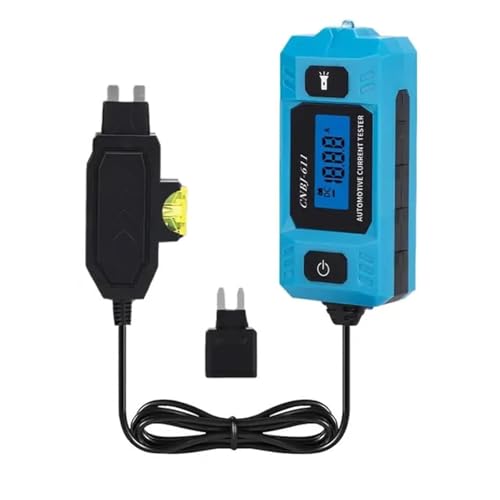
Automotive Circuit Fault Probe Tester, High-Precision Current and Circuit Tester, ABS/PC 1PC Design, 20A 48V Fuse Blade Checker with LCD Screen and Front Light
【Accurate Automotive Circuit Testing】High-precision automotive circuit fault tester measures current up to 20 amperes at 48 volts. Detects…
As an affiliate, we earn on qualifying purchases.
As an affiliate, we earn on qualifying purchases.