TL;DR

Get business pricing on monitors, keyboards and dev gear
- Business-only prices and quantity discounts
- Tax-exempt purchasing
- Multiple users, one account, clear invoices
Elgin Community College asked Flock Safety to remove six license plate reader cameras after concerns that surveillance could put immigrant students at risk. The company initially refused, according to college President Peggy Heinrich, and the cameras stayed in place until the contract expired in April 2026. Public records show immigration-related searches involving Flock data at other Illinois colleges, though Elgin said its own audit found no evidence of federal access.
Elgin Community College says Flock Safety refused to remove six automated license plate reader cameras after the school asked to end their use amid concerns about immigrant student safety. The cameras remained on campus until the contract expired in April 2026, when Flock removed them, according to college President Peggy Heinrich and reporting by Open Campus.
The college installed the cameras in April 2025, intending to help locate stolen vehicles and missing people. Flock’s readers use artificial intelligence to capture license plate numbers and details about passing vehicles, including vehicle models, dents and bumper stickers. Heinrich said her view changed after reports that data from Flock cameras in Illinois had been shared with U.S. Customs and Border Protection.
In September 2025, Immigration and Customs Enforcement detained an Elgin Community College student in a campus parking lot. More than half of the college’s students identify as Latino. Heinrich said enrollment dipped and students were afraid to attend class. She said a college audit found no evidence that federal immigration agents had accessed Elgin’s camera data, but officials still asked Flock to take the cameras down “out of an abundance of caution for our students.”
Heinrich told Open Campus that staff first requested cancellation and removal in October 2025. Flock rejected the request within a day, she said, arguing that it had not breached its agreement. In December, the college offered to pay the remaining five months of the contract if the cameras were removed; Heinrich said the company did not respond. Staff then covered the equipment with black trash bags and zip ties, but workers in an unmarked vehicle repeatedly removed the coverings. The contract ended and the cameras came down in April 2026.
Campus Surveillance and Student Trust
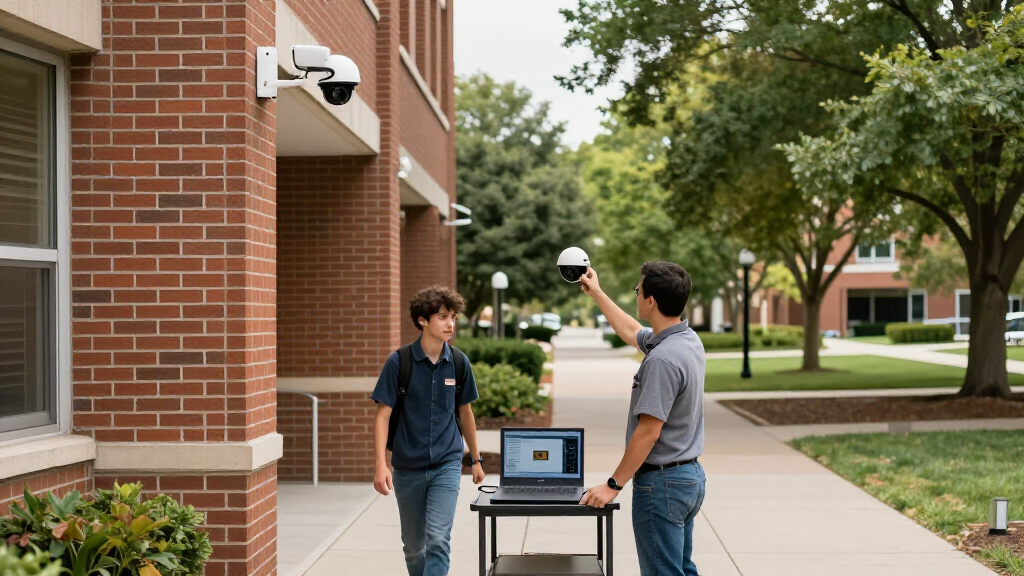
The dispute shows that a college’s decision to stop using surveillance equipment may not mean it can immediately remove the equipment. In Elgin’s case, Flock retained ownership of the cameras, and the college said the company would not take them down before the agreement expired. That left the school trying to prevent the cameras from recording while they remained physically installed.
The stakes extend beyond one campus. Public records obtained by surveillance researcher Torin Monahan and WBEZ show that Flock camera data at other Illinois public campuses was searched dozens of times last year in connection with immigration enforcement. In some instances, federal immigration authorities directly accessed college data. The Illinois Secretary of State also found that CBP had searched Illinois Flock data in violation of state law. Those findings do not establish that Elgin’s cameras were accessed; the college says its review found no evidence of that.
For students who may fear immigration enforcement, the presence of license plate readers can affect whether they feel safe traveling to class, regardless of whether a particular search of their campus data is documented. Elgin’s decision reflects a concern about the possible harm and loss of trust, not proof that federal agents used its cameras.
As an affiliate, we earn on qualifying purchases.
Other Illinois Campuses Still Have Cameras
Flock Safety sells automated license plate readers to public agencies and institutions. The cameras collect vehicle information that can be searched through a broader surveillance network. The company has said federal agencies, including ICE, can no longer access local Flock data unless a law enforcement agency grants access. That policy statement does not resolve how past searches occurred or how access controls operate in each case.
Open Campus reported that Flock cameras remain installed at several Illinois colleges, including five of the state’s 12 public universities and four community colleges. Joliet Junior College has seven cameras, and students entering its main campus pass at least one. Records also showed immigration-related searches involving Flock data at Joliet Junior College, the University of Illinois Chicago and the University of Illinois Urbana-Champaign.
Students and educators across Illinois have called on college leaders to end contracts with Flock, citing privacy and safety concerns. Monahan, a surveillance researcher and professor at the University of North Carolina at Chapel Hill, told Open Campus that the company benefits from having a wide camera network because prospective customers value its reach. That is an expert’s explanation of the company’s incentives, not a stated reason for Flock’s response to Elgin.
“We’re just doing everything we can here to be sure this feels like a safe place for our students to come. We want them to come here and to be able to focus on learning.”
— Peggy Heinrich, Elgin Community College president
As an affiliate, we earn on qualifying purchases.
Access to Campus Camera Data
It is not clear from the available reporting exactly how many immigration-related searches involved each Illinois campus, what information was returned in individual searches, or whether the searches led to enforcement actions. The Secretary of State’s finding concerned CBP searches of Illinois Flock data and a violation of state law; the report does not establish that every search at a college was unlawful.
Elgin says its own audit found no evidence of federal immigration access to its camera data. The college’s concerns followed broader reports and the detention of a student on campus, but those events do not prove the cameras contributed to that detention. Flock did not respond to WBEZ’s request for comment, according to Open Campus. The report does not give the full contract terms or explain what remedies were available to the college before the agreement expired.
automated license plate reader removal kit
As an affiliate, we earn on qualifying purchases.
As an affiliate, we earn on qualifying purchases.
Calls for Colleges to Review Contracts
The cameras at Elgin Community College have been removed, but the broader issue remains active at other Illinois campuses where Flock equipment is still installed. Students and educators are pressing college leaders to reconsider contracts, while questions persist about data-sharing practices and the safeguards governing searches.
The source report does not identify a specific date for additional reviews, contract decisions or regulatory action. Further developments will depend on decisions by individual colleges and any new findings about access to campus camera data. Colleges weighing whether to continue these agreements may also face questions about contract cancellation rights, who controls the equipment, and how students are informed about surveillance.
campus surveillance privacy shield
As an affiliate, we earn on qualifying purchases.
As an affiliate, we earn on qualifying purchases.
Key Questions
Why did Elgin Community College ask Flock to remove its cameras?
The college cited concern that surveillance could undermine immigrant students’ sense of safety, particularly after reports of immigration-related searches of Flock data in Illinois and an ICE detention in a campus parking lot. Heinrich said the college found no evidence federal agents had accessed Elgin’s own data.
When were the Elgin cameras removed?
Flock removed the six cameras in April 2026, when the college’s contract expired, according to Heinrich and Open Campus.
Did federal immigration agents access Elgin’s camera data?
The college said its audit found no evidence that federal immigration agents accessed Elgin’s data. Public records documented immigration-related searches at other Illinois campuses, but that does not establish access to Elgin’s cameras.
Are Flock cameras still at other Illinois colleges?
Yes. Open Campus reported that cameras remained at five of Illinois’ 12 public universities and four community colleges. Public records also showed immigration-related searches involving data from several campuses, including Joliet Junior College and the University of Illinois campuses in Chicago and Urbana-Champaign.
Source: fediverse
Columbus Day / Indigenous Peoples' Day Picks
long weekend sales
As an affiliate, we earn on qualifying purchases.