TL;DR

Get business pricing on monitors, keyboards and dev gear
- Business-only prices and quantity discounts
- Tax-exempt purchasing
- Multiple users, one account, clear invoices
Google says its three-year partnership with Ignite Energy Access has supported delivery of 3.7 million solar devices across sub-Saharan Africa since 2023. Google estimates the partnership enabled more than 160,000 metric tons of carbon-dioxide-equivalent emissions reductions in the first half of 2026; it is also developing mapping and logistics tools, with community microgrids for electric cooking under study.
Google said Oct. 26 that its three-year partnership with Ignite Energy Access has helped deliver 3.7 million solar devices across sub-Saharan Africa since 2023, while the company estimates the work enabled more than 160,000 metric tons of CO2-equivalent emissions reductions in the first half of 2026. The partnership is developing mapping, routing and supply-chain tools to help reach households outside conventional electricity networks.
Google said its Startups for Sustainable Development program brought Ignite together with its researchers, engineers and data specialists for more than 100 advisory sessions over three years. Ignite aims to connect 100 million people across Africa to electricity by 2030, according to Google’s report. The report describes work to address three practical barriers: finding homes without formal addresses, delivering equipment over rural routes that are often unmapped, and identifying small solar installations in satellite imagery.
For household targeting, the teams combined satellite imagery with Google’s Open Buildings dataset and routing algorithms. Google said its researchers are developing geospatial models to identify rural paths and incorporate them into route planning. Its operations-research models are also being used to assess where warehouses and local distribution hubs could be located, taking account of transport costs, routes, vehicle capacity and inventory expenses.
The partners are developing computer-vision models to detect small rooftop solar systems from orbit. A single panel can occupy roughly one pixel in standard satellite imagery, Google said, making large-scale visual identification difficult. The models use Gemini for Science and are being fine-tuned against drone imagery supplied by Ignite. Google said teams are testing code variations to improve precision and recall; it did not report final performance results.
Reaching Homes Beyond Power Lines
For households beyond the reach of grid infrastructure, off-grid solar can provide basic electricity without waiting for conventional network expansion. The work described by Google focuses on operational problems that can limit deployment even when solar equipment is available: teams need to find scattered homes, plan deliveries across difficult terrain and identify where systems have already been installed.
If the tools work reliably in field conditions, they could help energy providers plan routes and future deployments with better information. Google’s reported 3.7 million device deliveries indicate the scale of activity associated with the partnership, but the report does not establish how many individual households gained access, how long the devices remain in service, or what share of the region’s electricity gap they address.
The emissions figure also needs to be read as a company estimate, not an independently verified measurement in the report. Google links the estimated reductions to solar devices delivered since 2023, but does not provide the calculation method or a comparison baseline in the material supplied. That limits what readers can conclude about the estimate’s scope and accuracy.
Popular right now

TCL 85 Designer Series QD-Mini LED TV (Model 85A400U) with Google Smart TV

Hisense 85 U6 Pro Series Mini-LED ULED 4K UHD HDR Gaming AI Smart Fire TV (85U6SF Pro)

LG 85-inch QNED75B Mini LED Smart TV Bundle with HDMI and CPS Protection Plan
As an affiliate, we earn on qualifying purchases.
From Solar Kits to Microgrids
Google frames the partnership against a large access gap: it says more than 600 million people in sub-Saharan Africa live without electricity. The company describes households relying on kerosene and candles for lighting, while rural homes may be missing from standard mapping services because they lack formal addresses and are reached by dirt paths.
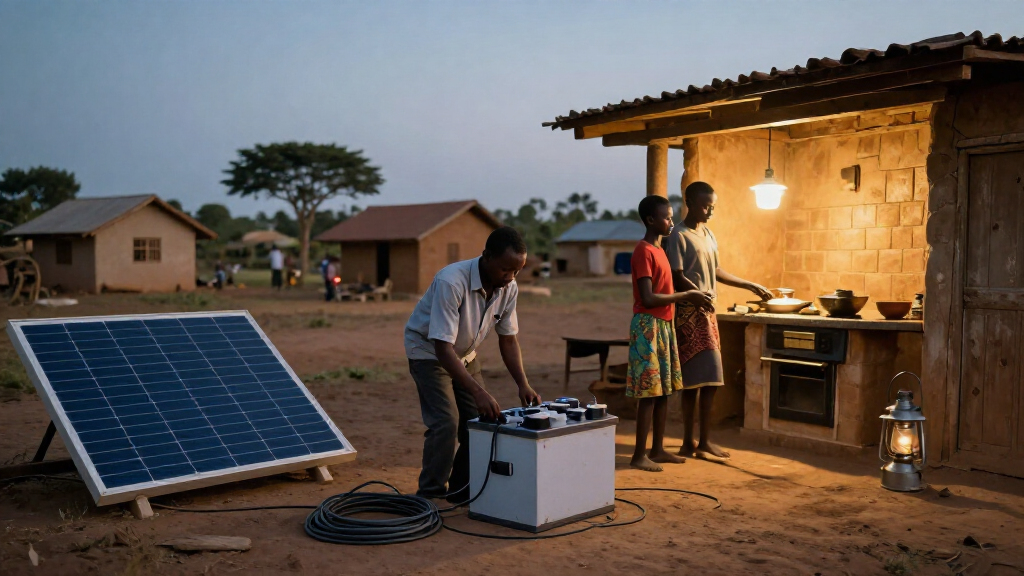
The current work centers on individual solar systems, often made up of one rooftop panel. Google says the teams are now modeling community-level microgrids as a possible next step toward electric cooking. Such stoves need more power than an individual rooftop kit can provide, according to the report. The proposed modeling is at an early planning stage; Google did not announce a completed microgrid or a deployment timetable.
““In the first half of 2026 alone, we estimate our partnership with Ignite Energy Access has enabled over 160,000 tCO2e in emissions reductions.””
— Google, in its Oct. 26 report
Results Still Need Field Evidence
The report does not provide the method behind the emissions estimate, independent verification, or a baseline against which the claimed reductions were calculated. It also does not disclose how many households received working systems, where the devices were delivered, or how the total is distributed across countries.
Google describes the satellite detection models as under development and provides no accuracy scores, deployment results or timetable for operational use. The report likewise gives no cost or schedule for the proposed microgrid modeling and does not say where community systems might be tested. Those details will be needed to judge whether the approach can be expanded and sustained.
Testing Models and Cooking Networks
Google says its teams are continuing to test variations of the solar-detection models and refine them using Ignite’s drone imagery. The partners are also modeling community microgrids intended to supply enough electricity for clean cooking. The report does not specify when either effort will produce public results or move into deployment.
The next useful updates would include field performance for the mapping and routing tools, independently supported emissions accounting, and details on any microgrid pilots, including locations, costs and household reach. Until then, the report establishes the partnership’s stated progress and plans, while leaving their measured outcomes and next milestones open.
Key Questions
What did Google and Ignite Energy Access report?
Google said the partnership has supported delivery of 3.7 million solar devices across sub-Saharan Africa since 2023. Google also estimated that the work enabled more than 160,000 metric tons of CO2-equivalent reductions in the first half of 2026.
How are the partners trying to find homes and plan deliveries?
Google says the teams are combining satellite imagery, the Open Buildings dataset and routing algorithms to identify homes and routes. Its operations-research models are also being used to assess possible warehouse and local-hub locations.
Are the solar-detection models already in use?
The report describes them as under development. Google says the models use Gemini for Science and are being refined with drone imagery from Ignite, but it provides no final accuracy results or operational launch date.
What is the partnership planning for clean cooking?
Google says the partners are modeling community microgrids that could supply enough power for electric cookstoves. It has not announced a deployment location, pilot schedule or completed system.
Source: blog.google