🔍 Read the full analysis: A Practical Guide To 10 Best 4K Monitors For 2027 on ThorstenMeyerAI.com

Get business pricing on monitors, keyboards and dev gear
- Business-only prices and quantity discounts
- Tax-exempt purchasing
- Multiple users, one account, clear invoices
TL;DR
A guide published by ThorstenMeyerAI.com compares 10 4K monitors for office work, creative tasks and gaming, highlighting the LG 27US500-W as its best overall pick. The recommendations are source assessments, not independent test results; model availability, pricing and performance for 2027 are not confirmed in the supplied material.
ThorstenMeyerAI.com’s guide to 10 4K monitors names the LG 27US500-W its best overall choice for most users, while recommending higher-refresh models for gaming and USB-C-equipped Dell displays for mixed work. The guide emphasizes that a monitor’s refresh rate, color performance, connectivity and stand can matter as much as its 4K resolution, but the supplied source does not provide current prices, test measurements or confirmation of 2027 availability.
The guide’s recommendations are organized around use rather than resolution alone. It identifies the ASUS TUF Gaming VG27UQ1A as a 4K gaming option with a stated 160Hz refresh rate, and the Dell S2725QC as a 120Hz choice for productivity and lighter gaming. Those higher refresh rates can make motion look smoother, but the guide cautions that driving games at 4K and high frame rates calls for a powerful graphics card.
For creative and office work, the source favors the LG 27US500-W and Samsung ViewFinity S71H for color consistency at 60Hz. It also points to Dell’s S2725QC and S3225QS for USB-C connectivity and more adjustable stands, features it says are often limited on budget competitors. The source does not include independent lab data or specify the test conditions behind its color assessments.
The guide includes 10 models, but the supplied material names only five: the LG, ASUS, two Dell models and Samsung ViewFinity S71H, along with the budget Sceptre U275W-UPT. The six named models are covered below; the other four cannot be identified from the provided source, so their specifications and recommendations are not inferred.
The 10 picks
- 1
 Dell 27" S2725QC 4K UHD IPS Monitor with 120Hz Refresh Rate and FreeSync PremiumView on Amazon →
- 2
 Dell 32 Plus 4K Monitor S3225QSView on Amazon →
- 3
 ASUS TUF Gaming VG27UQ1A 27‑inch 4K 160 Hz G‑Sync Gaming MonitorView on Amazon →
- 4
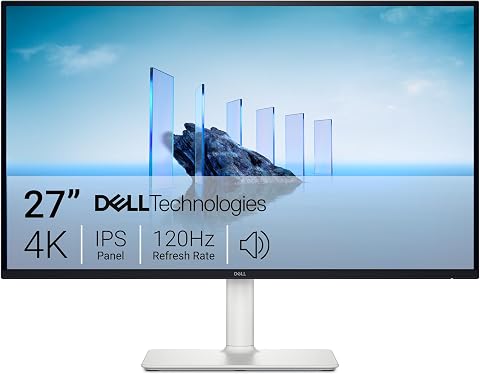 Dell 27 Monitor S2725QS, 4K UHD IPS, 120Hz, 5ms, FreeSync PremiumView on Amazon →
- 5
 Samsung ViewFinity S7 32-Inch 4K UHD Monitor (S70H)View on Amazon →
- 6
 Samsung 27" ViewFinity S7 (S71H) 4K UHD IPS HDR10 High Resolution MonitorView on Amazon →
- 7
 LG 27US500-W 27-Inch 4K UHD IPS MonitorView on Amazon →
- 8
 LG 32U701B-B 32-inch Ultrafine 4K UHD 60Hz HDR10 HDMI DP Computer MonitorView on Amazon →
- 9
 Sceptre Prime 4K IPS 27" 3840 x 2160 UHD Monitor up to 70+Hz DisplayPort HDMI…View on Amazon →
- 10
 Sceptre U275W-UPT 27-inch 4K UHD IPS MonitorView on Amazon →
Match the Monitor to the Work
The guide’s main practical point is that a 4K label does not settle which display is right for a buyer. Refresh rate affects motion, while color performance and connectivity shape creative and office workflows. Choosing a 160Hz display without hardware capable of delivering high frame rates may offer little benefit for a particular gaming setup.
Physical size also changes how the image feels. The source says 27-inch 4K screens provide denser text than 32-inch models, which can make text sharper but may require operating-system scaling. Buyers comparing prices should also account for stand adjustments, USB-C power delivery and ports—not just panel resolution.
Popular right now

Dyson V8 Cyclone Cordless Vacuum

Dyson V15 Detect Cordless Vacuum

Hisense 43-Inch S5 DécoTV Series 4K UHD Smart Fire TV with Hi-QLED Color, Dolby Vision and Atmos (43S5QF, 2026 Model)
As an affiliate, we earn on qualifying purchases.
The Six Models Named in the Source
1. LG 27US500-W: Best Overall
The guide selects the LG 27US500-W for a balance of IPS clarity, color accuracy and price. Its 60Hz refresh rate is better suited to general work and content viewing than competitive gaming, according to the source’s broader tradeoff discussion. No price or measured accuracy result is provided.
2. ASUS TUF VG27UQ1A: High-Refresh Gaming
The ASUS TUF Gaming VG27UQ1A is the source’s gaming pick, with a stated 160Hz at 4K. The guide warns that reaching high frame rates at that resolution demands substantial GPU capability; it does not supply game-specific performance tests.
3. Dell S2725QC: Mixed Work and Play
The Dell S2725QC is presented as a 120Hz option for productivity and light gaming. The source also highlights Dell S-series USB-C connectivity and stand ergonomics, but does not give port-by-port specifications in the material supplied.
4. Dell S3225QS: Larger Dell Option
The Dell S3225QS appears among the guide’s Dell S-series recommendations for connectivity and adjustable stands. Its larger 32-inch format may suit viewers who prefer a bigger screen, though the source notes that larger 4K panels have lower pixel density than 27-inch displays.
5. Samsung ViewFinity S71H: Color-Focused Work
The guide recommends the Samsung ViewFinity S71H for color consistency at 60Hz. That makes it a potential fit for creative work where color matters more than fast motion, but the source says models in this category lack the adaptive-sync features sought by competitive gamers.
6. Sceptre U275W-UPT: Budget Display
The Sceptre U275W-UPT is described as a budget 4K choice, with compromises in brightness and stand adjustment. The source suggests it may work better as a secondary display than as a main workstation screen; no brightness measurement or specific price is included.
“The LG 27US500-W stands out as the best overall 4K monitor for most users.”
— ThorstenMeyerAI.com guide
Prices and Test Evidence Missing
The supplied source does not identify four of the promised 10 monitor picks, so they cannot be described without adding unsupported details. It also provides no publication date, current prices, retailer availability, test methodology or measured results for brightness, color accuracy, response time and HDR performance. The guide’s assessments should be read as its editorial recommendations, not as independently verified findings.
Specific connectivity claims also need checking against manufacturer specifications for the exact model and regional version. The source discusses USB-C power delivery and adaptive sync as selection factors, but does not establish which ports, power levels or sync standards each named monitor supports.
Verify Models Before Buying
Readers considering a purchase should check current manufacturer specifications and local listings for price, ports, stand adjustments and warranty. Gaming buyers should confirm their graphics card can support the resolution and refresh rate they intend to use. The supplied guide gives no date for future testing or updates, so whether its rankings or availability will change in 2027 remains unknown.
Key Questions
Which 4K monitor does the guide recommend overall?
ThorstenMeyerAI.com names the LG 27US500-W its best overall pick, citing a balance of IPS clarity, color accuracy and price. The source does not provide a current price or independent test results.
Do I need a powerful graphics card for a 4K monitor?
Not for every use. The guide says static office tasks can work well at 60Hz, but 4K gaming at 120Hz or 160Hz can require a powerful GPU to produce high frame rates. The right requirement depends on the games and settings.
Is a 27-inch or 32-inch 4K monitor sharper?
At the same resolution, a 27-inch display has higher pixel density than a 32-inch one, so text may appear sharper. Larger screens can make content physically bigger; some users may need to adjust display scaling.
Does HDR10 support guarantee strong HDR picture quality?
No. The guide warns that an HDR10 input label alone does not establish meaningful high-dynamic-range performance. Brightness and local dimming also affect HDR, and the supplied source gives no model-by-model HDR measurements.
Does the source actually identify all 10 monitors?
No. The supplied material names six distinct models, not 10. The other four picks cannot be confirmed from the source provided for this article.
Source: ThorstenMeyerAI.com