📊 Full opportunity report: Best Quiet Case Fans + the Airflow Setup That Actually Works on ThorstenMeyerAI.com — validation score, market gap, and execution plan.

Get business pricing on monitors, keyboards and dev gear
- Business-only prices and quantity discounts
- Tax-exempt purchasing
- Multiple users, one account, clear invoices
TL;DR
This article identifies the best quiet case fans for 2026 and explains an effective airflow setup. Proper fan selection and configuration can deliver both cooling and silence for high-power workstations.
In 2026, the top-rated quiet case fans have been identified as the Noctua NF-A12x25 and NF-A14, which, combined with a specific airflow setup, can achieve effective cooling while maintaining near-silence in high-performance workstations.
The Noctua NF-A12x25 is widely regarded as the best-engineered 120mm fan, moving over 100 CFM at less than 16 dB of noise, thanks to its refined bearing and motor. Its larger counterpart, the NF-A14, offers similar performance at 140mm. Arctic’s P12 Pro and P14 PWM PST fans provide high value, delivering nearly comparable airflow and static pressure performance at a fraction of the cost, making them ideal for budget-conscious builds. For absolute silence, be quiet!’s Silent Wings 4 fans excel, producing around 17 dB with stable operation even at high RPMs. Fans designed for radiators, such as the Arctic P12 Pro and Noctua NF-F12, are optimized for static pressure, essential for cooling AIO radiators or dense heatsinks. The guiding principle is to use large, slow-moving fans to generate airflow, which reduces noise significantly while maintaining effective cooling.Best quiet case fans
+ the airflow that works.
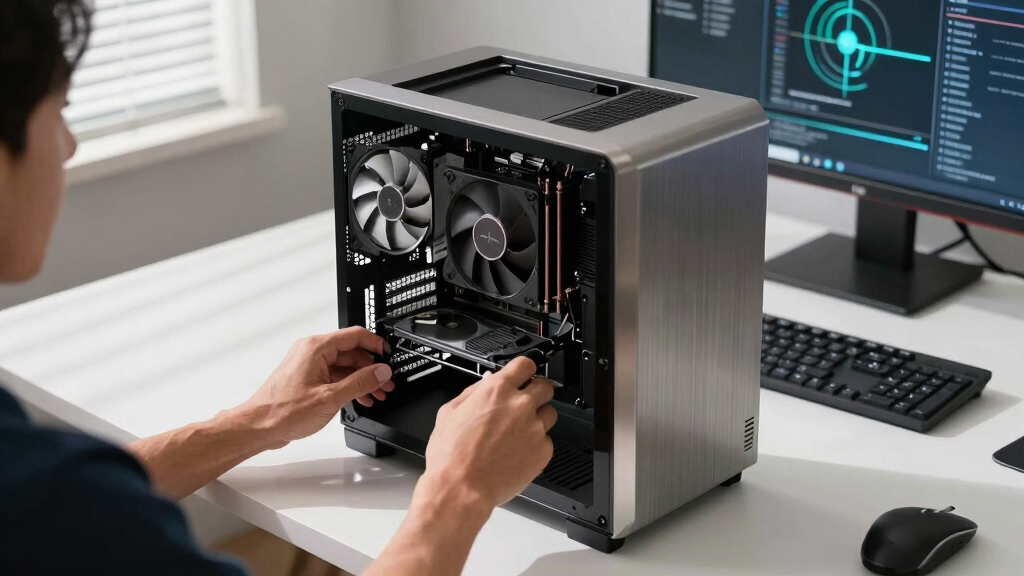
The best fan won’t help if it’s pointed the wrong way. The whole recipe: big fans, running slowly, in a clean front-to-back path, with slightly more intake than exhaust. Build a config in Part 2 and watch the pressure balance respond.
Why Proper Fan Choice and Airflow Matter in 2026
Choosing the right fans and airflow setup is critical for high-performance workstations that require both effective cooling and low noise levels. Proper configuration extends hardware longevity, improves user comfort, and ensures consistent performance, especially under sustained AI workloads. As noise reduction becomes increasingly important in shared workspaces or offices, these optimized setups help users maintain productivity without distraction or thermal throttling, making this guidance highly relevant for builders and users aiming for quiet, reliable systems.Popular right now

Bose QuietComfort True Wireless Earbuds with Active Noise Cancellation, Black

Ninja Flip Toaster Oven and Air Fryer, 8-in-1, Stainless Steel, SP151

KitchenAid Artisan 5-Quart Tilt-Head Stand Mixer, Almond Cream
As an affiliate, we earn on qualifying purchases.
Advances in Quiet Fan Technology and Cooling Strategies
Over recent years, fan engineering has shifted toward larger, slower fans that move air efficiently with less noise. The 2026 landscape features refined designs like Noctua’s NF-A12x25, which combine high airflow with near-silent operation. Budget options like Arctic’s P12 Pro have closed the performance gap at a lower price point, broadening options for builders. The importance of airflow setup—using larger fans on flat curves and pairing static-pressure fans with radiators—has become a standard best practice for achieving optimal cooling with minimal noise. These developments reflect ongoing industry efforts to balance performance, reliability, and acoustic comfort in high-power systems."Big, slow fans are the key to quiet, effective cooling in high-performance workstations. Moving more air at lower RPMs reduces noise without sacrificing thermal performance."
— Thorsten Meyer, expert in PC cooling
Remaining Questions About Optimal Fan Configurations
It is still unclear how specific airflow setups perform across different case models and configurations in real-world, long-term use. Variations in case design, ambient conditions, and load profiles may influence effectiveness, and ongoing testing is needed to refine recommendations.Next Steps for Builders and Users in 2026
Manufacturers are expected to release new fan models with improved acoustics and airflow efficiency. Further testing and user feedback will help refine airflow configurations, especially for custom high-power setups. Users should monitor updates from leading brands and consider experimenting with fan curves and placement to achieve optimal results tailored to their specific hardware and environment.Key Questions
What is the best fan size for quiet operation?
Large fans, such as 140mm models, are generally quieter because they move the same amount of air at lower RPMs compared to smaller fans.
Should I use airflow fans or static-pressure fans for my case?
Use airflow fans for case intake and exhaust; static-pressure fans are best for radiators and dense heatsinks where air must be forced through restrictive surfaces.
Are budget fans like Arctic P12 Pro suitable for high-performance workstations?
Yes, Arctic P12 Pro fans deliver nearly comparable airflow and static pressure performance at a much lower cost, making them a smart choice for budget builds.
How can I tune my fans for maximum silence?
Set fans to run on flat, low RPM curves and prioritize larger fans that move more air slowly, reducing noise while maintaining adequate cooling.
Source: ThorstenMeyerAI.com