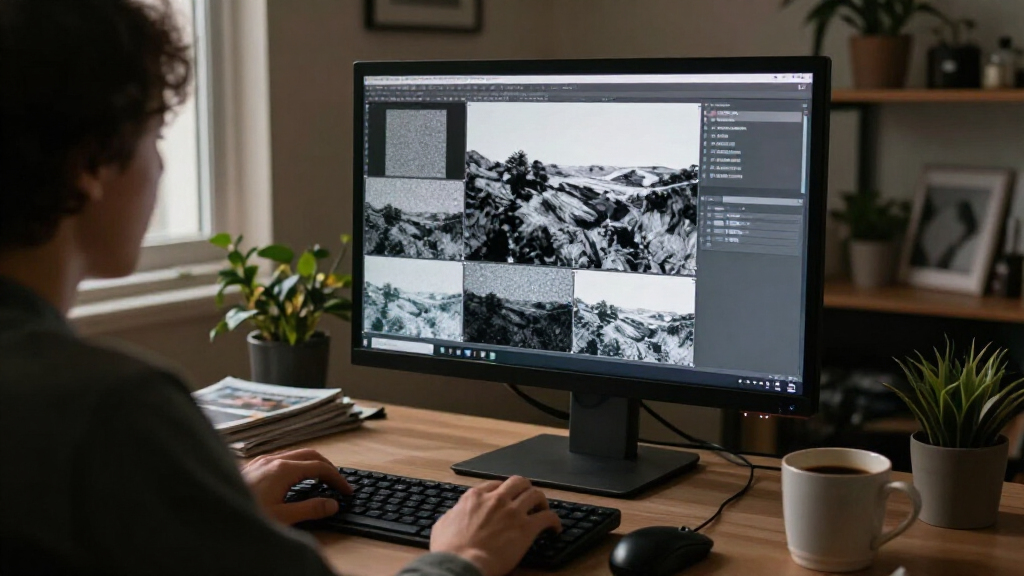

🔍 Read the full analysis: Noise, Steps, Picture: How Diffusion Models Generate Images on ThorstenMeyerAI.com

Get business pricing on monitors, keyboards and dev gear
- Business-only prices and quantity discounts
- Tax-exempt purchasing
- Multiple users, one account, clear invoices
TL;DR
Diffusion models generate images by learning to predict and remove noise added to training images, then running a similar process in reverse from random noise. The method explains how prompts guide generation, why image models can struggle with text and object placement, and why memorization and copyright questions remain relevant.
Diffusion models generate images by starting with random noise and repeatedly estimating and removing part of it, according to a technical explainer published by ThorstenMeyerAI.com on November 23. The account traces the process from training through prompt-guided generation and describes how the method helps explain familiar weaknesses such as misspelled text and misplaced objects.
Training begins with real images that are gradually corrupted by adding noise. A neural network is shown a noisy image and the step in that corruption process, then trained to predict the noise that was added. The explainer points to the 2020 paper “Denoising Diffusion Probabilistic Models,” by Jonathan Ho, Ajay Jain and Pieter Abbeel, as a key practical account of this approach. Their experiments used 1,000 noise steps.
Image generation runs the learned process in reverse. The model begins with random values, predicts noise and removes some at each step. Repeated estimates gradually produce an image: large-scale forms appear before fine details, according to the 2020 paper. Later systems use fewer generation steps to reduce the time required, although the source material does not provide a full account of current systems or a single standard step count.
Many image generators do this work in a compressed representation rather than directly on every pixel. The explainer says Stable Diffusion v1 compresses a 512-by-512 image into a representation with 48 times fewer numbers. A text encoder turns a prompt into numerical features, and guidance steers the denoising process toward those features. The source says stronger guidance can bring results closer to the prompt, while potentially reducing image quality.
Why Prompted Images Still Misfire
The process helps explain why an image can look convincing while getting a detail wrong. A model is trained to estimate patterns and remove noise, not to follow a human-like plan that guarantees exact counts, spelling or spatial relationships. The source identifies lettering, counting and object placement as recurring difficulties; a requested cube may appear beside a sphere rather than on top of it.
Knowing how generation works also matters for interpreting questions about training data. The model’s stated training objective is to predict noise, rather than reproduce a stored clean image. That objective alone does not establish that a model cannot retain or reproduce material from its training set. The explainer reports that researchers have extracted near-copies of training images from models, making memorization a separate issue from the way the training objective is described.
For users, the practical implication is that prompts guide rather than guarantee outcomes. For researchers, developers and policymakers, the process provides a basis for discussing model behavior, evaluation and the limits of claims about how generated images relate to training material.
Popular right now

Dyson Ball Animal 2 Total Clean Upright Vacuum Cleaner, Blue

Bose QuietComfort Headphones (2nd Gen), Wireless Over-Ear Noise-Cancelling Headphones, Black

Roborock Qrevo S Pro Robot Vacuum and Mop with Multifunctional Dock
As an affiliate, we earn on qualifying purchases.
From Noise Experiments to Latent Images
The basic idea predates today’s image generators. In 2015, Jascha Sohl-Dickstein and colleagues described a method that gradually destroys structure in data and learns a reverse process to restore it. The analogy in the explainer is a drop of ink spreading through water: the forward process disperses structure, while the learned reverse process attempts to recover it.
Ho, Jain and Abbeel’s 2020 work made the approach practical for image generation. Their paper describes a sequence that adds noise until the original signal is effectively lost, and a neural network trained to estimate that noise. Later latent-diffusion systems reduce computational work by operating on compressed image representations. The explainer cites Stable Diffusion v1 as an example and says its training used subsets of the public LAION-2B(en) image dataset.
The source also places copyright questions alongside technical issues. It reports that a UK court ruled in 2025 that Stable Diffusion itself was not an “infringing copy,” while other questions remained open. That specific ruling should not be read as resolving every dispute about training data, generated outputs or copyright law in other jurisdictions.
“The loss is a reconstruction objective between the noise that was added to the latent and the prediction made by the UNet.”
— Stable Diffusion v1-4 model card, as quoted by ThorstenMeyerAI.com
Limits of the Evidence and Rulings
The source provides a technical account, not a new experiment comparing current image models. Its examples and figures should not be taken as measurements of every diffusion system: architectures, training sets, compression methods and generation settings vary. The article’s stated step counts and Stable Diffusion v1 details are specific examples, not universal defaults.
The extent to which models retain or reproduce particular training images remains a distinct question from whether they are trained to predict noise. The source says researchers have extracted near-copies, but it does not specify the studies, frequency or conditions in the material provided. It also does not detail the scope of the UK court’s 2025 ruling or how it applies to other legal claims. Those questions remain unsettled in the account.
Further Tests and Legal Questions
The explainer does not announce a new product, study or policy change, so there is no specific next milestone reported. For readers assessing a particular image model, the relevant next evidence would include its model documentation, training-data disclosures, evaluation results and testing of prompt accuracy and image reproduction.
Legal developments will depend on the claims brought and the jurisdictions involved. The reported UK decision addresses Stable Diffusion in a particular legal setting; it does not settle all questions about training or outputs. Further court decisions and research into memorization may clarify those issues, but their timing and outcome are not established by the source.
Key Questions
Does a diffusion model search for a matching image?
Not as described in this account. It starts from random noise and repeatedly estimates and removes noise to form an image. That does not by itself rule out the possibility that a model may reproduce material resembling something in its training data.
How does a prompt affect the result?
A text encoder converts prompt words into numerical features, and guidance steers the denoising process toward them. Stronger guidance can make an output adhere more closely to the prompt, but the source says this can come at a cost to image quality.
Why do image models often get words or object positions wrong?
The method learns to estimate noise and form plausible image patterns; it does not guarantee exact spelling, counting or spatial relationships. The source identifies text, counts and object placement as common weaknesses.
Does the reported UK ruling settle AI image copyright?
No. The source says a UK court ruled in 2025 that Stable Diffusion itself was not an “infringing copy,” while other questions remained open. It does not establish a universal ruling on training data or generated images.
Source: ThorstenMeyerAI.com