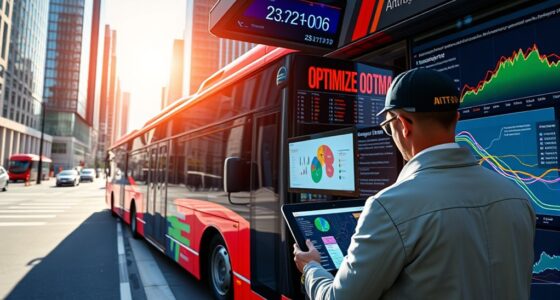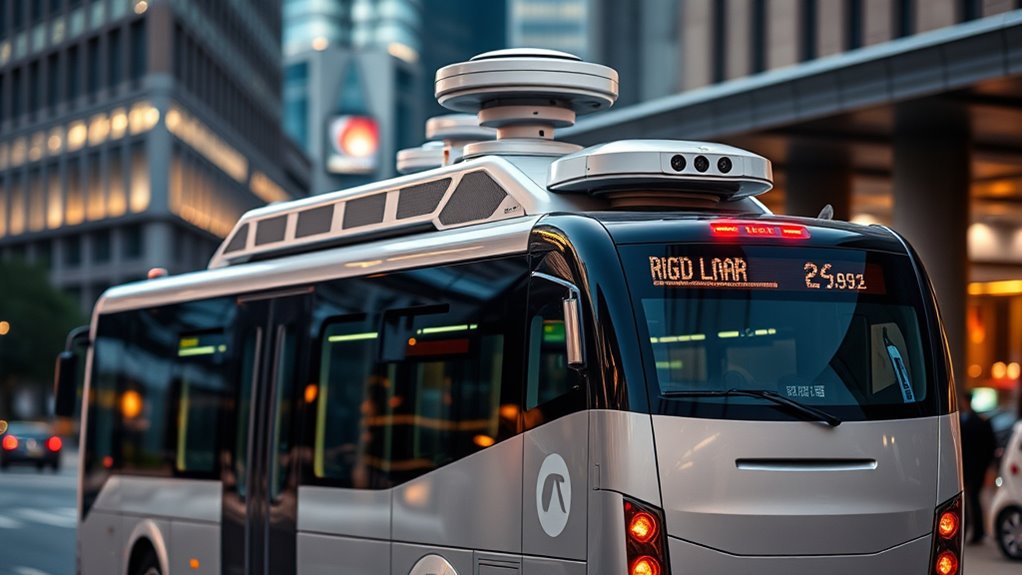

Advances in LiDAR, radar, and cameras are transforming autonomous bus sensors, making them more accurate and reliable. You’ll find that modern LiDAR provides detailed 3D environmental maps even in low visibility, while radar detects objects at longer ranges regardless of weather. Cameras add visual context for traffic signals and signs. The integration of these sensors, known as sensor fusion, creates a complete perception system that’s essential for safe navigation. Keep exploring to discover how these innovations keep urban transit smarter and safer.
Key Takeaways
- Advances in LiDAR technology now offer higher resolution, longer range, and better performance in adverse weather conditions.
- Radar sensors have seen improvements in range, accuracy, and integration capabilities, enhancing obstacle detection in various environments.
- Sensor fusion algorithms combine LiDAR, radar, and camera data for more comprehensive and reliable perception of complex urban scenarios.
- Enhanced perception systems leverage real-time environmental mapping to improve navigation, obstacle avoidance, and dynamic scenario understanding.
- Ongoing innovations in sensor processing and AI enable faster, more adaptive responses, increasing safety and efficiency in autonomous bus operations.
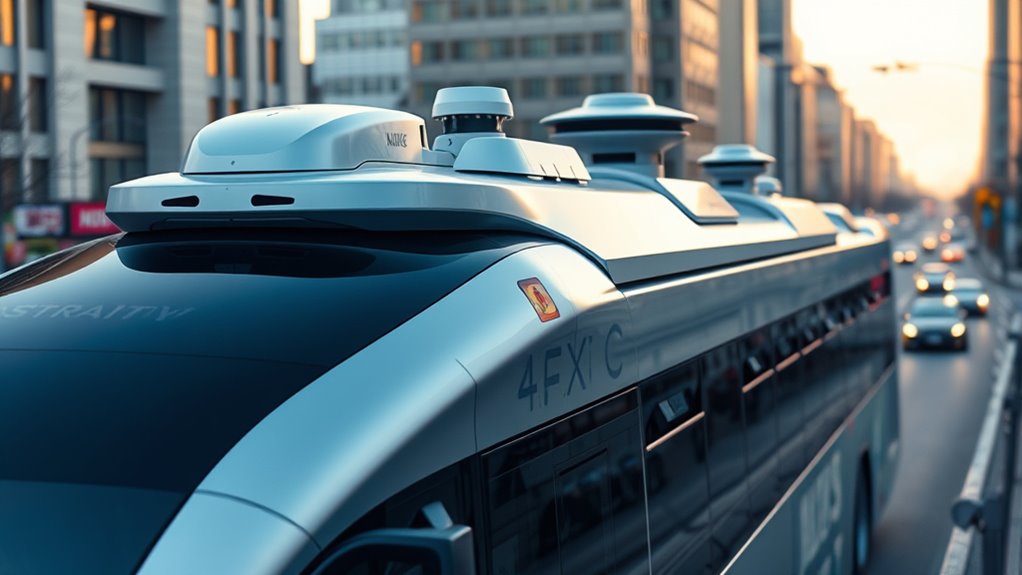
Autonomous bus sensors are essential components that enable self-driving transit vehicles to operate safely and efficiently. These sensors work together to gather detailed information about the vehicle’s surroundings, allowing it to steer through complex environments with confidence. A key element in this process is sensor fusion, which combines data from multiple sensors like LiDAR, radar, and cameras. By integrating these inputs, you get a comprehensive understanding of your environment, reducing blind spots and increasing accuracy. Sensor fusion ensures that your autonomous bus can detect obstacles, interpret traffic signals, and anticipate the movements of pedestrians and other vehicles, even in challenging conditions such as poor weather or low light. This integration is vital for creating a reliable perception system that can adapt to dynamic urban landscapes.
Environmental mapping plays a crucial role in how your autonomous bus perceives its surroundings. Using advanced sensors, your vehicle continuously creates detailed maps of its environment, which are updated in real-time. These maps include static features like roadways, buildings, signage, and curbs, as well as dynamic elements such as moving vehicles and pedestrians. With accurate environmental mapping, your bus can plan optimal routes, avoid hazards, and respond swiftly to unexpected changes. This process relies heavily on LiDAR sensors, which emit laser beams to produce high-resolution 3D models of the surroundings. These models are then processed and integrated with data from radar and cameras to generate a comprehensive environmental map that guides safe navigation.
LiDAR is especially effective in environmental mapping because of its ability to generate precise 3D representations, even at night or in low visibility conditions. Meanwhile, radar complements LiDAR by providing robust detection of objects at longer ranges and in adverse weather, such as fog or heavy rain. Cameras add visual context, helping your autonomous bus interpret traffic lights, signs, and road markings. When these sensors work together through sensor fusion, the system gains a layered understanding that surpasses what any single sensor could achieve alone. This synergy allows your vehicle to recognize and respond to complex scenarios quickly, ensuring passenger safety and punctual operation.
In essence, the integration of sensor fusion and environmental mapping forms the backbone of autonomous bus perception systems. They enable your vehicle to see, interpret, and react to its environment with remarkable precision. As these technologies advance, your autonomous bus will become even better at navigating the intricacies of city streets, maintaining safety, and delivering reliable public transportation. Continuous advancements in sensor technology and data processing will further enhance your vehicle’s capabilities, paving the way for smarter and safer autonomous transit solutions.
LiDAR sensor for autonomous vehicles
As an affiliate, we earn on qualifying purchases.
As an affiliate, we earn on qualifying purchases.
Frequently Asked Questions
How Do Sensors Perform in Extreme Weather Conditions?
In extreme weather conditions, sensors’ weather resilience and sensor durability vary. You’ll find that LiDAR can struggle with heavy rain or snow due to scattering, while Radar typically performs better in these situations. However, harsh conditions can still affect all sensors. To maintain safety, you should verify your sensors are built with high durability standards and incorporate weather-adaptive algorithms that help them function reliably despite challenging weather.
What Are the Cybersecurity Measures for Autonomous Bus Sensors?
You should guarantee that autonomous bus sensors are protected with robust cybersecurity measures. Implement sensor encryption to secure data transmission, preventing unauthorized access. Use intrusion detection systems to monitor for suspicious activities and respond quickly to threats. Regularly update software and security protocols, and restrict access to sensor controls. These steps help safeguard sensor integrity, ensuring safe and reliable operation of autonomous buses in various environments.
How Is Sensor Data Integrated With Vehicle Control Systems?
Did you know that over 80% of autonomous bus accidents could be prevented with proper sensor integration? You can see that sensor data gets integrated through sensor fusion, combining inputs from LiDAR, Radar, and cameras, creating an extensive environment picture. Data synchronization ensures real-time accuracy, allowing the vehicle control systems to react swiftly. This seamless integration helps the bus navigate safely and efficiently, minimizing risks on the road.
What Is the Maintenance Process for Sensor Calibration?
You should regularly perform sensor calibration as part of maintenance procedures to guarantee accuracy. This involves checking sensor alignment, running calibration routines, and adjusting settings if necessary. You’ll typically use specialized tools or software to verify sensor performance, especially after impacts or repairs. Follow manufacturer guidelines for calibration intervals, and document each maintenance session to maintain peak sensor function and safety for autonomous bus operations.
How Do Sensors Detect and Respond to Unexpected Obstacles?
Imagine sensors acting like vigilant eyes darting across the road, swiftly detecting unexpected obstacles. You rely on sensor fusion to combine data from LiDAR, Radar, and cameras, creating an extensive scene. Once an obstacle is identified, the system classifies it—distinguishing a stray shopping cart from a pedestrian—and responds by braking or steering to avoid danger. This rapid, coordinated reaction keeps the bus and everyone on board safe.

Roneeson Cruise Control Distance Radar Sensor for Honda Civic 2019-2021
Fit for Honda Civic 2019-2021
As an affiliate, we earn on qualifying purchases.
As an affiliate, we earn on qualifying purchases.
Conclusion
In conclusion, mastering the marvels of modern sensors like lidar, radar, and perception systems propels autonomous buses forward. By blending bold breakthroughs with brilliant innovation, you can harness these tools to enhance safety, streamline solutions, and succeed in shaping smarter, safer streets. Stay vigilant, stay visionary, and embrace the evolving edge of autonomous technology—because your role in revolutionizing transportation is both essential and vibrant. Together, you’re steering toward a smarter, safer future.

TIER IV C1 Camera for Autonomous Driving, HDR, 2.5MP, Remote Monitoring, Autoware, GMSL2, IP69K, Angle Lens, C1 Camera for Autonomous Vehicles (C1-046)
High dynamic range (HDR): With a dynamic range of 120dB, the camera can capture scenes with a large…
As an affiliate, we earn on qualifying purchases.
As an affiliate, we earn on qualifying purchases.

AUTONOMOUS ROBOT PERCEPTION SYSTEMS: Sensor Fusion Mapping Localization and Real Time Environmental Understanding
As an affiliate, we earn on qualifying purchases.
As an affiliate, we earn on qualifying purchases.