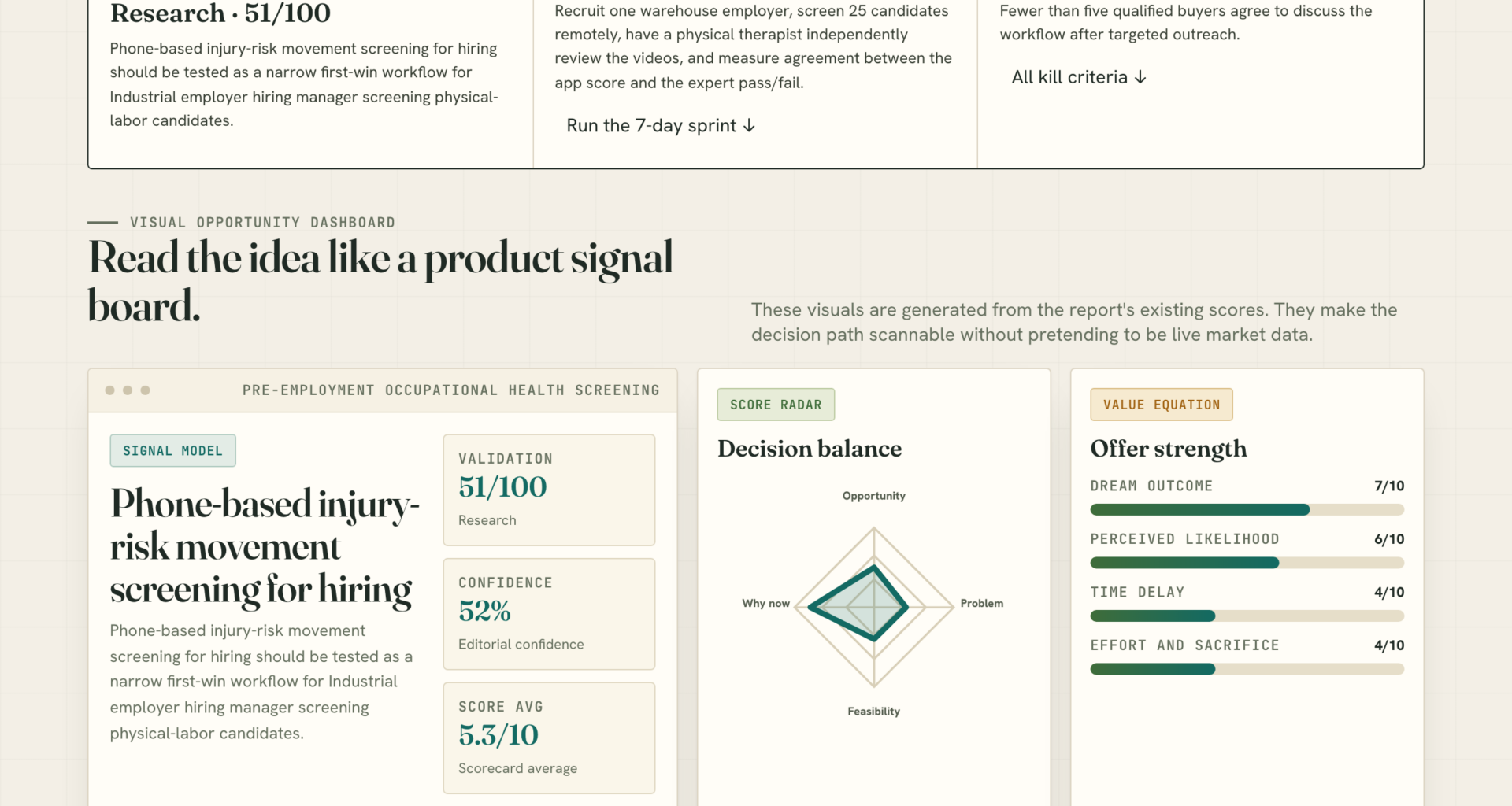

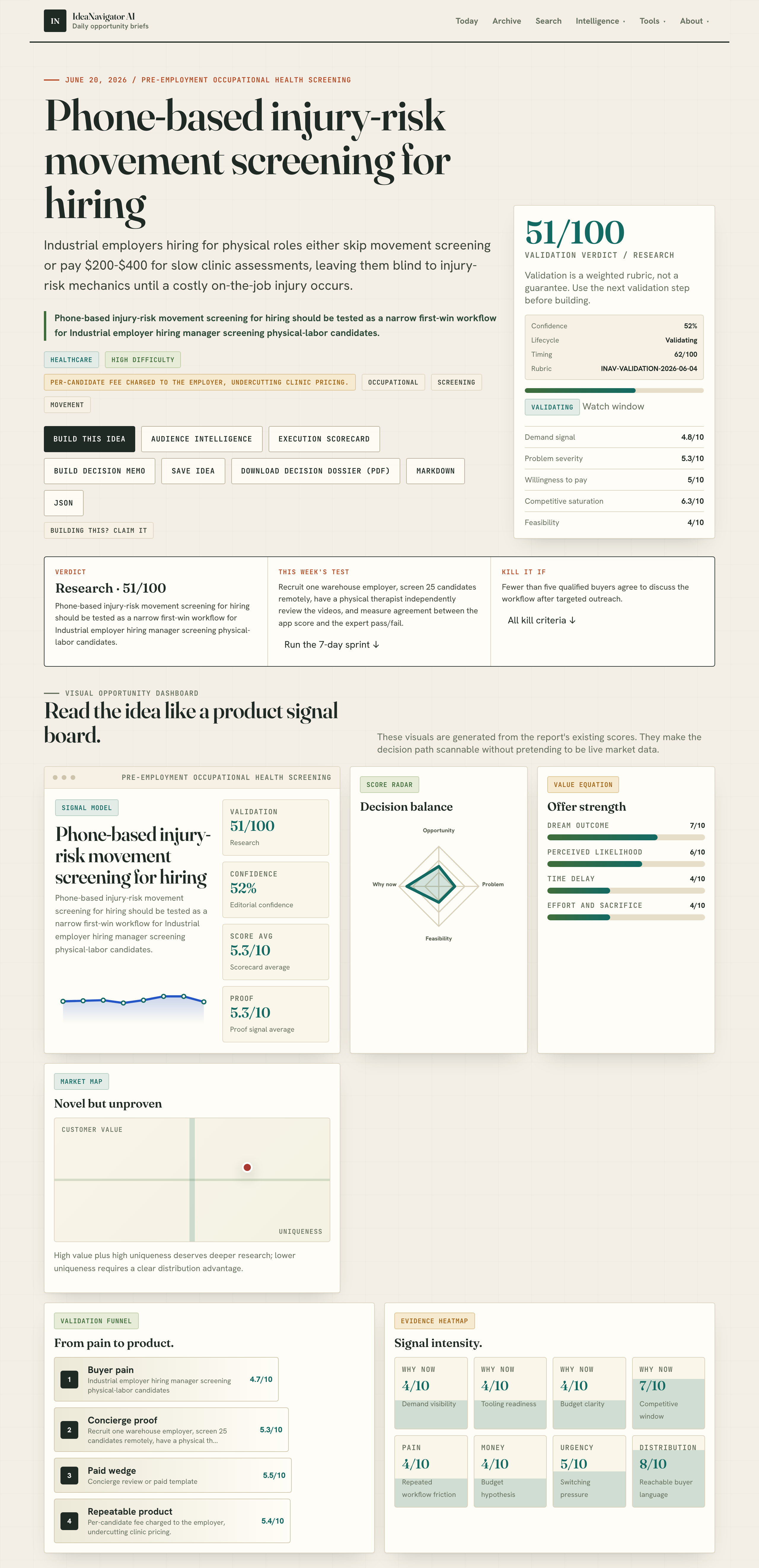
📊 Full opportunity report: Phone-based injury-risk movement screening for hiring on IdeaNavigator AI — validation score, market gap, and execution plan.

Get monitors, keyboards and dev gear delivered free — and shop member deals
- Fast, free delivery on millions of items
- Access to Prime Big Deal Days deals on October 6–7
- Prime Video, Amazon Music and more included
TL;DR
A pilot program is testing a phone-based movement screening tool for hiring industrial workers. It uses phone cameras and pose estimation to evaluate injury risk remotely, potentially reducing costs and injury rates.
A new phone-based movement screening tool is being tested for pre-employment injury risk assessment among industrial workers, aiming to provide a faster, cheaper alternative to clinic assessments.
The approach involves candidates performing 5-7 physical movements, such as squats and lifts, captured via their phone cameras. An app analyzes these videos using pose estimation algorithms to generate a pass/fail injury risk score within 24 hours, at a cost of approximately $30-50 per candidate. This method targets employers in the industrial sector who currently rely on costly, slow clinic assessments or skip movement screening altogether, increasing injury risk.
Initial testing involves recruiting a warehouse employer, screening 25 candidates remotely, and comparing the app’s scores with assessments from independent physical therapists. The goal is to validate the accuracy and reliability of the app’s injury risk predictions against expert judgment, with the potential for broader adoption if successful.
Implications for Industrial Worker Safety and Hiring Costs
This development could significantly reduce the costs and time associated with pre-employment injury screening, enabling employers to identify high-risk candidates early. If validated, the tool could decrease workplace injuries and associated expenses, while streamlining hiring processes for physically demanding roles.
As an affiliate, we earn on qualifying purchases.
Growing Need for Remote Injury Risk Assessment Tools
Industrial employers face rising workers’ compensation costs and increased safety regulations. Traditional movement screening methods involve in-person clinic assessments costing between $200 and $400, which many employers find prohibitively slow and expensive. The advent of phone cameras and pose estimation technology now makes remote movement analysis feasible, opening new pathways for pre-employment screening. Pilot programs exploring these tools are emerging, aiming to address the gap between cost and safety in hiring practices.
“Using phone cameras for movement screening could revolutionize how employers assess injury risk before hiring.”
— an anonymous researcher
As an affiliate, we earn on qualifying purchases.
Validation and Accuracy of Phone-Based Screening Remain Unconfirmed
It is not yet confirmed how accurately the app’s injury risk scores will match expert assessments across diverse candidate populations. The pilot study is ongoing, and results are pending, leaving questions about reliability and scalability.
remote injury risk assessment tool
As an affiliate, we earn on qualifying purchases.
As an affiliate, we earn on qualifying purchases.
Next Steps in Pilot Testing and Broader Validation
The pilot involving 25 candidates is expected to conclude within the next few months, with results informing further development. If successful, larger-scale trials and potential integration into hiring workflows are anticipated, alongside regulatory and industry acceptance processes.
pre-employment physical assessment app
As an affiliate, we earn on qualifying purchases.
As an affiliate, we earn on qualifying purchases.
Key Questions
How does the phone-based screening work?
Candidates perform specific movements while recording on their phone. The app analyzes the videos using pose estimation algorithms to assess injury risk, providing a pass/fail score within 24 hours.
What are the benefits of remote screening over traditional methods?
Remote screening reduces costs, speeds up the process, and allows for screening candidates from any location, potentially lowering injury rates and associated costs.
Is this method accurate enough for widespread use?
The accuracy is still under evaluation. The current pilot aims to compare app scores with expert assessments to determine reliability before broader adoption.
Who is developing this screening tool?
The development is being explored by a startup or research team utilizing existing pose estimation technology, with initial testing involving industrial employers.
When might this technology be available for general use?
If pilot results are positive, further validation and regulatory approval could take several months to a year before commercial deployment.
Source: IdeaNavigator AI
Halloween Picks
halloween
As an affiliate, we earn on qualifying purchases.