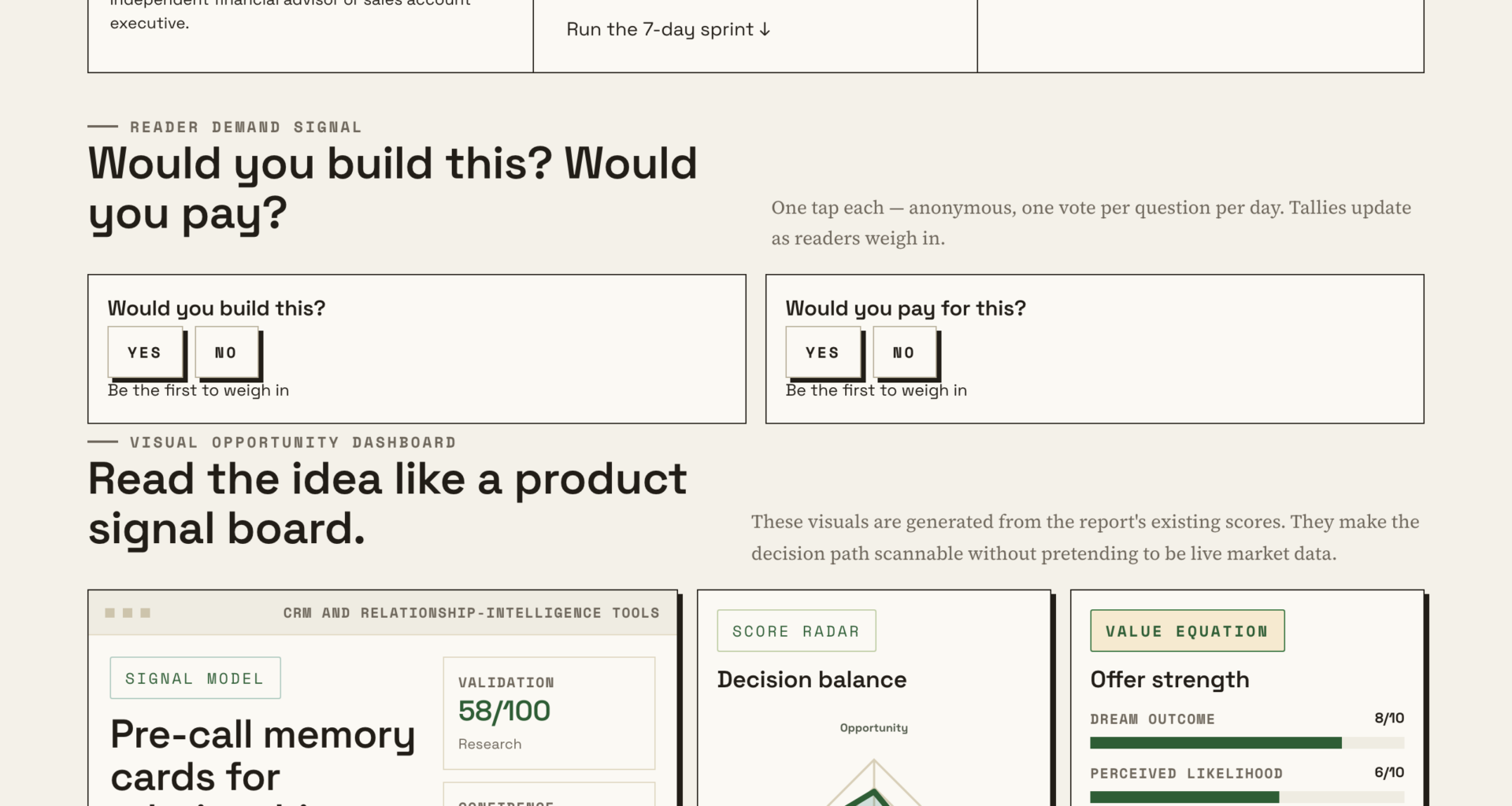

📊 Full opportunity report: Pre-Call Memory Cards To Keep Customer Relationships Front And Center on IdeaNavigator AI — validation score, market gap, and execution plan.

Get business pricing on monitors, keyboards and dev gear
- Business-only prices and quantity discounts
- Tax-exempt purchasing
- Multiple users, one account, clear invoices
TL;DR
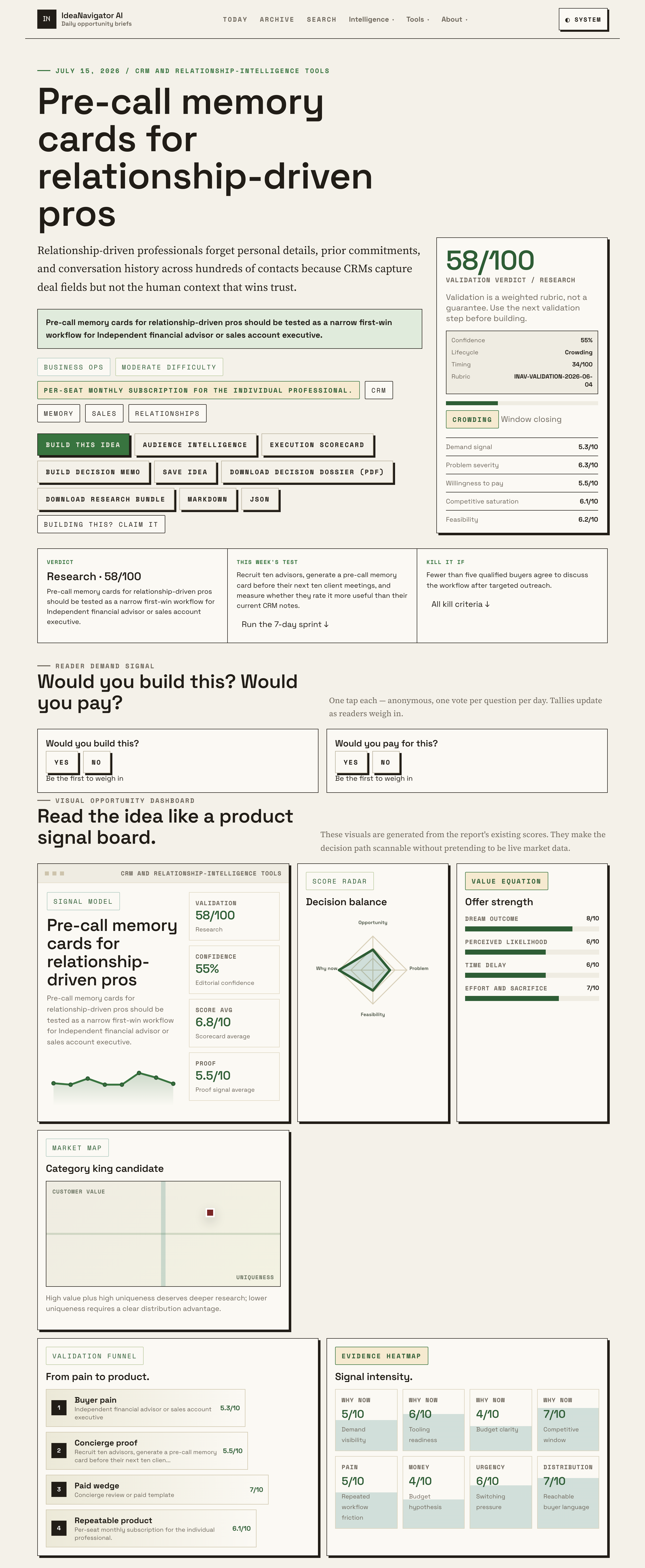
A new tool for relationship-focused professionals is being tested to generate pre-call memory cards that summarize client history and commitments. This innovation aims to enhance trust and client retention. The development is in early testing stages with potential market impact.
IdeaNavigator AI is piloting pre-call memory cards designed for relationship-driven professionals, such as independent financial advisors and sales account executives, to enhance client interactions. This development aims to address the challenge of maintaining personal context across hundreds of contacts, which traditional CRMs often overlook. The initiative could significantly impact how professionals build trust and retain clients.
The proposed pre-call memory cards are generated by connecting a contact’s past emails and notes to produce a concise, one-page summary of who the client is, recent promises, and open issues. This tool leverages large-language-model summarization technology, making it feasible to distill long conversation histories into a searchable, durable format.
According to sources from IdeaNavigator AI, the goal is to test this workflow with ten advisors by generating memory cards before their next ten client meetings. Participants will then evaluate whether these summaries are more useful than their existing CRM notes. The product will be offered as a per-seat monthly subscription aimed at individual professionals.
The concept is designed to fill a gap in current CRM systems, which often capture deal-related data but lack the personal context necessary for relationship-building. Early feedback from the pilot will determine if this approach can become a standard tool for relationship-driven sales and advisory work.
Potential Impact on Client Relationship Management
If successful, pre-call memory cards could transform relationship management by providing professionals with a quick, accurate snapshot of each client’s history and commitments. This could lead to more personalized interactions, increased trust, and higher client retention rates. The approach also demonstrates how AI can augment human memory in professional settings, addressing a common pain point for relationship-driven roles.
Popular right now

Apple AirPods Pro 3 Wireless Earbuds

iRobot Roomba Max 715 Pet Robot Vacuum with AutoEmpty Dock

Bose QuietComfort True Wireless Earbuds with Active Noise Cancellation, Black
As an affiliate, we earn on qualifying purchases.
Emergence of AI-Driven Client Context Tools
Traditional CRM systems focus on transactional data and deal tracking, often neglecting the nuanced human context that fosters trust. Recent advances in large-language models have made it possible to generate summaries from extensive communication histories, opening new possibilities for relationship management tools.
This initiative by IdeaNavigator AI builds on the trend of integrating AI into CRM workflows, aiming to provide a practical, easy-to-use solution for professionals who rely heavily on personal relationships. The concept is still in early testing, with validation steps planned to assess its effectiveness.
“The ability to distill long conversation histories into a concise, searchable memory could be a game-changer for relationship-driven professionals.”
— an anonymous researcher
Uncertain Outcomes and Validation Stage
It is not yet confirmed whether advisors will find the memory cards significantly more useful than their current notes. The effectiveness of the summaries in real-world client interactions remains to be validated through pilot testing. Additionally, questions remain about the scalability and integration of this tool into existing CRM workflows.
Next Steps in Pilot Testing and Market Adoption
IdeaNavigator AI plans to recruit ten advisors to generate pre-call memory cards over their next ten meetings, then collect feedback on usefulness and impact. Success in this phase could lead to broader deployment and potential integration with existing CRM platforms. Further development may include refining AI summarization accuracy and expanding features based on user feedback.
Key Questions
How will the pre-call memory cards be generated?
The cards will be created by connecting a contact’s past emails and notes, then using AI summarization to produce a one-page overview of key details and open issues.
Who is the target user for this tool?
Independent financial advisors and sales account executives who rely on personal relationships to build trust and retain clients.
Is this technology ready for widespread use?
The concept is currently in pilot testing; broader adoption depends on validation results and integration capabilities.
What are the main benefits of using pre-call memory cards?
They aim to provide quick, accurate context about clients, helping professionals personalize interactions and strengthen trust.
Will this replace existing CRM systems?
Likely not entirely, but it could complement CRMs by providing a more human-centered view of client history.
Source: IdeaNavigator AI