🔍 Read the full analysis: The AI Tower’s Twelve Rooms: Practical Examples Of Safe AI Use on ThorstenMeyerAI.com

Get business pricing on monitors, keyboards and dev gear
- Business-only prices and quantity discounts
- Tax-exempt purchasing
- Multiple users, one account, clear invoices
TL;DR
The AI Tower introduces twelve practical rooms demonstrating safe AI applications, from retrieval-based answering to autonomous agents. This development offers guidance on responsible AI use, with ongoing assessments of limitations and next steps.
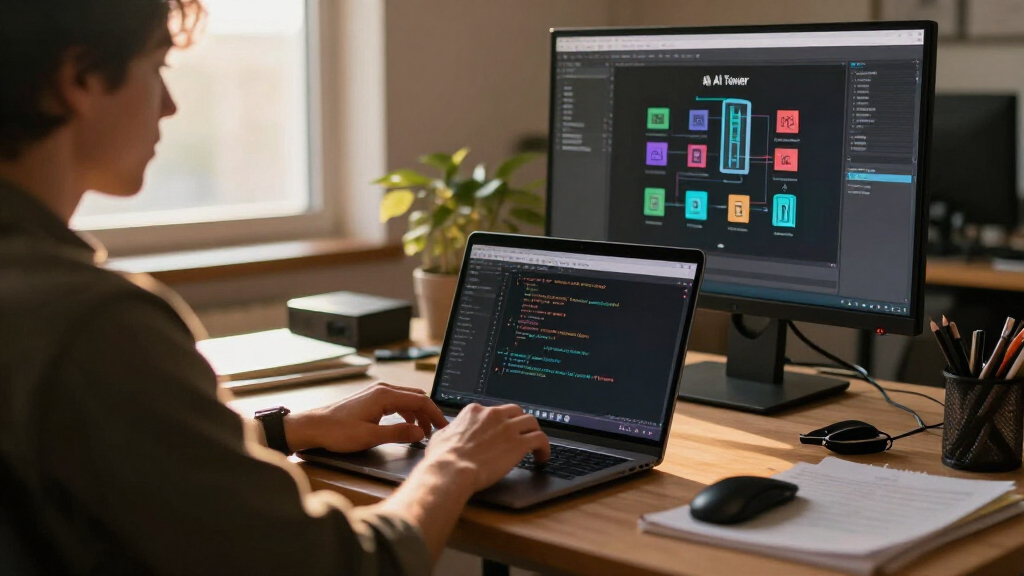
The AI Tower’s twelve rooms, introduced by Thorsten Meyer, provide concrete, hands-on examples of how AI can be used responsibly and safely in various contexts. These practical demonstrations run directly in users’ browsers without sign-up, cookies, or tracking, making AI more accessible and transparent. The initiative aims to guide users and developers in understanding best practices for AI deployment, emphasizing safeguards and limitations.
The twelve rooms in the AI Tower cover key aspects of AI application, including retrieval from personal documents, building custom assistants, prompt engineering, autonomous agents, and automation workflows. For example, the ‘Archive Desk’ illustrates how AI can fetch information from personal files with source transparency, while the ‘Hiring Desk’ shows how to set clear instructions for AI assistants. Each room offers hands-on testing, allowing users to explore how AI systems behave in controlled scenarios.
According to Meyer, these examples are designed to demonstrate how AI can be used responsibly, highlighting both its capabilities and limitations. The platform is accessible across devices, emphasizing ease of use and safety, with no data collection or tracking involved. The initiative is part of Meyer’s broader effort to promote transparent, controlled AI deployment, especially in professional and personal settings.
A practical field guide · Responsible AI
The AI Tower’s Twelve Rooms
Hands-on examples make safe AI practices easier to explore—from retrieving answers from personal documents to designing assistants, prompts, agents, and workflows.
Created by Thorsten Meyer · Browser-based demonstrations · No sign-up required
Inside the tower · 01
Twelve rooms, practical lessons
Each room presents a focused scenario that visitors can test in a controlled setting. Together, the demonstrations introduce ways to keep AI use understandable, bounded, and useful.
Archive Desk
Explore how an assistant can find information in personal files and show where an answer came from.
Hiring Desk
See how clear instructions shape an assistant’s role, boundaries, and responses.
Prompt engineering
Try how specific, well-structured requests can guide an AI system toward more useful results.
Custom assistants
Consider how purpose, context, and limits can be set for an assistant built around a task.
Autonomous agents
Examine systems that can take sequences of actions, along with the need for oversight.
Automation workflows
Follow how AI can fit into a process, with checkpoints to review outputs and actions.
The responsible-use loop · 02
From example to informed use
The tower’s educational approach connects experimentation with transparency and careful application. A demonstration is a starting point for learning, not a complete deployment assessment.
Try a scenario
Interact with a focused example in the browser.
Check the output
Notice sources, instructions, and system boundaries.
See the limits
Look for uncertainty, missing context, or possible failure.
Keep human oversight
Adapt lessons to the setting and review higher-risk uses.
Why it matters · 03
Make safety visible in everyday tasks
Scenario-based demonstrations can help newcomers and experienced users discuss practical boundaries. The tower builds on wider calls for responsible AI by turning principles such as transparency and control into examples people can examine.
Understand the answer
Source visibility, as illustrated by retrieval examples, can help users inspect how an answer was formed.
Set clear boundaries
Instructions and checkpoints help make an assistant’s intended role more explicit.
Learn by doing
Browser access across devices lowers the effort needed to explore AI behavior.
Illustrative emphasis based on the article’s themes; these bars are not measured evaluation scores.
Limitations & open questions · 04
Demonstrations are a beginning
The rooms use controlled, simplified examples. Their lessons need careful evaluation before being transferred to complex or high-stakes work.
How far do the lessons travel?
- Not every misuse scenario or long-term safety issue is represented.
- The effect on user understanding and behavior is still being assessed.
- Adoption across professional settings has not been established.
- High-stakes fields such as healthcare and finance need expert validation.
Learn first; validate before deployment
The AI Tower is an educational resource for exploring responsible AI practices. It does not replace risk analysis, domain expertise, or comprehensive safety testing.
Errors can have serious consequences in critical settings, so examples should be customized and independently reviewed before operational use.
Looking ahead · 05
Expand, learn, and evaluate
Planned next steps described for the initiative include adding rooms, improving guidance with user feedback, and exploring ways to bring practical examples into broader safety education.
Add practical rooms
Broaden the collection of scenarios that users can explore.
Improve guidance
Use user input to refine safety explanations and tutorials.
Study the impact
Assess how people use the platform and what they learn from it.
Quick answers · 06
Questions readers ask
How can I try the examples?
Visit the AI Tower through Thorsten Meyer’s website. The rooms are designed to run in a browser on a phone, tablet, or computer, with no sign-up required.
Are they suitable for professional use?
They can support learning about safe AI practices. Direct use in high-stakes areas requires expert validation and customization.
What are the main limitations?
The demonstrations are simplified and do not cover every misuse scenario or long-term risk. They cannot replace comprehensive deployment assessments.
Will the tower expand?
The creators plan to add rooms, incorporate feedback, and develop more detailed tutorials as the resource evolves.
Article information attributed to ThorstenMeyerAI.com
Why Practical AI Examples Matter for Safe Deployment
This development is significant because it provides tangible, accessible guidance on responsible AI use, helping both newcomers and experts understand the boundaries and best practices. By showcasing real-world scenarios, the AI Tower aims to prevent misuse and misunderstandings, fostering safer integration of AI in daily tasks and business processes. It also serves as an educational resource, promoting transparency and user control in AI interactions, which are critical for building trust and avoiding unintended consequences.
AI personal document retrieval tool
As an affiliate, we earn on qualifying purchases.
As an affiliate, we earn on qualifying purchases.
Background and Evolution of Practical AI Demonstrations
The concept of using structured, scenario-based AI demonstrations has grown alongside broader efforts to ensure AI safety and transparency. Previous initiatives, such as OpenAI’s safety guidelines and industry standards, have emphasized the importance of controlled environments. The AI Tower builds on these principles by offering interactive, hands-on examples that run locally in the browser, avoiding data privacy concerns. This approach responds to ongoing concerns about AI misuse, hallucinations, and lack of transparency, providing concrete tools for responsible application.
Thorsten Meyer’s series, including the museum and engine room, has progressively expanded to include these twelve practical rooms, each illustrating different facets of AI use. The latest installment emphasizes safety, control, and user empowerment, aligning with current industry and academic calls for responsible AI deployment.
“The AI Tower’s twelve rooms are designed to show how AI can be used responsibly, with clear boundaries and safeguards. Our goal is to make AI practical, transparent, and safe for everyday use.”
— Thorsten Meyer
As an affiliate, we earn on qualifying purchases.
Limitations and Unanswered Questions About the AI Tower
While the AI Tower provides valuable practical examples, it remains unclear how well these demonstrations translate to complex, real-world deployments outside the controlled environment. The platform does not simulate all possible misuse scenarios or address long-term safety concerns. Additionally, the effectiveness of these examples in changing user behavior or understanding is still being evaluated. It is also not yet confirmed how widely adopted or integrated these practices will become in professional settings.
Further assessment is needed to determine the scalability of these models, especially in high-stakes environments like healthcare or finance, where errors can have serious consequences. The ongoing development of AI safety standards and user education will influence how impactful these practical guides ultimately are.
As an affiliate, we earn on qualifying purchases.
Next Steps for Broader Adoption and Evaluation
Moving forward, the creators of the AI Tower plan to expand the number of practical rooms and incorporate feedback from users to improve safety guidance. They aim to develop more detailed tutorials and integrate these examples into broader AI safety training programs. Researchers will also monitor how users interact with the platform to assess its impact on understanding and responsible use.
Additionally, industry stakeholders and policymakers are expected to evaluate these demonstrations as part of ongoing efforts to establish AI safety standards. The goal is to embed these practical examples into professional training, certification programs, and regulatory frameworks, ensuring that safe AI practices become standard across sectors.
As an affiliate, we earn on qualifying purchases.
Key Questions
How can I try the AI Tower’s practical examples myself?
You can access the AI Tower directly through Thorsten Meyer’s website. The platform runs in your browser on any device—phone, tablet, or computer—and requires no sign-up or data sharing. Each of the twelve rooms offers interactive demonstrations you can test immediately.
Are these examples suitable for use in professional environments?
The examples are designed to illustrate safe AI practices and are suitable as educational tools. However, their direct application in high-stakes settings like healthcare or finance requires further validation and customization by experts. They serve best as foundational guides for understanding AI safety principles.
What are the main limitations of the AI Tower demonstrations?
The demonstrations are simplified models that do not cover all possible misuse scenarios or long-term safety issues. They also do not replace comprehensive safety assessments needed for deployment in critical sectors. Their primary role is educational and illustrative.
Will the AI Tower be updated or expanded in the future?
Yes, the creators plan to add more practical rooms, incorporate user feedback, and develop detailed tutorials. They aim to make the platform a continually evolving resource for safe AI use and education.
Source: ThorstenMeyerAI.com
Halloween Picks
halloween
As an affiliate, we earn on qualifying purchases.