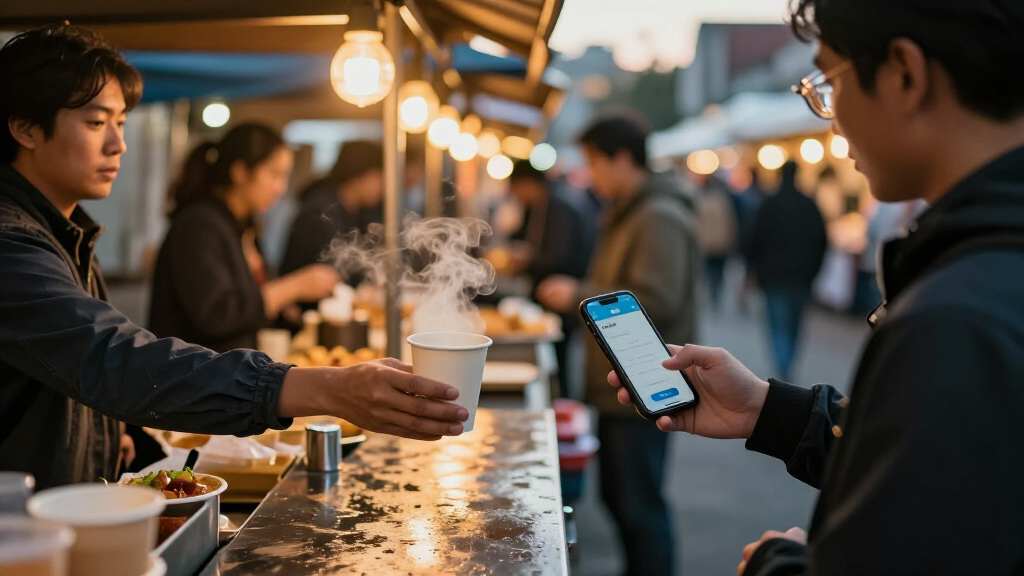
🔍 Read the full analysis: The Last Turn Of The Clock In “Nightmarket — Mercado De Medianoche” (FABLE/175) on ThorstenMeyerAI.com

Get business pricing on monitors, keyboards and dev gear
- Business-only prices and quantity discounts
- Tax-exempt purchasing
- Multiple users, one account, clear invoices
TL;DR
ThorstenMeyerAI.com has published a field guide to “Nightmarket — Mercado de Medianoche,” a live digital scene designed to change as its closing time approaches. The guide describes how time-driven details—including shifting light, steam and disappearing stalls—create a gradual move from busy market to near-empty room; technical implementation details are not specified in the available description.
ThorstenMeyerAI.com has published “Nightmarket — Mercado de Medianoche” (FABLE/175), a field guide to the live digital market designed to gradually wind down as time passes. The project uses clock-driven changes in the scene—including lantern-like light, imperfect neon, rising steam and stalls beginning to disappear—to make the environment feel less like a fixed backdrop and more like a place approaching closing time.
The guide’s central design idea is to make time part of the environment, rather than treating atmosphere as a static layer. Small changes accumulate across the scene, shifting it from a busy, warmly lit market toward a quieter, nearly empty one. The description presents that progression as the mechanism for giving the digital room a sense of activity and eventual closure.
Its visual elements include lantern-like warmth, imperfect neon and steam rising into the night. As the scene winds down, the final stalls begin to disappear. The published description says the guide follows how these effects are built and how they work together, but it does not list particular software, code, timing intervals or implementation steps.
The room is described as available to visit live, alongside the design teardown. The available details establish the concept and intended visual progression, not how visitors interact with the space or whether the experience changes identically for every visitor.
FABLE / 175 · FIELD GUIDE
The Last Turn
of the Clock in Nightmarket
“Nightmarket — Mercado de Medianoche” is a live digital scene designed to wind down as closing time approaches. Light, steam and vanishing stalls turn time into part of the environment.
01 / The visual progression
A market that changes
as the night moves on
Small details accumulate, shifting the room from warm activity toward quiet near-closure.
Warmth in the dark
Lantern-like light and imperfect neon give the market its nighttime glow.
Steam rises
Steam adds a sense of activity, making the digital room feel like a place in use.
Stalls disappear
As the scene winds down, the final stalls begin to vanish and the room grows quieter.
02 / The clock at work
From busy market
to near-empty room
The description establishes the intended arc, while leaving its timing and mechanics unspecified.
Market activity
A warmly lit digital night market.
Atmosphere moves
Light and steam help signal a living environment.
Stalls thin out
The last stalls begin to disappear.
Quiet remains
The room approaches a nearly empty state.
03 / The design proposition
Make time part of the place
Atmosphere can change with time, instead of sitting still as a backdrop.
The field guide presents a design idea for generative environments and responsive interfaces: accumulated visual cues can communicate change without relying only on a label or status update.
It is an artistic example and live demonstration. The available description reports no usability testing, performance results or deployments beyond the Nightmarket room.
What the published description leaves open
It does not name the software or code, specify timing intervals, explain whether visitors can control or reset the sequence, or clarify how the stalls disappear. The final state and visitor response are also not detailed.
04 / Reader guide
Key questions
Visit the live room and read the teardown for a closer look at the project.
What is Nightmarket?
A live digital market scene and field guide, identified as FABLE/175, designed to wind down toward closing.
What changes as it closes?
The description mentions shifting light and atmosphere, rising steam and stalls beginning to disappear. It gives no timing schedule.
Can readers visit?
Yes. The page describes a live room to visit and links to a design teardown.
Does it prove this works elsewhere?
No. Broader interface use is proposed as an idea; no tests or other deployments are reported.
Time Becomes Part of the Market
The project offers a specific design proposition for generative environments and responsive interfaces: a digital space can communicate change through accumulated visual cues, rather than relying only on a label or status update. A shift in lighting, the gradual thinning of activity and the disappearance of stalls can convey that a place is nearing closure without announcing it in text.
That approach may interest people building virtual rooms, interactive scenes or automated experiences because it treats time as a design mechanism. The field guide describes an artistic example, however, not evidence that the method improves usability or that it has been tested across other applications. Its significance is the documented design idea and live demonstration, not a verified performance result.
As an affiliate, we earn on qualifying purchases.
A Scene Designed to Close
“Nightmarket — Mercado de Medianoche” is identified as FABLE/175 and presented as a field guide with a live room and a design teardown. The description frames the scene around a familiar progression: a market that begins with warmth and activity gradually becomes quieter as its closing time approaches.
The project’s stated distinction is that atmosphere changes over time, rather than remaining a polished, unchanging visual layer. Its description connects that approach to possible uses in generative environments and interfaces, but does not provide examples of deployments beyond the Nightmarket room itself.
“What if the most convincing way to make a digital market feel alive were to give it a closing time?”
— ThorstenMeyerAI.com, describing the design concept
As an affiliate, we earn on qualifying purchases.
How the Clock Drives the Scene
The published description does not specify how the timing is implemented, how long the room takes to wind down, or whether visitors can control or reset the sequence. It also does not explain whether the disappearing stalls are animated, generated dynamically or presented through another technique.
There are no reported measurements, user tests or comparisons showing how visitors respond to the experience. The possible use of the approach in interfaces and other generative environments is presented as an idea, not a confirmed application. The scene’s final state and what it leaves behind are also not explained in the available description.
steam machine for digital displays
As an affiliate, we earn on qualifying purchases.
As an affiliate, we earn on qualifying purchases.
Visit the Room and Teardown
Readers can visit the live room and read the design teardown linked from the FABLE/175 page. Those materials may provide a closer look at how the visual changes are assembled; the published description does not name a later release, technical demonstration or follow-up date.
The next concrete step for interested readers is to examine the room and teardown directly. Until further details are published, the mechanics behind the clock-driven progression and the experience’s response to visitors remain open questions.
Source: ThorstenMeyerAI.com
As an affiliate, we earn on qualifying purchases.
Key Questions
What is “Nightmarket — Mercado de Medianoche”?
It is a live digital market scene and field guide identified as FABLE/175, described by ThorstenMeyerAI.com as an environment that gradually winds down toward closing.
What changes as the market approaches closing?
The description points to shifts in light and atmosphere, steam in the scene and stalls beginning to disappear. It does not provide a detailed sequence or timing schedule.
Can readers visit the experience?
Yes. The page describes the room as available to visit live and also links to a design teardown.
How is the clock-driven scene built?
The available description says the guide follows how the effects are built, but does not identify the software, code or technical implementation. Those specifics remain unclear from the published summary.
Does the project prove the approach works for other interfaces?
No such result is reported. The description says the idea could inform other environments and interfaces, but does not cite testing or deployments beyond the Nightmarket experience.
Source: ThorstenMeyerAI.com
Halloween Picks
halloween
As an affiliate, we earn on qualifying purchases.