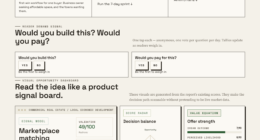
📊 Full opportunity report: Wholesale For Independent Retailers: A Small-Order Sourcing Approach on IdeaNavigator AI — validation score, market gap, and execution plan.

Get monitors, keyboards and dev gear delivered free — and shop member deals
- Fast, free delivery on millions of items
- Access to Prime Big Deal Days deals on October 6–7
- Prime Video, Amazon Music and more included
TL;DR

IdeaNavigator AI has outlined a proposed small-order wholesale marketplace for independent retailers who cannot meet distributors’ order minimums. The concept calls for manually testing orders with 20 brands and 50 shops, then tracking whether trial purchases lead to standard reorders within a quarter; no pilot results or operating platform are reported.
IdeaNavigator AI’s proposal describes a wholesale marketplace lane where independent retailers could test products in small quantities, including five-unit assortments, without meeting traditional distributor minimums. The proposal outlines a manual pilot involving 20 brands and 50 shops, but does not report that the pilot has taken place or provide results; the idea remains a business concept to validate.
According to IdeaNavigator AI’s proposal, the service would target independent shop owners who want to try unfamiliar products but cannot justify the larger opening orders or case quantities distributors may require. The proposal argues that those minimums can discourage experimentation and leave retailers with fewer chances to assess new merchandise between trade shows. These are the proposal’s characterization of the problem, not independently measured findings.
For an initial product, the proposal says brands would set micro-minimums, while the platform would consolidate fulfillment so small orders could be shipped economically. Retailers would buy trial assortments of around five units, track sales, and potentially move products that perform well into ordinary wholesale relationships. IdeaNavigator AI also suggests charging a transaction take rate and selling brands subscription analytics on trial performance.
To test the model, IdeaNavigator AI recommends arranging trial orders manually between 20 brands and 50 shops. The proposed measure is the share of trial purchases that lead to a standard reorder within a quarter. The proposal does not define a successful conversion or provide a pilot budget, identify participating businesses, or report conversion data.
Testing Small Orders at Scale
The proposal addresses a practical tension in independent retail: a shop may want to broaden its assortment, but taking on a distributor-sized order can tie up cash and shelf space before demand is known. Smaller trials could give retailers a lower-commitment way to judge customer interest. For brands, the same test could create a route to stores that do not meet ordinary order thresholds.
The key commercial question is not simply whether shops place small orders. It is whether consolidated shipping can make those orders workable and whether trial purchases lead to repeat business at a scale that supports the platform’s costs. If retailers reorder, brands might gain a new wholesale channel; if they do not, the marketplace could be left handling many small shipments without enough revenue. IdeaNavigator AI’s suggested quarter-long measurement focuses on that conversion, but the proposal gives no target rate or cost benchmarks.
For retailers considering such a service, the proposal does not establish that five-unit orders are available, cheaper, or reliably delivered. Those outcomes would depend on brand participation, fulfillment arrangements, product economics, and the terms offered. The proposal is therefore best understood as a testable operating hypothesis, not evidence that small-order wholesale is already commercially proven.
small order wholesale products for retailers
As an affiliate, we earn on qualifying purchases.
As an affiliate, we earn on qualifying purchases.
From Marketplace Model to Trial Orders
IdeaNavigator AI’s proposal says the broader wholesale marketplace model has been demonstrated by Faire, then identifies very small trial orders and consolidated shipping as a possible underserved segment. This is the proposal’s framing; it does not include independent market research, comparative platform data, or evidence that existing marketplaces cannot serve these orders.
The suggested workflow narrows the idea to one buyer problem rather than attempting to rebuild wholesale distribution broadly: connect shops that cannot meet minimums with brands willing to offer smaller quantities. IdeaNavigator AI proposes manual brokerage to test the buying process before investing in a full marketplace. The proposed 20-brand, 50-shop pilot could examine whether participants transact and whether successful trials produce standard reorders within a quarter.
assorted trial products for independent shops
As an affiliate, we earn on qualifying purchases.
As an affiliate, we earn on qualifying purchases.
Pilot Evidence Is Still Missing
IdeaNavigator AI’s proposal reports no pilot results and does not identify participating brands or retailers. It is unclear whether the proposed 20 brands and 50 shops have been recruited, whether any trial orders have been placed, or whether a platform is being built.
Other unresolved details include how shipments would be consolidated across brands, who would cover handling and delivery costs, how returns and unsold inventory would work, and what minimum order sizes brands would accept. The proposal also does not specify the platform’s take rate, subscription price, analytics design, or what proportion of trial orders would count as a successful conversion. Without those details, the costs and likely value to retailers and brands cannot be assessed.
As an affiliate, we earn on qualifying purchases.
Measure Reorders After Trials
IdeaNavigator AI’s proposal identifies the next step as brokering trial orders manually between 20 brands and 50 shops, then monitoring whether retailers make standard reorders within a quarter. That could provide an initial measure of repeat demand before a larger software build, provided the businesses are recruited and the trials proceed. The proposal gives no launch date or timetable.
Any reported results would need to clarify how many shops placed orders, the size and value of those orders, fulfillment costs, and the number that converted to standard wholesale purchases during the stated period. Until such evidence is available, the marketplace’s economics and retailer demand remain unverified.
Source: IdeaNavigator AI’s small-order wholesale sourcing proposal
As an affiliate, we earn on qualifying purchases.
Key Questions
What is the proposed small-order wholesale platform?
IdeaNavigator AI proposes a marketplace lane where independent retailers could order small product trials, such as five-unit assortments, from brands that set lower minimums. The proposal also suggests consolidated fulfillment and sales tracking.
Has the platform launched?
IdeaNavigator AI’s proposal does not report a launch or an operating platform. It describes a concept and recommends testing it through manually brokered trial orders.
How would the idea be tested?
IdeaNavigator AI proposes arranging orders between 20 brands and 50 shops and measuring whether trial purchases become standard reorders within a quarter. The proposal includes no pilot outcomes.
How might the platform make money?
IdeaNavigator AI’s proposal suggests combining a take rate on orders with subscriptions for brand analytics on trial performance. Pricing and financial viability are not specified.
What is still unknown?
IdeaNavigator AI’s proposal does not say whether retailers and brands have committed to participate or explain how shipment consolidation would work. It also provides no evidence that small orders can cover fulfillment costs, and reports no reorder rates or other pilot data.
Source: IdeaNavigator AI
Fall Picks
fall essentials
As an affiliate, we earn on qualifying purchases.