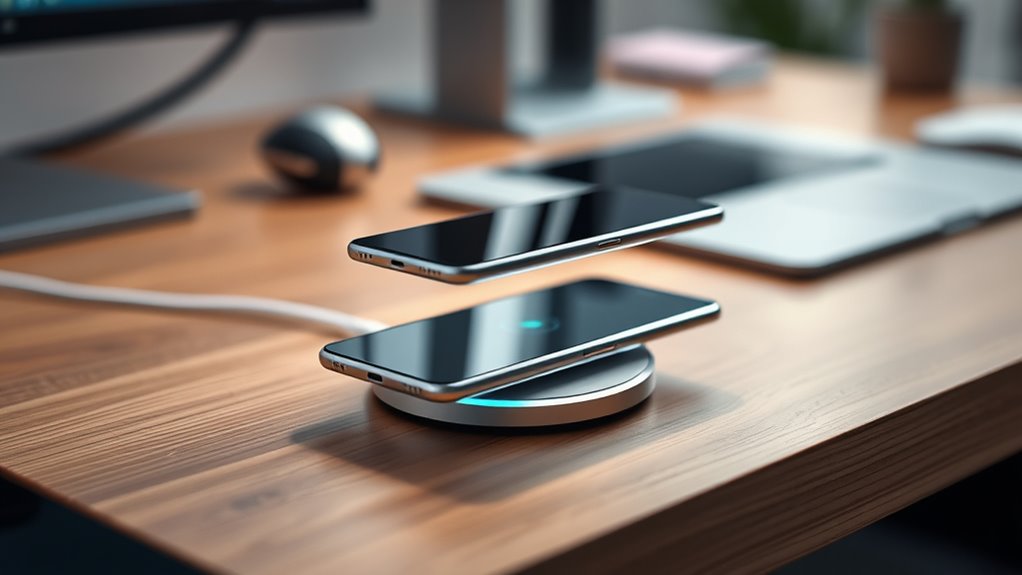

Wireless inductive charging has seen significant advances with the development of resonant coupling, which makes charging faster, more efficient, and more flexible. You can now charge devices simply by placing them on a pad or stand, even if they’re not perfectly aligned. This technology is increasingly deployed in public spaces like airports and cafes, supporting multiple devices simultaneously. If you want to explore how these innovations are shaping everyday charging, there’s more to discover below.
Key Takeaways
- Resonant coupling enhances wireless charging efficiency and distance flexibility, enabling rapid, contactless power transfer for various devices.
- Advances focus on coil design, frequency tuning, and materials to improve energy transfer, reduce losses, and support higher power levels.
- Real-world deployments include public stations, airports, and cafes, offering convenient, cable-free charging experiences for consumers.
- Challenges such as coil alignment and energy losses over larger distances are being addressed through ongoing technological refinement.
- Future developments aim for seamless, widespread wireless charging solutions with increased efficiency, higher power, and user convenience.

Have you ever wondered how your smartphone charges without plugging it in? Wireless inductive charging has become a common feature, allowing you to power up your devices simply by placing them on a pad or stand. This convenience is made possible through a process called resonant coupling, which enhances the way energy is transferred between the charger and your device. Unlike traditional inductive charging that relies on direct contact, resonant coupling uses specific frequencies to create a magnetic field that can transfer power more efficiently over a short distance. This technology improves power transfer efficiency, meaning less energy is wasted during the process and your device charges faster and more reliably.
Resonant coupling works by aligning the frequencies of the transmitter and receiver coils, creating a magnetic resonance that allows energy to flow smoothly between them. Because of this resonance, the system can maintain a high level of efficiency even if the device isn’t perfectly aligned with the charging pad. That’s a noteworthy advantage, as it offers more flexibility and ease of use compared to older, tightly coupled systems. The goal is to maximize power transfer efficiency, ensuring that most of the energy from the charger makes it into your device’s battery rather than dissipating as heat. This not only conserves energy but also helps prevent overheating, which can damage your device over time.
In real-world deployments, manufacturers have optimized resonant coupling to support higher power levels, enabling faster charging for smartphones, tablets, and even small appliances. Public charging stations, airports, and cafes are starting to incorporate these systems, making wireless charging more accessible and convenient. Some advanced setups can even charge multiple devices simultaneously or operate over slightly larger distances, although efficiency tends to decrease as the gap widens. Engineers continuously refine coil design, frequency tuning, and materials to improve power transfer efficiency, pushing the technology closer to seamless, cable-free power solutions.
Despite these advances, challenges remain. Maintaining high efficiency over larger distances is difficult because energy losses increase, and aligning coils precisely isn’t always practical in everyday use. Nonetheless, the progress made with resonant coupling has markedly improved the practicality of wireless inductive charging, making it a reliable and increasingly widespread method. As this technology continues to evolve, you’ll likely see even more innovative applications that make charging your devices effortless, clean, and efficient—no wires required.
Top picks for "wireles inductive charg"
Open Amazon search results for this keyword.
As an affiliate, we earn on qualifying purchases.
Frequently Asked Questions
What Are the Safety Concerns With Wireless Inductive Charging?
You should be aware that wireless inductive charging poses safety concerns, like electromagnetic interference that can disrupt nearby electronic devices. Additionally, thermal hazards may occur if charging pads overheat, potentially damaging your devices or causing burns. To stay safe, make certain your charging setup complies with standards and avoid prolonged contact with hot surfaces. Proper design and safety protocols help minimize these risks, making wireless charging a convenient yet safe technology.
How Does Wireless Charging Perform in Outdoor Versus Indoor Environments?
In outdoor environments, wireless charging faces challenges like signal interference from weather, obstacles, and electromagnetic noise, which can reduce efficiency. You’ll find indoor setups generally perform better because they have less interference and more controlled conditions. Durability matters too; outdoor chargers need rugged designs to withstand environmental factors like rain and dust. Overall, indoor wireless charging tends to be more reliable, but outdoor solutions are improving with better shielding and durable materials.
Can Wireless Inductive Charging Damage Sensitive Electronic Devices?
Wireless inductive charging generally doesn’t harm sensitive electronics if proper device shielding is in place. However, electromagnetic interference can disrupt device function or cause overheating. To prevent this, verify your devices have adequate shielding and use certified chargers. When used correctly, wireless inductive charging remains safe, but avoiding exposure to strong electromagnetic fields is wise to protect your sensitive electronics from potential damage.
What Are the Cost Implications of Implementing Wireless Charging Infrastructure?
Implementing wireless charging infrastructure involves some thoughtful cost analysis. While the initial infrastructure expenses might seem notable, they often lead to long-term savings through reduced cable replacements and convenience. You’ll need to regard installation costs, technology upgrades, and maintenance. Although upfront investments are necessary, the ease of use and future-proofing benefits can make these expenses worthwhile, especially as adoption grows and economies of scale kick in.
How Does Wireless Inductive Charging Compare to Other Wireless Power Transfer Methods?
You’ll find wireless inductive charging, which uses resonant coupling and magnetic fields, more efficient for short distances compared to other wireless power transfer methods like microwave or radio frequency. It offers high transfer efficiency and safety, making it ideal for everyday devices. However, it’s limited by proximity, unlike resonant coupling techniques that can transfer power over slightly larger gaps, though with some efficiency loss.
Conclusion
You’re on the brink of a charging revolution that will change your life forever! With wireless inductive charging advancing at lightning speed, you’ll never worry about tangled cords or dead batteries again. Imagine a future where your devices power up instantly, effortlessly, and everywhere — it’s almost too good to be true! This technology is transforming the way we live, work, and connect, making exhaustion from low batteries a thing of the past. Prepare to be amazed!