A digital backlit tire pressure gauge makes it easier to check tire pressure in dim garages or roadside conditions, but the best choice depends on more than screen lighting. My best overall pick is the AstroAI Digital Tire Pressure Gauge, 0–150 PSI for its practical range and straightforward design; the ETENWOLF T300 stands out for users who need a wider pressure range, while the AstroAI gauge and inflator suits those who want to check and add air with one tool. The main tradeoffs are readability versus simplicity, a standalone gauge versus an inflator, and everyday car use versus higher-pressure applications. This roundup compares 15 options across those needs, including two listings for the ETENWOLF T300. Read on for the full breakdown and help matching a gauge to your tires.

Get business pricing on monitors, keyboards and dev gear
- Business-only prices and quantity discounts
- Tax-exempt purchasing
- Multiple users, one account, clear invoices
Key Takeaways
- A 150 PSI ceiling covers ordinary car checks: Several picks, including the standard AstroAI and Slime gauges, target everyday vehicle use; a higher maximum matters more for specialty applications than for most passenger-car tires.
- Higher range and everyday usefulness are different strengths: The ETENWOLF T300 reaches 200 PSI, and the AstroAI inflator gauge reaches 250 PSI, but those ceilings do not automatically make either the best simple glove-box gauge.
- An inflator changes the tool’s role: The AstroAI gauge and inflator combines pressure checking with air-line use, while standalone gauges are the simpler choice for quick checks.
- Backlighting is only part of low-light usability: The talking gauge adds audible readings and an LED light, making it distinct from models that rely on a lit screen alone.
- Bundles and duplicate listings affect the comparison: The Geartronics two-pack and AstroAI two-pack may suit multiple vehicles, while the two ETENWOLF T300 entries describe the same model rather than two distinct designs.
| Digital Talking Tire Gauge with Backlit LCD, Audible Voice, LED Light, and Keychain Hook |  | Best for Hands-Free Readouts | Display: Backlit LCD | Voice readout: Yes | LED light: 8 lumens | VIEW ON AMAZON | See Our Full Breakdown |
| Slime Digital Tire Pressure Gauge, 5-150 PSI |  | Best for Straightforward Nighttime Checks | Measurement range: 5–150 PSI | Measurement units: psi, kPa, bar | Display: LCD screen | VIEW ON AMAZON | See Our Full Breakdown |
| AstroAI Digital Tire Pressure Gauge, 0–150 PSI |  | Best Overall for Specified Accuracy | Measurement range: 0–150 PSI | Accuracy: ±1 PSI | Measurement units: PSI, Bar, Kgf/cm², KPA | VIEW ON AMAZON | See Our Full Breakdown |
| Geartronics Digital Tire Pressure Gauge, 150 PSI, 2-Pack |  | Best Two-Gauge Set | Maximum pressure: 150 PSI | Pressure settings: 4 | Display: Backlit LCD | VIEW ON AMAZON | See Our Full Breakdown |
| AstroAI Heavy Duty Digital Tire Pressure Gauge, 230 PSI for Car and Bicycle |  | Best for High-Pressure Tires | Maximum pressure: 230 PSI | Display: Green backlit LCD | Additional lighting: Flashlight | VIEW ON AMAZON | See Our Full Breakdown |
| Silverback Digital Tire Pressure Gauge, 0–150 PSI |  | Best for Controlled Deflation | Pressure range: 0–150 PSI | Accuracy: ±0.5% | Measurement units: PSI, bar, kPa, kgf/cm² | VIEW ON AMAZON | See Our Full Breakdown |
| Digital Tire Pressure Gauge, Accurate Cars Air Gauge 150 PSI |  | Best for Straightforward Multi-Vehicle Checks | Measurement range: 4–150 PSI | Units: PSI, bar, kPa, kgf/cm² | Minimum measurable value: 0.1 | VIEW ON AMAZON | See Our Full Breakdown |
| ETENWOLF T300 Digital Tire Pressure Gauge, 3–200 PSI |  | Best for Temperature Extremes | Pressure range: 3–200 PSI | Accuracy: ±1 PSI | Calibration standard: ANSI B40.7 Grade 2A | VIEW ON AMAZON | See Our Full Breakdown |
| AstroAI Digital Tire Pressure Gauge and Inflator, 3–250 PSI, 1/4-Inch NPT |  | Best All-in-One Inflator | Pressure range: 3–250 PSI | Resolution: 0.1 PSI | Accuracy: ANSI B40.7 Grade 2A (±0.5% full scale) | VIEW ON AMAZON | See Our Full Breakdown |
| ETENWOLF T300 Digital Tire Pressure Gauge, 3–200 PSI |  | Best for a More Rugged T300 Pick | Model: T300G | Pressure range: 3–200 PSI | Accuracy: ANSI B40.7 Grade 2A (±1 PSI) | VIEW ON AMAZON | See Our Full Breakdown |
| Digital Tire Pressure Gauge, 150 PSI, 4 Settings, Backlit LCD, High Accuracy, Portable for Cars, Trucks, Bicycles |  | Best for Multiple Measurement Units | Measurement range: 0–150 PSI | Supported units: PSI, bar, kPa, kg/cm² | Display: Backlit LCD | VIEW ON AMAZON | See Our Full Breakdown |
| Digital Tire Pressure Gauge 150 PSI with Backlight LCD |  | Best for Bicycles and Mixed-Vehicle Households | Measurement range: 0–150 PSI | Units: PSI, bar, kgf/cm², kPa | Display: Backlit LCD | VIEW ON AMAZON | See Our Full Breakdown |
| JACO ElitePro Digital Tire Pressure Gauge, 100 PSI |  | Best for Pressure Adjustment | Maximum pressure: 100 PSI | Accuracy: ±0.50 PSI | Resolution: 0.10 PSI | VIEW ON AMAZON | See Our Full Breakdown |
| AstroAI Digital Tire Pressure Gauge 0-150 PSI, 4 Units, Backlit LCD, 2-Pack |  | Best for a Shared Garage | Range: 0–150 PSI | Units: PSI, bar, kgf/cm², kPa | Display: Backlit LCD | VIEW ON AMAZON | See Our Full Breakdown |
| Rhino USA Digital Tire Pressure Gauge, 150 PSI | 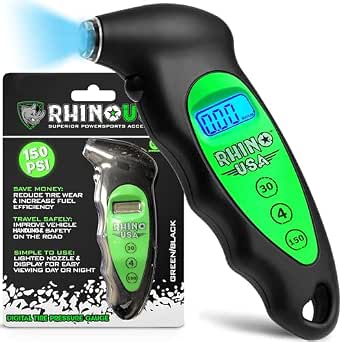 | Best for Illuminating the Valve Area | Maximum pressure: 150 PSI | Display: Backlit LCD | Nozzle: Lighted | VIEW ON AMAZON | See Our Full Breakdown |
| tire pressure gauge digital backlit | Display |
|---|---|
| Digital Talking Tire Gauge wit | Backlit LCD |
| Slime Digital Tire Pressure Ga | LCD screen |
| AstroAI Digital Tire Pressure | Backlit LCD |
| Geartronics Digital Tire Press | Backlit LCD |
| AstroAI Heavy Duty Digital Tir | Green backlit LCD |
| Silverback Digital Tire Pressu | Backlit LCD |
| Digital Tire Pressure Gauge | Backlit LCD |
| ETENWOLF T300 Digital Tire Pre | — |
| AstroAI Digital Tire Pressure | Backlit LCD |
| ETENWOLF T300 Digital Tire Pre | — |
| Digital Tire Pressure Gauge | Backlit LCD |
| Digital Tire Pressure Gauge 15 | Backlit LCD |
| JACO ElitePro Digital Tire Pre | 2.5-inch backlit LCD with pressure hold |
| AstroAI Digital Tire Pressure | Backlit LCD |
| Rhino USA Digital Tire Pressur | Backlit LCD |
More Details on Our Top Picks
Digital Talking Tire Gauge with Backlit LCD, Audible Voice, LED Light, and Keychain Hook
The audible voice readout sets this compact gauge apart from the Slime Digital Tire Pressure Gauge and AstroAI Digital Tire Pressure Gauge, which rely on visual readings. That can help when you have difficulty seeing a small display or want to keep your attention on the valve. Its backlit LCD and 8-lumen LED also address two separate low-light tasks: reading the result and finding the valve. At just 3 inches, it is easy to keep on a keychain rather than leave in a garage drawer. The tradeoff is a lack of stated pressure range, units, or accuracy figures, so buyers who need specific measurement details may prefer the AstroAI. It also requires two replaceable coin batteries and is described as less suited to rough handling.
Pros:- Voice readout provides an alternative to reading the LCD
- Backlit display and 8-lumen LED support low-light checks
- Three-inch body and keychain hook make it easy to carry
- Connects to the tire valve for pressure readings
Cons:- Product data does not state the measurement range, units, or accuracy
- Requires two CR2032 batteries that will need replacement
- Compact construction may be less durable with rough handling
Best for: Drivers who want a pocket-sized gauge with spoken readings and light for checking tires in dark parking areas
Not ideal for: Buyers who need a documented pressure range, selectable measurement units, or a sturdier tool for frequent workshop use
- Display:Backlit LCD
- Voice readout:Yes
- LED light:8 lumens
- Power:2 x CR2032 batteries
- Size:3.00 inches
- Attachment:Keychain hook
Our verdict“Choose this gauge if spoken readings and keychain portability matter more than published measurement specifications or heavy-duty construction.”
Slime Digital Tire Pressure Gauge, 5-150 PSI
The Slime gauge keeps its low-light setup simple: a bright LCD shows the reading while a lighted tip helps locate the valve. Unlike the talking gauge in this lineup, it does not announce results, but it supplies more useful measurement detail, including a stated 5–150 PSI range and psi, kPa, and bar units. That makes it a practical choice for drivers who want a conventional digital readout without extra features. The AstroAI 0–150 PSI gauge offers four units and a stated ±1 PSI accuracy, so it is the stronger pick for shoppers who prioritize those specifications. Slime counters with automatic shut-off and replaceable batteries, though the supplied product information does not state an accuracy figure, and it measures pressure only rather than inflating tires.
Pros:- Lighted tip helps illuminate the valve area at night
- LCD provides a clear digital reading
- Supports psi, kPa, and bar
- Automatic shut-off helps conserve battery power
Cons:- No accuracy figure is provided in the product data
- Requires replaceable batteries
- Measures pressure only and does not inflate tires
Best for: Everyday drivers who want a simple illuminated gauge with familiar pressure units for routine car-tire checks
Not ideal for: Buyers who need a stated accuracy specification, voice guidance, or a gauge that also inflates tires
- Measurement range:5–150 PSI
- Measurement units:psi, kPa, bar
- Display:LCD screen
- Valve lighting:Lighted tip
- Battery:Replaceable
- Power management:Automatic shut-off
Our verdict“Pick the Slime for uncomplicated nighttime tire checks and three common units, but choose the AstroAI if a stated accuracy figure matters more.”
AstroAI Digital Tire Pressure Gauge, 0–150 PSI
The AstroAI is the most clearly specified everyday pick here: it combines a 0–150 PSI range with stated ±1 PSI factory-calibrated accuracy. That gives buyers a firmer basis for comparing readings than the Slime gauge, whose supplied details do not include an accuracy figure. Its backlit LCD and illuminated nozzle also cover both reading the display and finding a Schrader valve in dim conditions. Four selectable units make it more adaptable than the Slime’s three, while the talking gauge adds voice output but lacks published range and accuracy details. The main limits are straightforward: this model is designed for standard Schrader valves, not every bicycle valve, and it needs three batteries. Automatic shut-off after 30 seconds saves power, but a delayed reading may mean restarting the check.
Pros:- Factory-calibrated accuracy stated as ±1 PSI
- Backlit LCD and illuminated nozzle aid low-light use
- Four measurement units cover different preferences
- Automatic shut-off after 30 seconds limits battery drain
Cons:- Valve compatibility is limited to standard Schrader valves
- Requires three batteries
- Automatic shut-off can interrupt a slow or repeated check
Best for: Car, SUV, and motorcycle owners who want a compact backlit gauge with a stated accuracy and several unit choices
Not ideal for: Cyclists using non-Schrader valves or buyers who want a built-in air inflator rather than a pressure-only tool
- Measurement range:0–150 PSI
- Accuracy:±1 PSI
- Measurement units:PSI, Bar, Kgf/cm², KPA
- Valve compatibility:Standard Schrader valves
- Display:Backlit LCD
- Additional lighting:Illuminated nozzle
- Auto-off:After 30 seconds of inactivity
- Power:3 included batteries
- Warranty:1 year
Our verdict“Choose this AstroAI as a well-specified daily gauge if your tires use Schrader valves and you value stated accuracy over voice guidance.”
Geartronics Digital Tire Pressure Gauge, 150 PSI, 2-Pack
The Geartronics set is the practical choice for keeping a gauge in two places, with two backlit units and batteries included. That is a different kind of value from the single AstroAI 0–150 PSI gauge: AstroAI provides a stated ±1 PSI accuracy, while Geartronics offers a spare or a second gauge for another vehicle. Its non-slip grip can help when positioning the tool on a valve, and the 30-second shut-off reduces unnecessary battery use. The compromise is that each gauge uses a combination of three AG13 batteries and one CR2032 coin cell, and replacement requires a small Phillips screwdriver. It also does not work with Presta stems, so the listing’s bicycle compatibility does not make it suitable for every bike. Choose it for household coverage, not documented precision.
Pros:- Includes two gauges for separate vehicles or storage locations
- Backlit LCD supports checks in low light
- Non-slip grip aids handling at the valve
- Batteries are included and automatic shut-off is built in
Cons:- Does not work with Presta valve stems
- Battery replacement requires a small Phillips screwdriver
- Product data does not state a measurement accuracy figure
Best for: Households that want one gauge for the car and another for a second vehicle, tool kit, or garage
Not ideal for: Cyclists with Presta valves or buyers who want a single gauge with a stated accuracy specification and simpler battery replacement
- Maximum pressure:150 PSI
- Pressure settings:4
- Display:Backlit LCD
- Quantity:2 gauges
- Compatible vehicles:Cars, trucks, bicycles, and motorcycles
- Valve compatibility:Does not work with Presta stems
- Batteries:3 AG13 batteries and 1 CR2032 coin cell per gauge; included
- Automatic shut-off:After 30 seconds of inactivity
Our verdict“Choose this set when having two backlit gauges matters more than a published accuracy figure or easy battery access.”
AstroAI Heavy Duty Digital Tire Pressure Gauge, 230 PSI for Car and Bicycle
With a stated ceiling of 230 PSI, this heavy-duty AstroAI suits buyers whose pressure needs exceed the 150 PSI limit of the Slime and Geartronics gauges. Its green backlit LCD and flashlight offer two kinds of visibility, while 0.1 PSI increments support fine adjustments when checking pressure. The four unit choices also make it adaptable across vehicles. For ordinary car tires, though, the extra range may be unnecessary; the standard AstroAI 0–150 PSI model is a more clearly specified everyday alternative, with a stated ±1 PSI accuracy and Schrader compatibility. This heavy-duty version does not work with Presta stems, and the product data does not give a numerical accuracy figure despite describing readings as accurate. Batteries are included, but the automatic shut-off may catch a user who pauses between checks.
Pros:- 230 PSI maximum extends beyond the 150 PSI gauges in this lineup
- Green backlit LCD and flashlight aid low-light checks
- 0.1 PSI increments allow fine reading steps
- Four pressure units support varied measurement preferences
Cons:- Not compatible with Presta valve stems
- Product data does not state a numerical accuracy figure
- Automatic shut-off may interrupt checks if the user pauses
Best for: Owners of vehicles or equipment that call for readings above 150 PSI and who need an illuminated display
Not ideal for: Drivers checking only typical car tires, or cyclists using Presta valves who need a compatible gauge
- Maximum pressure:230 PSI
- Display:Green backlit LCD
- Additional lighting:Flashlight
- Measurement units:PSI, Bar, Kgf/cm², KPa
- Reading increments:0.1 PSI
- Power:Batteries included
- Compatibility:Cars, SUVs, and motorcycles; not compatible with Presta stems
- Warranty:1 year
Our verdict“Choose this model for high-pressure applications above 150 PSI; for routine car tires, the standard AstroAI gauge has more clearly stated accuracy details.”
Silverback Digital Tire Pressure Gauge, 0–150 PSI
The Silverback’s main advantage over a basic backlit gauge such as the Digital Tire Pressure Gauge, Accurate Cars Air Gauge 150 PSI is its metal chuck with deflate mode: I can check pressure and release excess air without switching tools. Its backlit LCD and four selectable units also suit drivers who work in dim garages or need readings in bar, kPa, or kgf/cm². The stated ±0.5% accuracy is a standout specification among these compact options, while automatic calibration is designed to simplify startup. Its 150 PSI ceiling is enough for many passenger vehicles, but it falls short of the AstroAI 3–250 PSI inflator for high-pressure applications or buyers who want active inflation from the same tool. The short 30-day warranty is the clearest ownership drawback.
Pros:- Metal chuck includes a deflate mode for correcting overinflation
- Backlit LCD supports readings in low-light conditions
- Offers PSI, bar, kPa, and kgf/cm²
- Specified accuracy is ±0.5%
Cons:- 30-day warranty offers limited coverage
- 150 PSI maximum is below the AstroAI inflator’s 250 PSI range
- Measures and deflates but does not inflate tires
Best for: Drivers who want a backlit gauge that can also bleed excess air and who value multiple pressure units.
Not ideal for: Buyers seeking long warranty coverage, inflation capability, or a gauge for pressures above 150 PSI.
- Pressure range:0–150 PSI
- Accuracy:±0.5%
- Measurement units:PSI, bar, kPa, kgf/cm²
- Display:Backlit LCD
- Air chuck:Professional-grade metal
- Additional features:Deflate mode, automatic shutoff, automatic calibration
- Dimensions:7.5 × 1.6 × 1 inches
- Weight:4.5 ounces
- Warranty:30 days
Our verdict“Choose the Silverback if you want a backlit gauge with a metal chuck for checking and bleeding pressure, but skip it if warranty length or inflation function matters more.”
Digital Tire Pressure Gauge, Accurate Cars Air Gauge 150 PSI
This gauge keeps its appeal simple: a backlit LCD, four measurement units, and a stated minimum measurable value of 0.1 make it a flexible choice for routine checks on cars, trucks, motorcycles, and bicycles. Compared with the Silverback Digital Tire Pressure Gauge, it lacks a specified metal chuck and deflate mode, so it is less useful when a tire needs pressure released rather than just measured. Its automatic shutoff after 30 seconds is a practical battery-saving detail, and the 4–150 PSI range covers common vehicle needs. The range starts above zero, though, and the product information does not specify accuracy, battery type, or water resistance. Buyers wanting a broader ceiling and stated environmental tolerance should look at the ETENWOLF T300 instead.
Pros:- Backlit LCD helps with checks in low light
- Supports PSI, bar, kPa, and kgf/cm²
- Automatic shutoff after 30 seconds conserves battery
- 0.1 minimum measurable value is specified
Cons:- Measurement range begins at 4 PSI rather than zero
- Accuracy and battery type are not specified
- No stated deflate function or waterproof feature
Best for: Drivers and riders who want one uncomplicated, backlit gauge for routine checks across several common vehicle types.
Not ideal for: Buyers who need documented accuracy, a deflation function, weather protection, or readings below 4 PSI.
- Measurement range:4–150 PSI
- Units:PSI, bar, kPa, kgf/cm²
- Minimum measurable value:0.1
- Display:Backlit LCD
- Power saving:Automatic shutoff after 30 seconds
- Intended vehicles:Cars, trucks, motorcycles, and bicycles
Our verdict“Pick this model for basic backlit pressure checks across everyday vehicles, but choose the Silverback for deflation or the ETENWOLF T300 for a higher pressure ceiling.”
ETENWOLF T300 Digital Tire Pressure Gauge, 3–200 PSI
The T300 is a stronger fit than the 150 PSI Silverback when a buyer needs more headroom: its 3–200 PSI range covers a broader spread of tires, and the stated operating range of -4°F to 130°F makes it suited to garages and vehicles exposed to pronounced seasonal swings. An LED light helps locate the valve and read the gauge in dark areas, while replaceable AAA batteries avoid relying on a sealed power source. Its ANSI B40.7 Grade 2A calibration and ±1 PSI accuracy give more context about measurement performance than the basic 150 PSI gauge’s unspecified accuracy. The tradeoff is that it measures only; unlike the AstroAI Digital Tire Pressure Gauge and Inflator, it cannot add or release air. The Presta adapter is also sold separately, limiting convenience for some bicycle owners.
Pros:- 3–200 PSI range extends beyond many 150 PSI gauges
- Operating range is specified from -4°F to 130°F
- LED light aids use in dark areas
- Replaceable AAA batteries and three-year warranty are specified
Cons:- Specified accuracy is ±1 PSI
- Presta valve adapter is not included
- Measures pressure but does not inflate or deflate tires
Best for: Drivers, RV owners, and motorcycle or bicycle owners who need a backlit gauge for varied pressures and hot or cold conditions.
Not ideal for: Cyclists using Presta valves who want an included adapter, or buyers who need an inflator and deflator in one tool.
- Pressure range:3–200 PSI
- Accuracy:±1 PSI
- Calibration standard:ANSI B40.7 Grade 2A
- Operating temperature:-4°F to 130°F (-20°C to 54°C)
- Batteries:2 replaceable AAA batteries
- Valve chuck:Schrader
- Dimensions:6.3 × 1.46 × 1.06 inches
- Weight:110 g
- Warranty:3 years
Our verdict“Choose the T300 for a broad pressure range and stated temperature tolerance, but select the AstroAI inflator if you want to adjust pressure with the same tool.”
AstroAI Digital Tire Pressure Gauge and Inflator, 3–250 PSI, 1/4-Inch NPT
Unlike the standalone ETENWOLF T300, this AstroAI combines pressure measurement, inflation, and deflation, so it can handle the correction after a reading instead of sending the user to another tool. Its 3–250 PSI range is the broadest here, and 0.1 PSI resolution gives a fine displayed increment. The backlit LCD is paired with a built-in LED flashlight, a useful combination when reaching a valve in a poorly lit space. Its stated ANSI B40.7 Grade 2A accuracy of ±0.5% of full scale provides a clear measurement specification. The tradeoff is a more equipment-oriented setup: it uses a 1/4-inch NPT connection and, unlike a simple handheld gauge such as the Silverback, is designed as an inflator tool. The supplied information does not list warranty, weight, or included accessories.
Pros:- Combines pressure measurement, inflation, and deflation
- 3–250 PSI range exceeds the other listed gauges
- Backlit LCD and built-in LED flashlight support low-light use
- 0.1 PSI resolution and stated ANSI calibration provide measurement detail
Cons:- 1/4-inch NPT connection may not suit buyers seeking a simple handheld gauge
- Warranty, weight, and included accessories are not specified
- Requires compatible air equipment to use its inflation function
Best for: Home mechanics and vehicle owners who already use compatible air equipment and want to measure, inflate, and deflate with one tool.
Not ideal for: Drivers who only want a compact standalone gauge or who do not have compatible 1/4-inch NPT air connections.
- Pressure range:3–250 PSI
- Resolution:0.1 PSI
- Accuracy:ANSI B40.7 Grade 2A (±0.5% full scale)
- Connection:1/4-inch NPT
- Functions:Inflates, deflates, and measures tire pressure
- Display:Backlit LCD
- Additional feature:Built-in LED flashlight
- Other pressure units:0.2–17.2 bar; 0.21–1724 kPa; 0.2–17.5 kg/cm²
- Power saving:Shuts off after 15 seconds of inactivity
Our verdict“Choose this AstroAI if you want one tool to measure and adjust pressure across a wide range, but pick a standalone gauge for simpler carry and setup.”
ETENWOLF T300 Digital Tire Pressure Gauge, 3–200 PSI
This T300 variant shares the 3–200 PSI range, temperature compensation, and ±1 PSI accuracy of the other ETENWOLF T300 in this roundup, so the choice between them is less about pressure capability than package details. This listing specifies an 81 g weight, 30-second auto shutoff, and a design described as able to withstand being run over by a car; the other T300 listing instead specifies a three-year warranty and weighs 110 g. Like that model, it has an LED light, replaceable AAA batteries, and an operating range of -4°F to 130°F. Compared with the AstroAI 3–250 PSI inflator, this ETENWOLF is a lighter handheld gauge but cannot inflate or deflate tires. The missing Presta adapter and ±1 PSI accuracy remain meaningful limits.
Pros:- 3–200 PSI range suits varied vehicle pressures
- Operating temperature range spans -4°F to 130°F
- LED light and replaceable AAA batteries support practical use
- Described as designed to withstand being run over by a car
Cons:- Presta valve adapter is not included
- Specified accuracy is ±1 PSI
- Two-year warranty is shorter than the three-year warranty listed for the other T300
Best for: Drivers who want a lightweight, backlit handheld gauge with broad pressure coverage and a design described as able to withstand being run over.
Not ideal for: Presta-valve cyclists, buyers seeking finer stated accuracy, or anyone who needs inflation and deflation functions.
- Model:T300G
- Pressure range:3–200 PSI
- Accuracy:ANSI B40.7 Grade 2A (±1 PSI)
- Operating temperature:-4°F to 130°F (-20°C to 54°C)
- Power:2 AAA batteries
- Auto shutoff:30 seconds
- Dimensions:6.3 × 1.46 × 1.06 inches
- Weight:81 g
- Warranty:2 years
Our verdict“Choose this variant if its lighter listed weight and run-over resistance suit your needs, but compare the other T300 if a longer stated warranty matters more.”
Digital Tire Pressure Gauge, 150 PSI, 4 Settings, Backlit LCD, High Accuracy, Portable for Cars, Trucks, Bicycles
For drivers who switch between unit systems, this gauge makes PSI, bar, kPa, and kg/cm² available in one compact tool. Its backlit LCD helps with roadside checks in dim conditions, while the non-slip grip is useful when handling it near a wheel. Compared with the AstroAI 2-Pack, this pick offers the same four-unit flexibility but comes as a single gauge rather than a pair. The 150 PSI ceiling covers typical cars, trucks, and bicycles, though it is not the high-pressure choice for specialized applications. I would also factor in the operating routine: it needs activation for each reading and powers off after 30 seconds, so repeated checks may mean pressing the controls again. Its three AG13 cells are replaceable, but they are not included.
Pros:- Supports four units: PSI, bar, kPa, and kg/cm²
- Backlit display is easier to read in low light
- Non-slip ergonomic body weighs 0.16 lb
- Compact size suits vehicle storage and travel
Cons:- Three AG13 button-cell batteries are not included
- Must be activated before each measurement
- 30-second auto-off can interrupt repeated checks
Best for: Drivers and cyclists who regularly read tire pressure in different units and want one lightweight gauge to keep in a glove box or bike kit.
Not ideal for: Buyers who want batteries included, a pair of gauges, or uninterrupted readings during a string of tire checks.
- Measurement range:0–150 PSI
- Supported units:PSI, bar, kPa, kg/cm²
- Display:Backlit LCD
- Material:ABS and electronic components
- Weight:0.16 lb
- Dimensions:5.5 × 2.2 × 1.1 inches
- Batteries:3 AG13 button cells
- Auto-off:After 30 seconds
Our verdict“Choose this compact gauge if four selectable units matter more to you than included batteries or hands-free repeat measurements.”
Digital Tire Pressure Gauge 150 PSI with Backlight LCD
The included Presta valve adapter gives this gauge a practical advantage for households checking both car tires and compatible bicycle valves. It also offers a backlit LCD and four unit choices, with a 150 PSI range suited to common vehicle and bike checks. Compared with the first 150 PSI gauge in this group, its stated accessory is the useful distinction: the other model describes a general portable design but does not list a bicycle adapter. The compact form and 30-second auto shut-off favor occasional checks and easy storage. The tradeoff is that the description provides no battery type or included-battery details, so buyers cannot plan around replacements from the listed specs. Its 150 PSI limit also rules it out for applications that need a higher range.
Pros:- Presta valve adapter is included
- Backlit LCD supports checks in low light
- Reads in PSI, bar, kgf/cm², and kPa
- Compact design and auto shut-off suit portable use
Cons:- Maximum reading is 150 PSI
- Battery type and inclusion are not specified
- No hose or pressure-release feature is listed
Best for: Households that check car, motorcycle, and Presta-valve bicycle tires and want one small gauge with a backlit readout.
Not ideal for: Owners of high-pressure specialty tires or buyers who need clear information about battery type and included power sources before purchase.
- Measurement range:0–150 PSI
- Units:PSI, bar, kgf/cm², kPa
- Display:Backlit LCD
- Auto shut-off:30 seconds
- Included adapter:Presta valve adapter
- Use cases:Cars, motorcycles, and bicycles
- Form:Compact and portable
Our verdict“Pick this model if the included Presta adapter makes it a better fit for your bicycle-and-car routine than a general-purpose gauge.”
JACO ElitePro Digital Tire Pressure Gauge, 100 PSI
The JACO ElitePro is the most control-focused pick here: its pressure hold keeps a reading visible, and the built-in air bleeder lets you reduce pressure without reaching for another tool. A flexible 10-inch hose and swivel chuck can also make valve access easier than with the compact, direct-grip gauges such as the AstroAI Digital Tire Pressure Gauge 2-Pack. Its 100 PSI ceiling is lower than those models’ 150 PSI limits, but the 0.10 PSI resolution and stated ±0.50 PSI accuracy suit buyers who value finer readouts within its range. The metal construction and protective guard favor workshop use. In exchange, this design is larger and more involved than a simple glove-box gauge, and the hose may be short for some setups.
Pros:- Pressure hold keeps the reading on screen
- Built-in bleeder allows pressure reduction at the valve
- 0.10 PSI resolution with stated ±0.50 PSI accuracy
- Alloy steel and brass body includes a protective guard
Cons:- 100 PSI maximum is below the 150 PSI range of several alternatives
- 10-inch hose may not suit every valve or work area
- Requires two AAA batteries
Best for: Drivers and home-garage users who want to check and bleed tire pressure with one tool and value a held reading.
Not ideal for: Owners of tires that may exceed 100 PSI or buyers seeking the smallest, simplest gauge for occasional glove-box checks.
- Maximum pressure:100 PSI
- Accuracy:±0.50 PSI
- Resolution:0.10 PSI
- Display:2.5-inch backlit LCD with pressure hold
- Hose length:10 inches
- Chuck:360-degree swivel angled air chuck
- Materials:Alloy steel and brass
- Batteries and warranty:Two AAA batteries included; lifetime warranty
Our verdict“Choose the JACO if you want a backlit gauge that can also hold and bleed pressure, provided 100 PSI covers your tires.”
AstroAI Digital Tire Pressure Gauge 0-150 PSI, 4 Units, Backlit LCD, 2-Pack
This two-gauge set is the clearest choice when more than one vehicle or driver needs a gauge close at hand. Each unit pairs a backlit LCD with a lighted nozzle, so the valve area as well as the readout is easier to see in dim conditions. Four measurement units and a 0–150 PSI range make it a flexible everyday option. Compared with the single-gauge Rhino USA model, the AstroAI gives you a second unit, which is handy for keeping one in each car or sharing with another driver. Its range is enough for many routine checks but does not match higher-capacity options in the broader roundup. Batteries are included, though they will eventually need replacement, and the listed details do not provide a specific accuracy tolerance.
Pros:- Two gauges support storage in separate vehicles
- Backlit LCD and lighted nozzle aid low-light use
- Four units cover common measurement preferences
- Batteries are included and auto shut-off conserves power
Cons:- 150 PSI maximum excludes higher-pressure applications
- Batteries will need replacement over time
- No specific accuracy tolerance is listed
Best for: Multi-car households, couples, or drivers who want a gauge in two vehicles and need an illuminated nozzle for nighttime checks.
Not ideal for: Buyers needing pressure readings above 150 PSI or a published accuracy tolerance for comparison.
- Range:0–150 PSI
- Units:PSI, bar, kgf/cm², kPa
- Display:Backlit LCD
- Nozzle:Lighted
- Pack size:2 gauges
- Battery:Included
- Auto shut-off:Yes
- Grip:Non-slip textured surface
Our verdict“Choose this two-pack if convenience across multiple vehicles matters more than a higher pressure ceiling or detailed accuracy specifications.”
Rhino USA Digital Tire Pressure Gauge, 150 PSI
The Rhino USA’s standout feature is its lighted nozzle, which helps locate the valve as well as read the backlit LCD when working in a dark garage or roadside setting. Its ergonomic shape and four unit choices make it a straightforward everyday option, while the 150 PSI maximum covers a broad range of routine tire checks. Compared with the AstroAI 2-Pack, Rhino USA focuses on a single gauge with an illuminated nozzle rather than offering two units for separate vehicles. The main information gap is its accuracy: the product details call it certified accurate but give no tolerance, making precision harder to compare with the JACO ElitePro’s stated ±0.50 PSI figure. Buyers who need documented accuracy or a higher range may prefer another model.
Pros:- Lighted nozzle helps locate the valve in low light
- Backlit LCD improves display visibility
- Supports PSI, bar, kPa, and kg/cm²
- Ergonomic design suits routine handling
Cons:- No specific accuracy tolerance is provided
- 150 PSI maximum limits use with higher-pressure applications
- Single gauge does not offer the shared-vehicle convenience of the AstroAI two-pack
Best for: Drivers who often check tires in poorly lit places and want illumination at both the valve and screen.
Not ideal for: Buyers who need a published accuracy tolerance, a second gauge for another vehicle, or readings above 150 PSI.
- Maximum pressure:150 PSI
- Display:Backlit LCD
- Nozzle:Lighted
- Measurement units:PSI, bar, kPa, kg/cm²
- Design:Ergonomic
- Accuracy information:Described as certified accurate; no tolerance specified
Our verdict“Pick the Rhino USA if valve visibility is your priority, but choose the JACO if a stated accuracy tolerance matters more.”

How We Picked
I compared the 15 listed products by how well they suit the central need: reading tire pressure clearly when ambient light is poor. The main criteria were the presence of a backlit display, pressure range, intended use, operating format, and features that change how a buyer uses the gauge, such as audible readings, a work light, multiple units, a two-pack, or an integrated inflator. I also considered whether a product’s listed range is proportionate to everyday car use or points toward higher-pressure applications.
The order gives priority to practical fit for a broad range of drivers, then recognizes narrower advantages such as high pressure capacity, bundled quantity, or added inflator function. A larger PSI ceiling alone does not outrank ease of use for routine checks, and extra features earn a place only when they serve a clear buyer need. Product descriptions provide limited detail on durability and measurement performance, so I avoid treating unlisted construction or accuracy claims as proven. The two ETENWOLF T300 entries are duplicate listings, not separate designs.
Factors to Consider When Choosing Tire Pressure Gauge Digital Backlit
To choose a digital backlit tire pressure gauge, start with where and how you check pressure, not the largest number on the package. The differences that matter most are the tire pressures you need to read, the lighting conditions, and whether you want a gauge alone or a tool that also connects to an air supply.
Match the Pressure Range to Your Tires
For a passenger car, the pressure listed on the vehicle placard is the number to follow; the tire sidewall’s maximum pressure is not the recommended setting. A 150 PSI gauge gives ample headroom for routine checks, so a higher ceiling may add little value if you only maintain ordinary car tires. Higher-range models can make more sense for specialized vehicles or equipment, but confirm that the intended operating pressure sits comfortably within the gauge’s range. Check the low end as well as the maximum, since a gauge’s stated range can affect whether it suits lower-pressure applications. Avoid choosing by maximum PSI alone: range does not tell you how clearly the display reads or how the gauge handles a valve stem.
Think Beyond the Backlight
A backlit screen helps when you are checking tires at night, in a shaded garage, or during poor weather. The display still needs to be easy to read at a glance, so look for clear digits and a layout that does not make unit selection confusing. A built-in LED light can help locate the valve, while spoken readings can help users who have trouble seeing a small screen or want an audible readout. Those extras can add convenience, but they may be unnecessary if your checks happen in a bright driveway. Decide whether your problem is seeing the display, finding the valve, or reading the result; each feature addresses a different task.
Choose Between a Standalone Gauge and an Inflator
A standalone digital gauge is usually the more direct tool for checking pressure: attach it, read the result, and adjust air separately. An inflator-style gauge can reduce tool swapping when you already use an air compressor, but it adds a hose connection and requires compatibility with your air setup. Check the connection specification and make sure it fits the compressor or air line you plan to use. An integrated tool may be less convenient to carry for a quick roadside reading than a compact gauge. Pay for the combined function only if you expect to use the air-delivery feature, not just because it has a higher PSI rating.
Treat Accuracy Claims and Resolution Carefully
Small pressure differences matter when setting tires, but a headline accuracy claim is useful only when its stated tolerance and measurement conditions are clear. Compare the gauge’s accuracy information with the precision your vehicle or equipment calls for, rather than assuming that a digital screen guarantees a more accurate reading. Use the same gauge for repeat checks when you can; switching between tools can make small differences harder to interpret. If readings seem inconsistent, check the valve seal and repeat the measurement before changing pressure. For critical applications, compare the gauge periodically with a trusted reference rather than relying on display detail alone.
Decide Whether a Two-Pack or Extra Features Fit Your Routine
A two-pack can be useful when you keep one gauge in each vehicle or share tools across a household, but it is unnecessary if one device will cover all your checks. Audible output, multiple measurement units, and a keychain-style attachment can each solve a specific usability problem; they are not substitutes for a readable display or suitable pressure range. Before buying a feature-heavy model, ask which part of your routine it improves. Also check what the listing says about power and shutoff behavior, since a digital tool that is left on can be inconvenient when stored. Match added features to regular use, not to a longer feature list.
Plan for Storage and Repeat Use
A gauge kept in a glove box or tool kit needs to be easy to locate and ready when you need it. Look for a form factor and attachment style that suit your storage spot, and consider whether the tool’s controls could be pressed accidentally in a crowded compartment. Digital gauges depend on power, so factor in the stated battery arrangement and how the device signals low power if that information is available. Keep the sensor end clean and protect it from dirt or moisture when stored with other tools. A simple, well-stored gauge can be more useful than a feature-rich model that is difficult to find or not ready for a check.
Frequently Asked Questions
Is a 150 PSI digital gauge enough for checking car tires?
For ordinary passenger-car tires, a 150 PSI maximum is generally more range than the vehicle’s recommended pressure requires. Set tires to the pressure on the vehicle placard or in the owner’s manual, not to the maximum printed on the tire. A higher-range gauge may be useful for other equipment, but it does not make a reading better for a regular car. If you maintain several types of tires, check the range and stated accuracy at the pressures you actually use. For a car-only kit, readability and ease of handling may matter more than an unusually high ceiling.
Does a backlit display work well enough for roadside checks at night?
A backlight makes the pressure reading easier to see, but it does not necessarily illuminate the valve stem or the area around the tire. If you often check tires in darkness, a model with a separate LED light can address that second task. Spoken readings may help when you cannot comfortably position the screen to view it. Keep in mind that additional features can add controls or power needs, so weigh those against how often you work in low light. A small flashlight can also complement a simpler backlit gauge.
Should I choose a gauge with an integrated inflator or buy a separate gauge?
Choose an integrated inflator gauge if you already use a compatible compressor and want to check pressure while adding air. It can reduce the number of tools involved, but the air-line connection makes it less like a simple pocket gauge. A standalone model is usually easier to carry for quick checks and does not depend on an air source. Before choosing an inflator, confirm that its connection fits your equipment and that its pressure range suits your intended use. If you only need readings, the added air-delivery function may not justify the extra bulk.
Are two-pack gauges a better choice for a household with multiple cars?
A two-pack can be practical if you want one gauge stored in each vehicle or if more than one driver needs regular access. It also reduces the chance that the tool is in the wrong car when a pressure check is due. If you keep a single shared kit in a garage, one gauge may be all you need. Check that the pack contains the same model and features in both units rather than assuming the second gauge is identical from the bundle label alone. Storage habits, not vehicle count by itself, should guide this choice.
Why does my digital gauge show a different reading from another gauge?
Small variations can come from differences in gauge calibration, valve-stem fit, or how firmly and quickly each tool is attached. Check the same tire more than once with a steady seal, and compare readings close together before air temperature or recent driving changes pressure. Avoid treating a more detailed digital display as proof that one gauge is automatically correct. If the disagreement is large or repeated, compare both tools with a trusted reference or have the gauge checked according to its instructions. Use your vehicle’s recommended cold-tire pressure as the target, not a reading from an unfamiliar tool alone.
Conclusion
For most drivers, I would start with the AstroAI Digital Tire Pressure Gauge, 0–150 PSI as the best overall fit for routine checks. The Geartronics two-pack or AstroAI 0–150 PSI two-pack makes more sense as a value-minded choice when you want gauges in multiple vehicles. For a wider pressure range, choose the ETENWOLF T300; for checking and adding air in one workflow, consider the AstroAI gauge and inflator. Beginners who want extra help reading in poor light may prefer the talking gauge with LED light, while drivers who need only a straightforward backlit tool can focus on the standard 150 PSI options. The best premium pick depends on the feature you will use most: range, integrated inflation, or added low-light assistance. Pick the tool around your tire pressures and routine, rather than the highest PSI figure alone.
Evergreen bestsellers Picks
bestsellers
As an affiliate, we earn on qualifying purchases.