
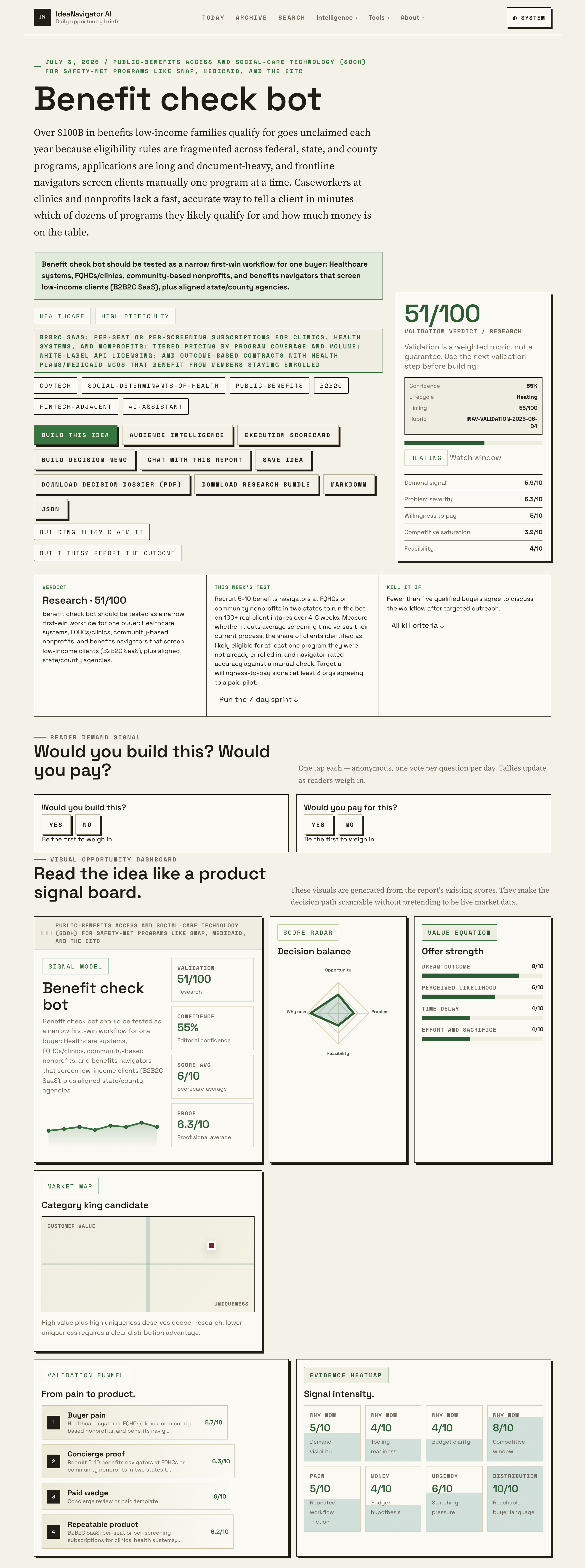
📊 Full opportunity report: Benefit Check Bot Solutions For Streamlined Public Benefits Eligibility on IdeaNavigator AI — validation score, market gap, and execution plan.

Get business pricing on monitors, keyboards and dev gear
- Business-only prices and quantity discounts
- Tax-exempt purchasing
- Multiple users, one account, clear invoices
TL;DR
A new benefit check bot is being tested to streamline eligibility screening for public benefits like SNAP and Medicaid. It addresses longstanding fragmentation and manual processes, potentially increasing access and efficiency. Pilot programs in select states will evaluate its impact.
A new benefit check bot is being tested as a streamlined, automated solution for screening low-income clients’ eligibility for multiple public benefits programs. Developed in response to the fragmentation and manual nature of current processes, this AI-powered tool aims to help healthcare systems, clinics, and nonprofits identify benefits worth billions that often go unclaimed. The pilot phase involves real-world testing with select community organizations across two states, with early results expected later in 2024.
The benefit check bot is a white-label conversational AI platform that can be embedded on websites or accessed via SMS. It asks a series of yes/no and multiple-choice questions to quickly assess a client’s eligibility for programs such as SNAP, Medicaid, EITC/CTC, WIC, and LIHEAP. Based on responses, it provides an estimated benefit amount and next steps, including application links and required documentation. The initial version covers rules from two to three states, with plans to expand coverage as the tool matures.
This initiative emerges after the shutdown of Benefits Data Trust, a nonprofit that historically facilitated enrollment for millions across seven states. The gap left by its closure coincides with increased redetermination efforts following Medicaid unwinding, which has overwhelmed manual screening processes. The conversational AI approach leverages recent advances in multilingual, low-cost AI to deliver near-instant, accurate assessments—a significant improvement over manual, time-consuming methods.
Early validation involves recruiting 5-10 benefits navigators at federally qualified health centers (FQHCs) and community nonprofits. Over 4-6 weeks, these organizations will use the bot during client intake, with key metrics including screening time reduction, the proportion of clients identified as eligible for additional programs, and navigator-rated accuracy. The goal is to demonstrate that the tool can improve efficiency and expand benefits access, with at least three organizations committing to paid pilots as validation.
Potential Impact on Benefits Access and System Efficiency
The benefit check bot addresses a critical gap in the current social services landscape by automating eligibility screening and reducing manual effort. Its deployment could unlock over $100 billion annually in benefits that low-income families qualify for but often do not claim, due to complex rules and cumbersome application processes. For healthcare providers and nonprofits, the tool promises to cut screening times from hours to minutes, enabling faster, more accurate assistance. This could lead to higher enrollment rates, better health outcomes, and reduced administrative costs. Moreover, the scalable, low-cost AI approach makes it feasible to serve large populations across multiple states, potentially transforming how public benefits are accessed and administered.
Popular right now

Dyson V8 Cyclone Cordless Vacuum

LG 85-Inch QNED84B Mini LED 4K Smart TV (2026)

Dyson W1 PencilWash Cordless Wet and Dry Floor Cleaner with Dock
As an affiliate, we earn on qualifying purchases.
Fragmentation and Challenges in Public Benefits Enrollment
Currently, over $100 billion in benefits go unclaimed each year because eligibility rules are fragmented across federal, state, and local programs. Manual screening processes are labor-intensive, requiring caseworkers and navigators to evaluate each program separately, often with long forms and extensive documentation. The shutdown of Benefits Data Trust in 2024 removed a key outsourced capacity that helped enroll millions, leaving clinics and nonprofits without a dedicated, efficient tool. Meanwhile, the post-pandemic Medicaid unwinding has increased redetermination efforts, straining existing workflows and exposing the need for automation. Advances in conversational AI, especially multilingual and low-cost models, now make it possible to deliver rapid, accurate screening at minimal marginal cost, representing a significant shift in social services delivery.
Uncertainties Around Pilot Outcomes and Scalability
It is not yet clear how accurately the benefit check bot will perform in diverse real-world settings or how well it will be received by frontline navigators and clients. The pilot phase will provide initial data on screening accuracy, time savings, and user satisfaction, but broader scalability, long-term impact, and integration with existing systems remain to be demonstrated. Additionally, questions about data privacy, multilingual support, and coverage expansion as rules evolve are still being addressed.
Next Steps for Validation and Expansion Efforts
Following the pilot testing with select organizations, developers plan to analyze the data to refine the AI’s accuracy and user experience. Successful validation could lead to wider deployment across more states and program types, with potential integration into Medicaid redetermination workflows and other eligibility checks. Further, partnerships with health plans and Medicaid managed care organizations are being explored to create outcome-based contracts, incentivizing benefits retention and improved health outcomes. The goal is to establish the benefit check bot as a standard tool in social care and healthcare settings, ultimately helping millions access benefits more efficiently.
Key Questions
How does the benefit check bot determine eligibility?
The bot uses a series of yes/no and multiple-choice questions based on program-specific eligibility rules from the states it covers. It then calculates likely benefits and provides next steps, including application links and documentation checklists.
Who can use the benefit check bot?
The tool is designed for healthcare providers, clinics, nonprofits, and state agencies involved in screening and enrolling low-income clients for public benefits.
What programs does the bot cover initially?
Initially, the bot will focus on programs like SNAP, Medicaid, EITC/CTC, WIC, and LIHEAP, with plans to expand coverage as the system evolves.
When will the pilot results be available?
Early results from the pilot testing are expected later in 2024, with full analysis to follow after data collection and review.
Will this tool replace human navigators?
The goal is to augment, not replace, human navigators by providing quick, accurate screening results that reduce manual workload and improve service quality.
Source: IdeaNavigator AI