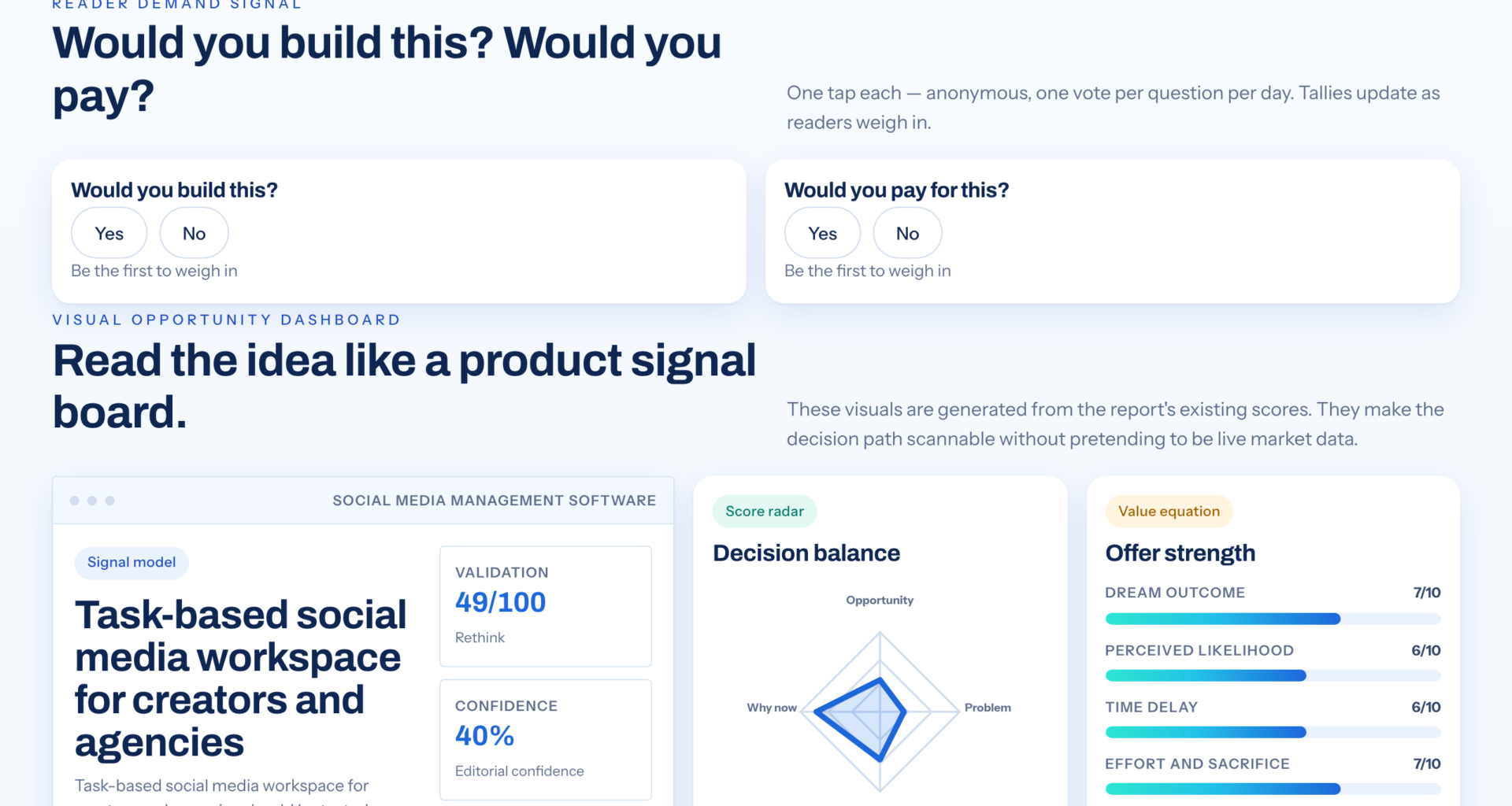

📊 Full opportunity report: Social Media Collaboration Tools For Task-Based Workflows on IdeaNavigator AI — validation score, market gap, and execution plan.

Get business pricing on monitors, keyboards and dev gear
- Business-only prices and quantity discounts
- Tax-exempt purchasing
- Multiple users, one account, clear invoices
TL;DR
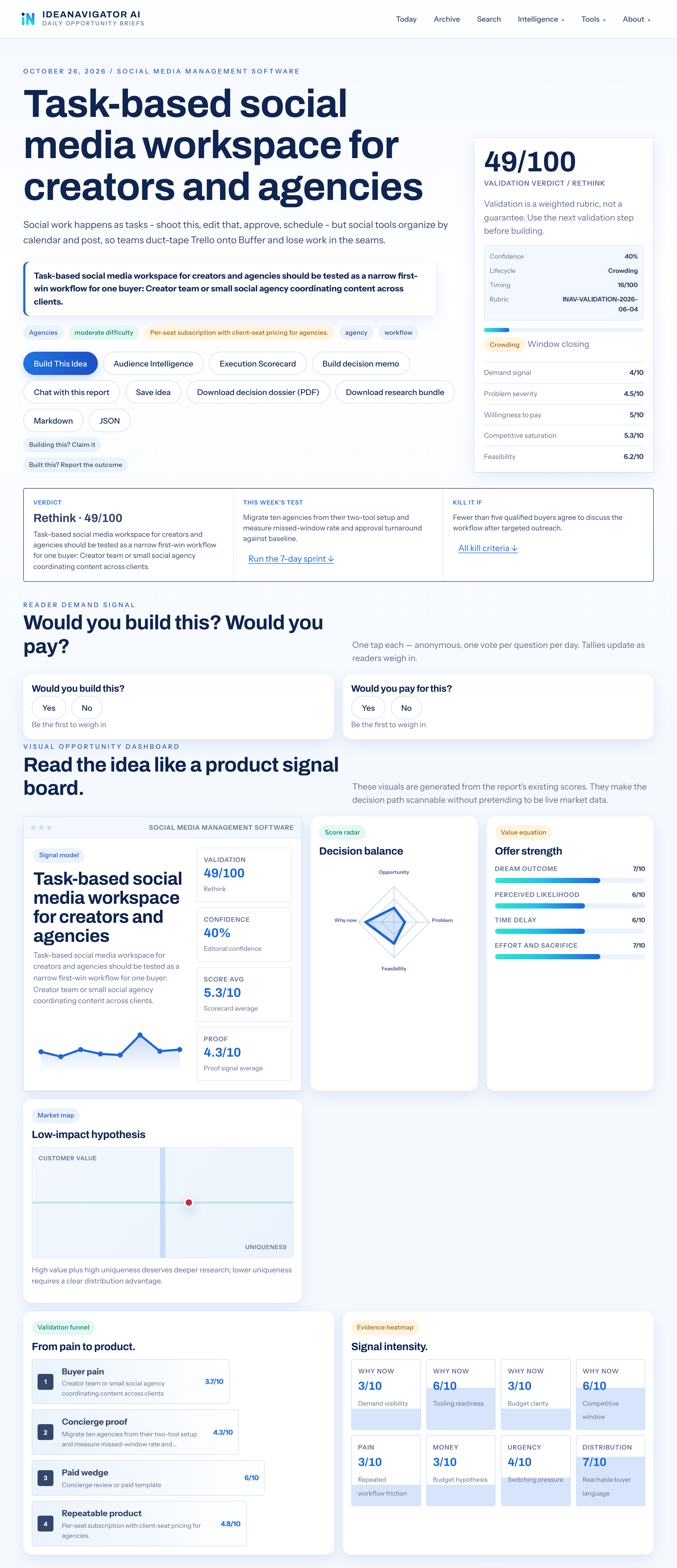
IdeaNavigator AI has outlined a product concept for creators and small social agencies: manage each social post as a task from brief through approval and scheduling. The proposal recommends testing it with 10 agencies, but reports no product launch, adoption data or validation results.
IdeaNavigator AI has proposed a social media workspace that treats each post as a task moving through briefing, asset creation, editing, approval and scheduling. The concept targets creator teams and small social agencies managing content for multiple clients; it is a product proposal, not a reported launch or a tested service.
The proposed workspace would place a post and its associated work in one pipeline, rather than separating planning and publishing from project management. Its suggested stages are brief, asset, edit, approval and scheduled. The outline also calls for client-facing approval links, asset versioning and scheduling that can happen once a post is approved.
The intended buyer is a creator team or small agency coordinating content across clients. The proposal identifies a per-seat subscription as the business model, with pricing for client seats intended to suit agencies. It does not provide prices, a product name, a release date or details on integrations and supported social networks.
For validation, the proposal recommends migrating 10 agencies from their existing two-tool setups and comparing missed publishing-window rates and approval turnaround times with each agency’s baseline. Those are suggested measures, not results: no participating agencies, baseline figures or test outcomes are reported.
A Post-Centered Workflow for Agencies
The concept addresses a specific coordination problem: social content involves a sequence of handoffs, while teams may manage tasks and publishing in separate products. If a brief, asset revision or approval is tracked away from the scheduled post, work can be harder to follow across clients. The proposed design makes the post itself the unit of work and links production steps to publication.
That could matter to small agencies handling multiple approval chains, where delays can push content past its intended publishing window. But the potential benefit remains a hypothesis. Whether a unified workspace reduces missed windows or shortens approvals would depend on how teams use it and whether its workflow fits their clients’ practices. The suggested pilot’s comparison against a baseline would help test that claim.
Popular right now

KitchenAid Artisan 5-Quart Tilt-Head Stand Mixer, KSM150PS, Almond Cream

Vitamix 5200 Professional-Grade Blender, 64 oz. Container, Black

Shark AI Ultra Robot Vacuum with Self-Empty Base
As an affiliate, we earn on qualifying purchases.
Why Separate Tools Create Friction
The IdeaNavigator AI outline describes a common arrangement in which teams combine a social scheduling tool with a general project-management product. It says scheduling products tend to organize around calendars and posts, while general task tools do not necessarily represent the details of social publishing. The resulting handoffs, it argues, can leave gaps in ownership, versions or approval status.
The proposal says rising content-velocity expectations have increased the number of workflows teams must coordinate, while scheduling-tool companies have left work management to general-purpose tools. These are the proposal’s market rationale; it supplies no survey, market-size figures or independent evidence quantifying the trend. Its scope is correspondingly narrow: test a workflow for creators and small agencies before treating it as a broader social-media software opportunity.
Product and Pilot Details Missing
No evidence is provided that the workspace has been built, launched or used by customers. The concept does not identify a developer or company offering the product, and it gives no technical details about integrations, security, permissions, supported platforms or how client access would work. It is also unclear whether the suggested per-seat and client-seat pricing has been tested with prospective buyers.
The proposed 10-agency test has no reported start date, participating firms or results. The outline does not define how missed-window rates and approval turnaround would be measured, what comparison period would be used, or what result would count as success. Until those details are available, claims that the workflow would improve delivery remain unverified.
Evidence Needed From Agency Tests
The next step described in the proposal is to recruit 10 agencies and move their work from a two-tool setup into the task-based workspace. A useful report from such a test would specify each agency’s baseline, the observation period and the methods used to track publishing-window misses and approval times. It would also clarify whether the proposed stages and client-facing links work across different client processes.
No schedule for that test or later product development is given. Until a pilot is reported, readers should treat the workspace as an early product opportunity rather than an available tool or a proven way to improve social publishing operations.
Source: IdeaNavigator AI
Key Questions
Has the task-based social media workspace launched?
No launch is reported. IdeaNavigator AI describes a product concept and suggested minimum viable product, without a release date or evidence that a service is available.
Who is the proposed workspace for?
The intended users are creator teams and small social agencies coordinating content across clients.
What would the workspace include?
The proposed workflow tracks each post through briefing, asset creation, editing, approval and scheduling. The outline also calls for client approval links, asset versioning and scheduling after approval.
How would the idea be tested?
The proposal recommends migrating 10 agencies from two-tool setups and comparing missed publishing-window rates and approval turnaround with baseline measurements. No test results or participating agencies are identified.
Source: IdeaNavigator AI