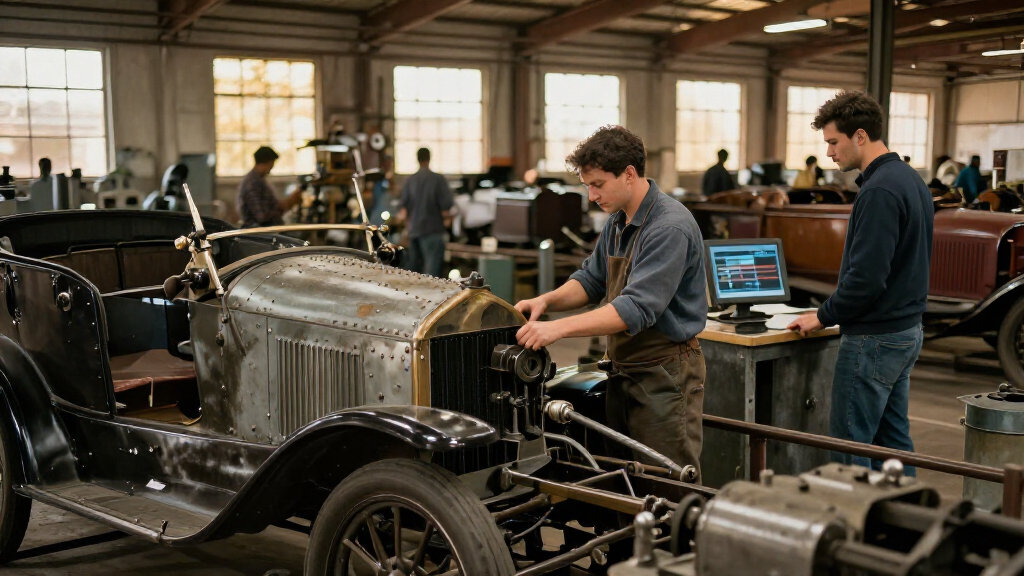

🔍 Read the full analysis: Tracing The History Of The Five-Dollar Day And Assembly Lines on ThorstenMeyerAI.com

Get business pricing on monitors, keyboards and dev gear
- Business-only prices and quantity discounts
- Tax-exempt purchasing
- Multiple users, one account, clear invoices
TL;DR
A November 6, 2026, article from ThorstenMeyerAI.com revisits how Ford’s moving assembly line cut the labor time needed to build a Model T chassis, while the company faced severe worker turnover. On January 5, 1914, Ford shortened the workday and raised the minimum daily wage to $5 under a conditional profit-sharing plan. The account presents the increase as a response to labor instability, not evidence that Ford’s primary aim was to make workers customers.
Ford’s moving assembly line sharply reduced the labor time needed to build a Model T chassis, but the company’s production gains coincided with workers leaving at an extraordinary rate. A November 6, 2026, account from ThorstenMeyerAI.com traces how Ford responded on January 5, 1914, by cutting the workday from nine hours to eight and raising minimum daily pay from $2.34 to $5 under a conditional profit-sharing plan. The episode argues that the pay change was chiefly a response to turnover, rather than a plan to make workers buy Ford cars.
Ford’s own account, published in My Life and Work in 1922 with journalist Samuel Crowther, put the labor required to assemble a chassis at 12 hours and 28 minutes before the moving line. By early 1914, the company said, that figure had fallen to 1 hour and 33 minutes—a reduction of about 88%. The account identifies Ford’s book as a company-side source, rather than an independent production record.
The experiment began with a smaller component. Ford wrote that the company tried an assembly line for a flywheel magneto around April 1, 1913. Dividing its assembly into 29 operations and moving the part between workers reduced the reported time from about 20 minutes per unit to 13 minutes and 10 seconds. Later changes, including adjustments to line height and speed, brought the reported time down further. Ford said the idea drew generally on overhead rails used in Chicago meatpacking plants.
The productivity shift came alongside labor instability. Figures reported by economists Daniel Raff and Lawrence Summers in a 1987 study put Ford’s 1913 turnover at 370%: the company hired 50,448 people to maintain an average workforce of 13,623. The source also cites Ford’s later estimate that the company hired at a rate of about 53,000 a year in 1914 to keep roughly 14,000 workers. These figures describe hiring relative to the workforce, not the share of employees who left in a single event.
How the Pay Raise Stabilized Production
The five-dollar day matters because it links a major change in factory organization to the cost of keeping a workforce in place. Faster production did not automatically produce a stable factory: Ford’s reported hiring figures suggest the company was repeatedly replacing workers even as the line reduced assembly time. The wage increase and shorter day were an attempt to address that operational problem.
The source reports that Ford turnover fell to 54% in 1914, though the material does not establish that the pay change alone caused the decline. It also cites Henry Ford later describing the policy as “one of the finest cost-cutting moves we ever made.” The episode uses that retrospective account to frame higher wages as a business measure as well as a labor policy.
The example also complicates a familiar account that Ford raised wages primarily so employees could afford his cars. The source says the company had about 14,000 workers and produced roughly 250,000 cars a year around 1914, and interprets the immediate problem as retaining workers rather than finding customers. That interpretation is grounded in the turnover figures but should not be mistaken for proof of every motive behind the policy.
Popular right now

Hisense 40-Inch Class QD4SR Series Hi-QLED FHD Smart Roku TV (2026 Model)

Hisense 55-Inch E6SR Series Hi-QLED 4K UHD Smart Roku TV (2026 Model)

Breville Bambino Espresso Machine, Brushed Stainless Steel
As an affiliate, we earn on qualifying purchases.
From Stationary Chassis to Moving Line
Before the new system, workers built a car around a chassis that remained in one place, bringing parts to it. Ford first tested moving work on magnetos, then applied the method to the chassis. In an early trial, a rope and windlass pulled the chassis along a 250-foot path while six assemblers moved with it and collected parts. Ford’s account put the labor time for that version at 5 hours and 50 minutes, before further division of work reduced it.
Ford described the production goal as reducing the worker’s movements and the need for individual thought. On the chassis line, tasks were split so that the worker putting in a bolt did not also place and tighten its nut. The source says similar changes were applied to engine assembly: Ford’s reported labor time for a motor fell from 9 hours and 54 minutes in October 1913 to 5 hours and 56 minutes six months later.
The pay plan was not simply a flat wage increase for every worker without conditions. The source describes the $5 minimum as “profit sharing” with strict conditions, and says Ford also reduced the workday from nine hours to eight. Those details matter when comparing the headline figure with workers’ actual eligibility and earnings.
““Along about April 1, 1913, we first tried the experiment of an assembly line.””
— Henry Ford, in My Life and Work
Limits of Ford’s Production Record
Several central figures come from Ford’s own retrospective account, not an independent audit presented in the source. The episode acknowledges that distinction, and its reported assembly times should be read as company figures. The turnover estimate of 370% comes instead from Raff and Summers’ 1987 study, which drew on earlier labor research and company surveys; the Henry Ford museum gives a somewhat higher figure of about 380%.
The source does not provide detailed eligibility rules for the profit-sharing plan, the number of workers who received the full $5, or how earnings varied across employees. It also does not isolate the wage increase from other changes that may have influenced turnover. The reported fall to 54% in 1914 is an association in the account, not proof by itself that the pay policy caused the entire decline.
The episode’s broader statement that U.S. factory employment grew by about a third between 1910 and 1920 is presented without a specific dataset or definition of factory jobs in the supplied material. The exact comparison basis is therefore not clear from the source.
The Line’s Long Industrial Afterlife
The source’s account is an episode in an ongoing series, not an announcement of a new Ford policy or a newly released historical dataset. Its next step is interpretive: placing the assembly line’s productivity gains alongside its effects on work and the company’s effort to retain employees. Readers should treat the production and labor numbers as historical claims with the source limitations described above.
The episode closes by connecting the early line to present-day factories, where it says more of the work is performed by robots. It does not provide current automation figures or identify a specific future milestone. The larger historical question it leaves open is how new production technologies change the balance between output, working conditions, and the need for human labor.
Key Questions
What was Ford’s five-dollar day?
On January 5, 1914, Ford cut the workday from nine hours to eight and raised minimum daily pay from $2.34 to $5 through a conditional profit-sharing plan, according to the source account.
Why did Ford introduce the pay change?
The account links the policy to severe worker turnover: it reports 50,448 hires in 1913 to maintain an average workforce of 13,623. It presents retention as the main business problem, while not ruling out other motives.
How much faster did the moving line make chassis assembly?
Ford’s own figures put labor time at 12 hours and 28 minutes per chassis before the moving line and 1 hour and 33 minutes by early 1914, a reported reduction of about 88%.
Did Ford raise wages so workers could buy its cars?
The episode calls that explanation a legend and argues that turnover was the immediate problem. The figures it cites support the scale of hiring, but they do not establish every motive behind Ford’s decision.
How reliable are the historical numbers?
Some assembly-time figures come from Ford’s 1922 account and are company-reported. The 370% turnover figure is attributed to a 1987 study by Daniel Raff and Lawrence Summers drawing on earlier research and company surveys; another cited source gives a higher estimate of about 380%.
Source: ThorstenMeyerAI.com