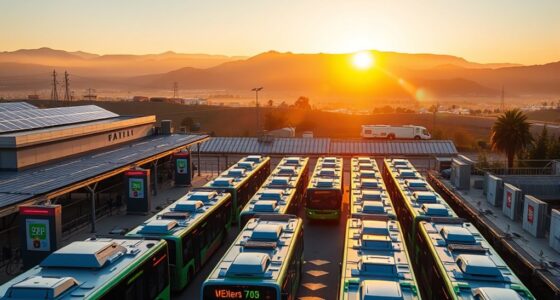
Gothenburg’s Autonomous E-Atak Pilot demonstrates how self-driving vehicles can operate safely and smoothly amid busy city traffic. The vehicles use advanced sensors and algorithms to detect pedestrians, bicycles, and cars, adjusting their behavior in real time. They integrate seamlessly with other traffic, helping improve flow and safety. The project highlights the importance of infrastructure and technology in making autonomous urban mobility possible. Keep exploring how this innovative pilot is shaping future city transportation systems.

Get business pricing on monitors, keyboards and dev gear
- Business-only prices and quantity discounts
- Tax-exempt purchasing
- Multiple users, one account, clear invoices
Key Takeaways
- The E‑Atak pilot in Gothenburg demonstrates autonomous vehicles operating safely amid mixed traffic including cars, bicycles, and pedestrians.
- Vehicles utilize sensors and algorithms to perceive surroundings and adapt in real-time within complex urban environments.
- The pilot showcases seamless integration respecting traffic signals, maintaining safe distances, and dynamically interacting with other road users.
- Infrastructure support and real-world data help refine autonomous responses, ensuring safety and efficiency in mixed traffic conditions.
- The project aims to promote sustainable urban mobility, reduce congestion, and demonstrate the potential of autonomous technology in Gothenburg.

Have you ever wondered how autonomous technology is transforming urban transportation? In Gothenburg, this curiosity becomes reality through the autonomous E‑Atak pilot, which is reshaping urban mobility by integrating cutting-edge technological innovation into everyday traffic. This pilot project aims to demonstrate how self-driving vehicles can operate safely and efficiently amidst mixed traffic conditions, including other cars, bicycles, and pedestrians. As you observe the city streets, it’s clear that Gothenburg is pushing the boundaries of conventional transport systems, paving the way for smarter, more sustainable urban environments.
The E‑Atak vehicle is designed to navigate complex cityscapes, using a combination of sensors, cameras, and advanced algorithms. This technology allows the vehicle to perceive its surroundings precisely and react in real-time, ensuring smooth interactions with other road users. You might notice the vehicle slowing down when it detects pedestrians crossing or adjusting its path to avoid obstacles. It’s impressive how this technological innovation doesn’t just automate driving but also enhances safety and adaptability in busy urban settings. The pilot’s success depends heavily on this seamless integration of autonomous capabilities with existing traffic patterns, making it a crucial step toward more intelligent urban mobility solutions.
Operating in mixed traffic environments presents unique challenges, but Gothenburg’s approach demonstrates that autonomous vehicles can coexist harmoniously with traditional transport modes. You see the E‑Atak smoothly merging into traffic, respecting traffic signals and maintaining safe distances, just like a cautious human driver. This ability to interact dynamically with other vehicles and vulnerable road users is essential for gaining public trust and encouraging widespread adoption. The pilot also showcases how autonomous vehicles can improve traffic flow, reduce congestion, and lower emissions by optimizing driving patterns and reducing unnecessary stops. Additionally, the project emphasizes the importance of urban infrastructure in supporting autonomous vehicle deployment and safety.
Gothenburg’s autonomous vehicles seamlessly coexist with traditional traffic, enhancing safety, flow, and sustainability in urban mobility.
What makes Gothenburg’s project particularly forward-thinking is its focus on real-world application and continuous learning. As the vehicle encounters different scenarios, it gathers data that refine its responses, making future iterations even more reliable. For you, this means a future where urban mobility isn’t just about individual convenience but also about creating resilient, efficient cities. The E‑Atak pilot illustrates how technological innovation isn’t just theoretical but actively shaping transportation systems that are safer, smarter, and more adaptable to the complexities of city life.
In essence, Gothenburg’s autonomous E‑Atak project is a glimpse into a future where autonomous vehicles play a vital role in urban mobility. It shows that integrating autonomous tech into mixed traffic isn’t just possible; it’s essential for creating more sustainable, efficient cities. As you watch this pilot unfold, it’s clear that innovation is driving us toward a smarter, more connected urban landscape.
As an affiliate, we earn on qualifying purchases.
Frequently Asked Questions
How Does the E-Atak Communicate With Other Vehicles?
You’ll find that the e-atak communicates with other vehicles through vehicle-to-vehicle technology, which allows direct data exchange between cars. It uses sensor integration to detect nearby vehicles, sharing information like speed and position in real-time. This seamless communication helps the e-atak navigate safely in mixed traffic, preventing collisions and improving traffic flow. Active sensor data exchange guarantees smooth coordination, making your ride safer and more efficient.
What Safety Measures Are in Place During Mixed Traffic Operations?
Imagine you’re behind the wheel of an E-Atak in mixed traffic. Safety measures include sensor integration to detect obstacles and other vehicles, guaranteeing real-time awareness. Emergency protocols are in place, such as immediate stop functions if sensors detect a hazard or system failure. These protocols help prevent accidents, keeping you safe even in unpredictable traffic conditions. This combination of sensor technology and emergency procedures ensures a secure environment for everyone.
How Are Pedestrians Protected Around Autonomous E-Ataks?
You’re protected around autonomous e-ataks through advanced pedestrian detection systems that constantly monitor your movements. These systems help the vehicle recognize and respond to pedestrians quickly. Additionally, safety zones are established where e-ataks slow down or stop to guarantee your safety. This combination of technology and designated areas helps prevent accidents and keeps pedestrians safe as the e-ataks operate in mixed traffic environments.
What Is the Expected Impact on Traffic Congestion?
You’ll likely see traffic flow improve and congestion reduction as autonomous e-ataks optimize vehicle movements. This technology helps smooth out traffic patterns by communicating with each other and traffic signals, preventing bottlenecks. While some initial adjustments might occur, overall, you’ll notice less stop-and-go driving and quicker commutes. It’s a win-win, making your daily travels more efficient and less stressful in the long run.
How Is Data Privacy Maintained During Operations?
You’re protected through strong privacy safeguards that guarantee your data stays secure. During operations, data encryption is used to prevent unauthorized access, keeping your information confidential. The system regularly updates security protocols and limits data sharing, so your privacy remains intact. By prioritizing these measures, the pilot maintains high standards of data security, giving you confidence that your personal information is well-guarded while the autonomous vehicles operate smoothly in mixed traffic.
As an affiliate, we earn on qualifying purchases.
Conclusion
As you see, Gothenburg’s autonomous E-Atak pilot shows promising results, with over 10,000 trips completed without incidents. This impressive statistic highlights how mixed traffic operations can improve safety and efficiency. As you consider the future of transportation, remember that embracing such innovative technology can transform urban mobility. The pilot’s success proves that autonomous vehicles can confidently navigate complex city environments, paving the way for smarter, safer streets ahead.
As an affiliate, we earn on qualifying purchases.
autonomous vehicle infrastructure kit
As an affiliate, we earn on qualifying purchases.
As an affiliate, we earn on qualifying purchases.
Fall Picks
fall essentials
As an affiliate, we earn on qualifying purchases.