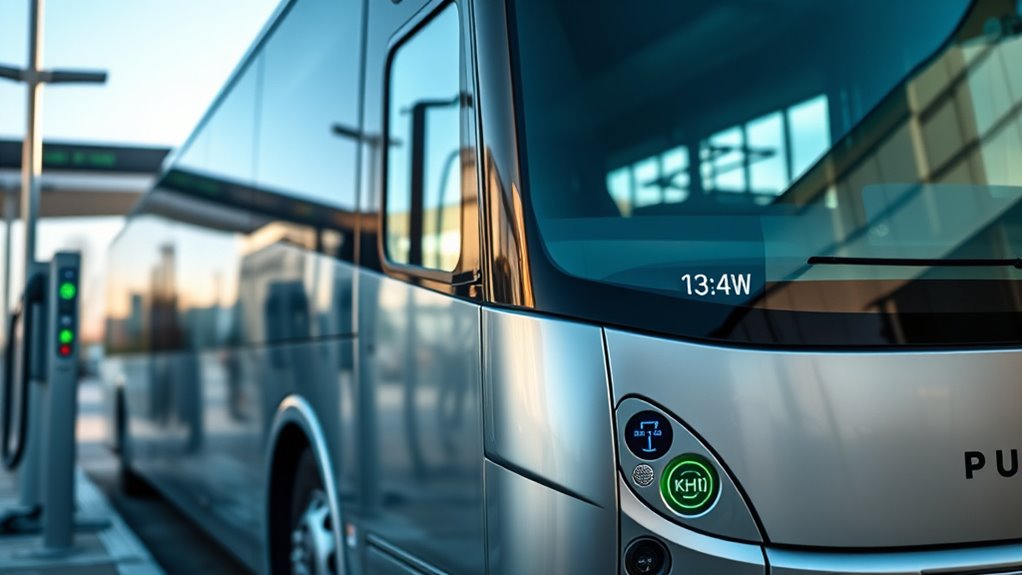

Understanding electric bus terminology helps you evaluate performance better. Kilowatts (kW) measure how power a bus can draw or deliver at a moment, like during acceleration. Kilowatt-hours (kWh) show how much energy the battery stores for driving range. Efficiency ratings reveal how far a bus can travel per kWh, impacting operational costs. Grasping these terms allows you to optimize fleet planning—continue exploring to learn how these factors work together for greater efficiency.

Get business pricing on monitors, keyboards and dev gear
- Business-only prices and quantity discounts
- Tax-exempt purchasing
- Multiple users, one account, clear invoices
Key Takeaways
- Kilowatt (kW) measures the bus’s power output or charging rate, indicating how quickly it can accelerate or recharge.
- Kilowatt-hour (kWh) reflects the total energy capacity of the bus’s battery, determining its maximum travel distance on a full charge.
- Efficiency ratings, expressed as miles per kWh, show how effectively the bus uses stored energy for travel.
- Higher kW charging infrastructure enables faster recharging, reducing downtime and supporting high-frequency routes.
- Understanding these terms helps optimize fleet management, route planning, and energy consumption for electric buses.

Ever wondered what the key terms in electric bus technology mean? If you’re new to the world of electric transportation, understanding concepts like battery capacity and charging infrastructure is essential. These components determine how far your bus can go and how smoothly it operates. Battery capacity, measured in kilowatt-hours (kWh), indicates the total amount of energy the bus’s battery can store. A higher capacity means the bus can travel longer distances without needing to recharge, which is crucial for route planning and operational efficiency. When selecting an electric bus, it’s important to consider your typical daily mileage; a bus with a larger battery capacity can handle longer routes or more frequent stops without losing power. But having a large battery isn’t enough on its own—you also need a reliable charging infrastructure. Charging infrastructure refers to the network of charging stations that supply power to the buses. These stations can be fast chargers or standard chargers, and their availability directly impacts how quickly and conveniently you can recharge your fleet. A well-developed charging infrastructure ensures minimal downtime, allowing buses to be charged overnight or during scheduled breaks, keeping your operations running smoothly. The relationship between battery capacity and charging infrastructure is vital: even a bus with a large battery needs proper charging stations to recharge efficiently, especially if you operate multiple shifts or have high daily mileage. Think about where you’ll place your charging stations—ideally, they’re close to depots or main routes to save time and reduce logistical hurdles. The efficiency of your charging infrastructure also matters; faster chargers can significantly cut down charging time, but they often require more advanced and sometimes more expensive infrastructure upgrades. When evaluating electric buses, you should ask about how well the vehicle’s powertrain converts stored energy into usable motion, known as efficiency ratings. These ratings, often expressed as miles per kWh, tell you how effectively the bus uses its stored energy, helping you estimate operational costs and energy consumption. Ultimately, understanding these key terms—battery capacity, charging infrastructure, and efficiency ratings—allows you to make well-informed decisions to optimize your fleet’s performance. You want buses that can cover your routes reliably while minimizing downtime and energy costs. As the technology advances, the importance of these concepts grows, making it easier to transition to sustainable electric transportation without sacrificing efficiency or operational effectiveness. So, grasping these terms guarantees you’re equipped to choose the right electric buses and build an infrastructure that supports your goals for cleaner, more efficient transit.
electric bus fast charging station
As an affiliate, we earn on qualifying purchases.
As an affiliate, we earn on qualifying purchases.
Frequently Asked Questions
How Does Ambient Temperature Affect Electric Bus Performance?
Ambient temperature crucially influences your electric bus’s performance. Higher temperatures can cause batteries to overheat, reducing efficiency and range, while colder temperatures can limit battery capacity and slow down thermal management systems. To maintain ideal performance, your bus relies on effective thermal management, which regulates battery temperature. Proper thermal management ensures consistent operation across varying ambient conditions, helping you maximize efficiency and extend the battery’s lifespan regardless of the climate.
What Is the Typical Lifespan of an Electric Bus Battery?
You can expect an electric bus battery to last around 8 to 15 years, depending on usage and maintenance. To maximize lifespan, you should prioritize proper charging infrastructure and consider battery recycling options when replacements are needed. Regularly monitoring battery health helps prevent premature degradation, and eco-friendly recycling guarantees sustainable disposal. Proper care and infrastructure support will keep your electric bus running efficiently for years to come.
How Often Do Electric Bus Batteries Require Replacement or Maintenance?
Like the steady flow of a river, your electric bus’s battery requires regular attention. Typically, you’ll need to schedule maintenance every 3 to 5 years, depending on usage and climate. When it’s time for replacement, consider battery recycling options to minimize environmental impact. Staying on top of maintenance schedules guarantees peak performance, extending your battery’s life and reducing the need for frequent replacements.
What Factors Influence the Actual Range of an Electric Bus?
You can influence the actual range of an electric bus through factors like battery degradation, which reduces capacity over time, and the quality of charging infrastructure, affecting how quickly and efficiently you recharge. Weather conditions, driving habits, and load also play roles in range. To maximize your bus’s distance, guarantee proper maintenance, use reliable charging stations, and adapt driving styles for efficiency.
How Do Charging Speeds Impact Bus Operational Efficiency?
Imagine a busy depot where charging speeds transform your bus operations. Faster charging infrastructure delivers quick power boosts, reducing downtime. This efficiency hinges on the power-to-weight ratio, ensuring your bus quickly refuels without excess weight slowing it down. When charging speeds are optimized, you get seamless schedules, less idle time, and improved fleet productivity. In fact, rapid charging keeps your buses moving smoothly, maximizing operational efficiency every mile.
electric bus battery capacity 100 kWh
As an affiliate, we earn on qualifying purchases.
As an affiliate, we earn on qualifying purchases.
Conclusion
Now that you understand those key terms, you might think electric buses are just about batteries and power. But here’s a fun fact: some experts believe that as battery tech advances, the efficiency ratings could be overestimated, making current numbers seem more impressive than they really are. So, while these terms help you grasp the basics, remember that real-world performance can surprise you. Stay curious, and keep exploring how these innovations are shaping smarter, greener transportation.
As an affiliate, we earn on qualifying purchases.
electric bus charging infrastructure
As an affiliate, we earn on qualifying purchases.
As an affiliate, we earn on qualifying purchases.
Fall Picks
fall essentials
As an affiliate, we earn on qualifying purchases.