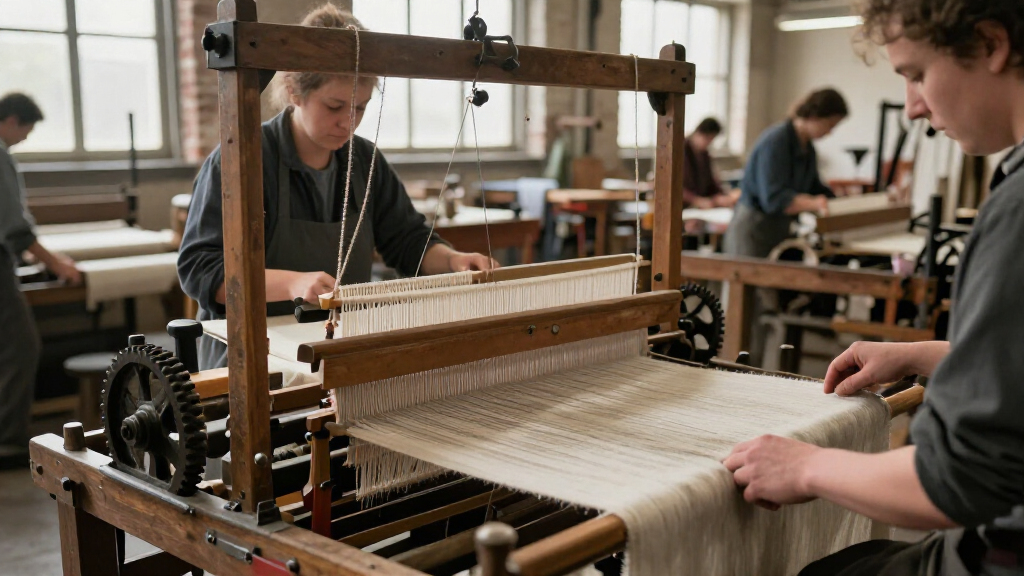

🔍 Read the full analysis: The Luddites’ Resistance Was About More Than Machine Fear on ThorstenMeyerAI.com

Get business pricing on monitors, keyboards and dev gear
- Business-only prices and quantity discounts
- Tax-exempt purchasing
- Multiple users, one account, clear invoices
TL;DR
A historical analysis published November 5 revisits records of the 1811–13 Luddite protests, arguing that Nottinghamshire frame breakers targeted employers accused of cutting pay and using wider frames to produce cheaper stockings. The records support a dispute over wages and control of work, though the movement also used violence and some attacks hit frames whose owners paid full rates.
A historical analysis published November 5 argues that the Luddites who attacked knitting frames in Nottinghamshire in 1811 were not simply opposing machinery: contemporary records describe workers targeting employers accused of paying below the going rate and using wider frames to make cheaper stockings. The account matters because it recasts a familiar label for technology hostility as a protest tied to wages, work quality and workers’ limited influence over production.
The analysis, published by ThorstenMeyerAI.com as part of its “Work After Work” series, draws on a February 1812 report by Nottingham magistrate Robert Baker to the Home Office, parliamentary speeches and the legislation that followed. Baker reported that in some places a fifth of frame workers were out of work before the disturbances and said resentment toward hosiers paying “the under-price” had been a leading feature of the protests. Hosiers were merchants who supplied work and sold the finished goods.
Baker’s account said protesters broke frames belonging to particular hosiers and also targeted wider frames, which the article says enabled production of cheaper, lower-quality stockings. He reported that breakers generally spared other property, but this description should not be taken to mean every attack was carefully targeted. A Nottingham reward notice from January 1812 described five frames broken at a framework knitter’s home; the workers said those frames had been operating at the full price.
The violence brought a severe state response. By December 1811, the source says, 900 cavalry and 1,000 infantry had been sent to Nottingham. Parliament passed the Frame-Breaking Act on March 20, 1812, making frame breaking a capital felony. Seventeen men were executed in 1813, according to the source. The movement also spread from Nottinghamshire to Yorkshire and Lancashire, where workers in other textile trades resisted production changes.
Pay and Control Behind Frame Breaking
The historical record complicates the modern shorthand “Luddite,” often used for someone hostile to new technology. The Nottingham framework knitters worked with the machines they attacked, and many depended on them for a living. The source describes a system in which workers often rented frames and were paid by the piece by merchants, leaving them exposed to changes in prices and production methods.
That distinction helps explain why the story is often invoked in present-day debates over workplace technology. The article draws a comparison with disputes over pay, product quality and worker input in areas such as Hollywood contracts, German works councils and the European Union’s AI Act. These examples are comparisons made by the source, not evidence that the circumstances are identical. The historical case suggests that opposition to a technology can also concern who controls its use and who bears the costs of change.
The account also shows the limits of that comparison. The Luddites’ resistance included attacks on property, and the government answered with troops, criminal penalties and executions. Present-day policy and labor disputes operate through different institutions. The useful connection is the recurring question of how workers can influence the terms on which new production methods are introduced.
Popular right now

Samsung 65-Inch The Frame Pro Neo QLED 4K TV (2026) Bundle with Modern Brown Bezel, HDMI Cables, and Home Theater Guide

Samsung QN65LS03FAFXZA 65 The Frame QLED 4K Art Mode Vision AI Smart TV (2025)

LG 55-Inch OLED evo G2 Series 4K Smart TV (OLED55G2PUA, 2022)
As an affiliate, we earn on qualifying purchases.
Nottingham’s Knitters and Their Machines
The first Luddites discussed in the article were framework knitters in and around Nottingham. They made stockings and other knitted goods on stocking frames, mechanical devices operated by hand and foot, often from homes or small workshops. Many workers did not own the frames: they rented them or worked with machines owned by merchants or other investors.
In a House of Commons speech on February 14, 1812, Home Secretary Richard Ryder described frames as hired to workers by masters or owned by a middle class that rented them out. The source says trade unions were illegal under the Combination Acts of 1799 and 1800, and Parliament had rejected a minimum wage for weavers in 1808. Those restrictions narrowed workers’ options for bargaining over pay.
The protests began in Nottinghamshire in 1811 and spread to textile districts including Yorkshire and Lancashire in 1812. Letters were signed by “General Ned Ludd” or “King Ludd.” The National Archives describes Ned Ludd as a mythical figure; the source says there is no reliable evidence that a real person by that name led the movement. The persona gave scattered protests the appearance of a shared cause and leader.
““For some time before these troubles broke out, in many places a fifth of the frame workers were out of employ.””
— Robert Baker, Nottingham magistrate, in a February 6, 1812, report to the Home Office
Limits of the Historical Record
The account relies in part on official reports and parliamentary records, not a complete or neutral record of every protester’s motives. Baker was a magistrate writing to the Home Office during unrest, so his observations should be read as an official account rather than an unfiltered statement from workers. The article says the Luddites’ own letters were written to frighten, and does not present them as a full explanation of the movement’s aims.
The records also show that targeting was imperfect: a January 1812 notice said five frames were broken despite workers’ claim that they were paid at the full rate. The source does not establish how representative Baker’s account was across all districts or attacks. Its wage figures about the broader economy are estimates, and the article notes that later research narrows, but does not eliminate, the gap between wage and productivity growth.
The Debate Over Work Continues
The source presents the Luddites’ history alongside current disputes about workplace technology, including contracts for writers in Hollywood, works-council rights in Germany and the EU’s AI Act. Those examples point to continuing negotiations over how new tools affect workers’ pay, job conditions and say in decisions. The article does not report a new policy decision or a scheduled next milestone in any of those debates.
For the historical argument, the next step for readers is to distinguish documented details from later legend: the dates, state response and Baker report are presented through named records, while the motives of a diverse movement cannot be reduced to one statement. The source’s central conclusion is that machine-breaking alone does not explain the protests; the available evidence also points to payment practices and control over production.
Key Questions
Who were the Luddites?
The first Luddites in the account were framework knitters in Nottinghamshire who made stockings using mechanical knitting frames. The movement later spread to textile workers in other English counties.
Were the Luddites opposed to all machines?
The source does not describe a blanket rejection of machinery. Many protesters worked with stocking frames, while contemporary magistrate Robert Baker linked attacks to below-rate payments and wider frames associated with cheaper goods.
Was General Ned Ludd a real leader?
The source says the National Archives describes Ned Ludd as a mythical figure and reports no reliable evidence that a real person by that name led the movement.
What happened to people who broke frames?
The Frame-Breaking Act of March 20, 1812, made frame breaking a capital felony. The source reports that 17 men were executed in 1813.
Why are the Luddites compared with current workplace technology debates?
The comparison concerns recurring disputes over pay, work quality and worker input when new technologies alter production. The source cites modern labor and regulatory debates as parallels, not as identical situations.
Source: ThorstenMeyerAI.com