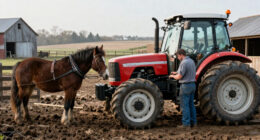

🔍 Read the full analysis: Will AI Reshape Work Across Society? on ThorstenMeyerAI.com

Get business pricing on monitors, keyboards and dev gear
- Business-only prices and quantity discounts
- Tax-exempt purchasing
- Multiple users, one account, clear invoices
TL;DR
An article published November 3, 2026, uses agriculture’s long shift from a dominant employer to a small share of the workforce to examine whether AI could reshape work across society. The historical figures show that farming’s workforce share fell over generations while food output increased; they do not establish how quickly AI will change other sectors or what jobs it will create.
A November 3 article from ThorstenMeyerAI.com uses agriculture’s two-century transformation to examine whether AI could reshape work across society. It reports that farming’s share of the U.S. workforce fell from an estimated 73.7% in 1800 to about 1.5% today, while arguing that this history is a useful comparison—not proof of how quickly AI will change other jobs.
The article, the second installment of the series Work After Work, says agricultural employment declined through a sequence of changes rather than one sudden automation wave. It points to improved tools, including a steel plough made by John Deere in 1837, industrial production of ammonia fertilizer after Fritz Haber’s 1908 patent, and higher-yield crop varieties associated with the Green Revolution in the 1960s. Tractors and other machinery also contributed, though the installment says those developments will be covered in a later episode.
The workforce figures describe a change in farming’s share of employment, not an immediate fall in the number of farm workers. In the United States, the number of farm workers continued rising until about 1910, reaching a reported 11.8 million. In Germany, agriculture’s share fell from 43% to 25% between 1882 and 1939 while the number of farm workers remained between 8 million and 10 million, according to the source’s historical account.
The article also cites a 2025 International Labour Organization estimate that 928 million people work in agriculture worldwide, or about one in four workers. It gives current national shares of about 43% in India, 1.5% in the United States and 1% in Germany. These figures underscore that agricultural change is at different stages across countries and that farming remains a major source of work globally.
What Farming Shows About Job Change
The historical comparison matters because it separates technological change from instant job disappearance. Agriculture became far less labor-intensive over a long period, but its workforce did not simply vanish at the moment new tools appeared. The U.S. headcount cited in the article rose into the early 20th century even as farming’s place in the wider labor force changed.
Food production also rose as fewer workers were needed relative to the whole population. The article says global cereal harvests grew 4.2-fold from 1961 while the world population grew 2.7-fold. It also reports that U.S. farm output in 2023 was nearly three times its 1948 level, with only a small increase in total inputs. Those are measures of agricultural production, not evidence that every displaced worker found equally paid or suitable work.
For readers weighing AI’s effect on employment, the example offers a caution against treating automation as a single event with a predictable outcome. New technology can raise output and change the mix of jobs, while the pace and distribution of those effects depend on adoption and economic conditions. The article’s projection that automation might affect as much as 90% of a sector within a decade or a few decades is explicitly presented as the author’s thesis, not a measured forecast or established finding about AI.
Popular right now

De'Longhi Rivelia Fully Automatic Espresso Machine with Milk Frother, White

TCL 65-Inch QM6K QLED Mini-LED 4K HDR Smart Google TV, 144Hz

KitchenAid Artisan 5-Quart Tilt-Head Stand Mixer, Almond Cream
As an affiliate, we earn on qualifying purchases.
How Agriculture’s Workforce Shifted
The article draws on historical estimates and censuses to show how much employment once depended on farming. Stanley Lebergott’s estimate, published by the U.S. Census Bureau in Historical Statistics of the United States, puts the 1800 labor force at 1.9 million people aged 10 and older, with 1.4 million working in agriculture. The source notes that the early figures are estimates rather than census counts and that the labor-force total included about 530,000 enslaved people.
Other examples in the installment point to similar patterns, though their measures and dates are not identical. Japanese economic historians estimated that about 85% of gainfully occupied people in Japan worked in the primary sector in 1872, a category that included farming, forestry and fishing. China’s official series recorded 83.5% of employed people in the primary sector in 1952, while India’s 1951 census counted cultivators and agricultural laborers as 69.7% of workers.
The account links changing productivity to several developments. It says dwarf wheat varieties introduced in India and Pakistan in the mid-1960s helped increase yields, alongside fertilizer and irrigation. Indian official figures cited in the article show wheat production rising from 12.3 million tonnes in 1964–65 to 26.4 million tonnes in 1971–72. The historical record provides a comparison for discussing automation, but agricultural technologies and AI systems are different, and the record alone cannot determine the consequences of AI adoption.
““The farm is the best test case this season has for its big question, because here a whole sector of human work has already been almost completely automated.””
— Thorsten Meyer, ThorstenMeyerAI.com
Limits of the AI Comparison
The installment does not provide new data measuring AI’s current effect on employment, nor does it specify which occupations or industries might see the largest changes. It also does not establish a timeline for any broad shift. Its historical statistics concern agriculture across different countries and periods, and some are reconstructions or estimates rather than directly comparable census counts.
It remains unclear how many jobs AI may replace, alter or create, and whether resulting gains will be distributed across workers and regions. The article’s 90% figure is a stated hypothesis about automation’s potential reach, not a forecast supported here by a model, dataset or named external research study. Agriculture’s history can inform the debate, but it cannot by itself predict AI’s labor-market effects.
The Series Turns to Machinery
The source identifies the next installment, Episode 3, as a discussion of mechanical reapers, threshers and tractors. That continuation is expected to add detail on machinery’s role in agricultural change. No publication date for the next episode is provided in the material.
For the wider question of AI and employment, the next useful evidence would include dated studies of adoption, job tasks, hiring and wages across specific industries. Until such evidence is presented, the article’s central contribution is historical: a workforce can change substantially over time, but the scale, pace and distribution of an AI-driven shift remain unsettled.
Key Questions
What is the news development?
ThorstenMeyerAI.com published an installment on November 3, 2026, using agriculture’s long-term decline in workforce share to explore whether AI could reshape work.
The article cites an estimate of 73.7% in 1800 and says agriculture accounts for about 1.5% of U.S. workers today. The 1800 figure is a historical estimate, not a census count.
Does the article prove that AI will eliminate most jobs?
No. It presents agriculture as a comparison and labels its suggestion that automation could affect up to 90% of a sector as the author’s thesis, not a confirmed prediction about AI or employment.
How many people work in agriculture worldwide?
The article cites an International Labour Organization estimate of 928 million agricultural workers in 2025, about one in four workers worldwide.
What remains unknown about AI and work?
The installment does not quantify AI’s current employment effects or identify how many jobs might be replaced, changed or created. The timing and distribution of any effects remain unclear.
Source: ThorstenMeyerAI.com